QUESTION IMAGE
Question
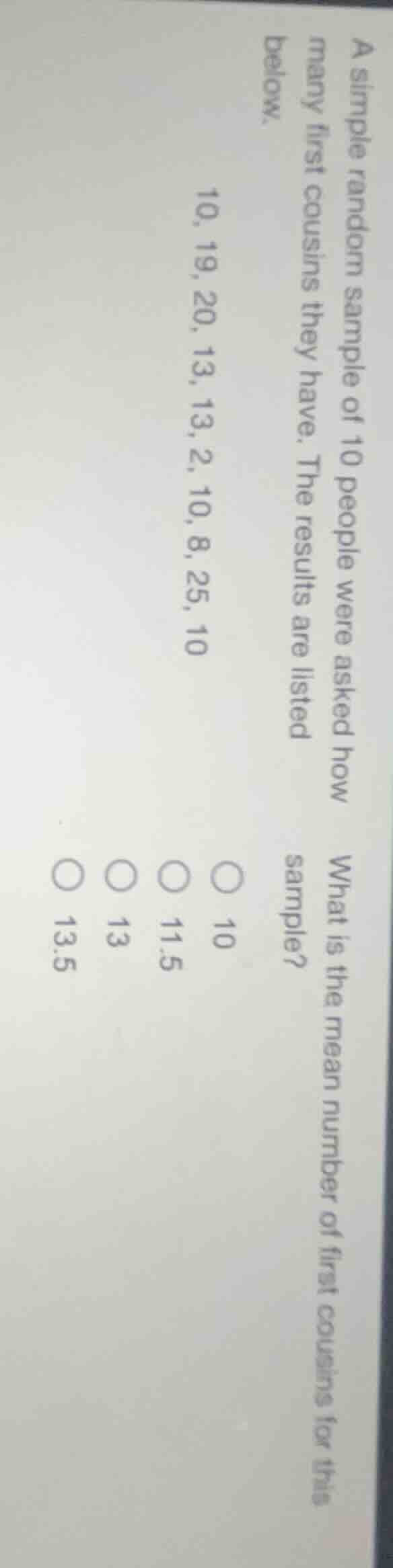
a simple random sample of 10 people were asked how many first cousins they have. the results are listed below. 10, 19, 20, 13, 13, 2, 10, 8, 25, 10 what is the mean number of first cousins for this sample? 10 11.5 13 13.5
Step1: Sum all the values
We have the data set: \(10, 19, 20, 13, 13, 2, 10, 8, 25, 10\). First, we sum these values.
\[10 + 19 + 20 + 13 + 13 + 2 + 10 + 8 + 25 + 10\]
\[= (10+19)+20 + 13 + 13 + 2 + 10 + 8 + 25 + 10\]
\[= 29+20 + 13 + 13 + 2 + 10 + 8 + 25 + 10\]
\[= 49+13 + 13 + 2 + 10 + 8 + 25 + 10\]
\[= 62+13 + 2 + 10 + 8 + 25 + 10\]
\[= 75+2 + 10 + 8 + 25 + 10\]
\[= 77+10 + 8 + 25 + 10\]
\[= 87+8 + 25 + 10\]
\[= 95+25 + 10\]
\[= 120+10\]
\[= 130\]
Step2: Calculate the mean
The mean \(\bar{x}\) of a sample with \(n\) values is given by \(\bar{x}=\frac{\sum_{i = 1}^{n}x_{i}}{n}\). Here, \(n = 10\) (since there are 10 data points) and \(\sum_{i=1}^{10}x_{i}=130\). So,
\[\bar{x}=\frac{130}{10}=13\]
Wait, wait, let's recalculate the sum. Let's add again: \(10+19 = 29\); \(29+20=49\); \(49 + 13=62\); \(62+13 = 75\); \(75+2=77\); \(77+10 = 87\); \(87+8=95\); \(95+25 = 120\); \(120+10=130\). Then \(130\div10 = 13\)? Wait, but let's check the data points again. The data is \(10, 19, 20, 13, 13, 2, 10, 8, 25, 10\). Wait, maybe I made a mistake. Wait, \(10+19=29\), \(29+20 = 49\), \(49+13=62\), \(62+13=75\), \(75+2=77\), \(77+10=87\), \(87+8=95\), \(95+25=120\), \(120+10 = 130\). So \(130\div10=13\). Wait, but let's check the options. Wait, maybe I miscalculated the sum. Wait, let's list all numbers: 10, 19, 20, 13, 13, 2, 10, 8, 25, 10. Let's count the number of terms: 1 (10), 2 (19), 3 (20), 4 (13), 5 (13), 6 (2), 7 (10), 8 (8), 9 (25), 10 (10). So 10 terms. Now sum: 10+19=29; +20=49; +13=62; +13=75; +2=77; +10=87; +8=95; +25=120; +10=130. So mean is 130/10=13. So the mean is 13.

Snap & solve any problem in the app
Get step-by-step solutions on Sovi AI
Photo-based solutions with guided steps
Explore more problems and detailed explanations
13