QUESTION IMAGE
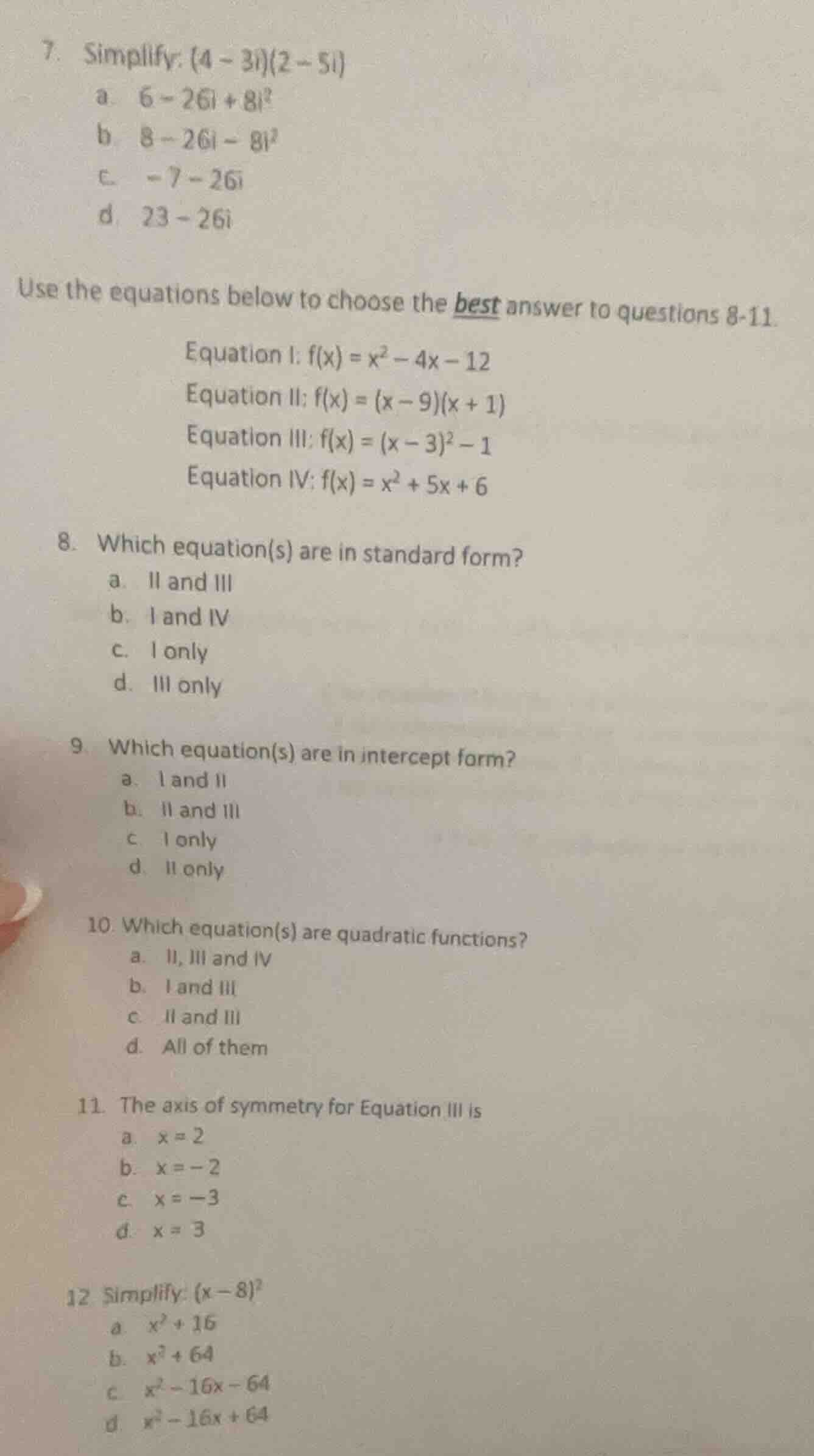
Question
- simplify: (4 - 3i)(2 - 5i)
a. 6 - 26i + 8i²
b. 8 - 26i - 8i²
c. -7 - 26i
d. 23 - 26i
use the equations below to choose the best answer to questions 8 - 11.
equation i: f(x) = x² - 4x - 12
equation ii: f(x) = (x - 9)(x + 1)
equation iii: f(x) = (x - 3)² - 1
equation iv: f(x) = x² + 5x + 6
- which equation(s) are in standard form?
a. ii and iii
b. i and iv
c. i only
d. iii only
- which equation(s) are in intercept form?
a. i and ii
b. ii and iii
c. i only
d. ii only
- which equation(s) are quadratic functions?
a. ii, iii and iv
b. i and iii
c. ii and iii
d. all of them
- the axis of symmetry for equation iii is
a. x = 2
b. x = -2
c. x = -3
d. x = 3
- simplify: (x - 8)²
a. x² + 16
b. x² + 64
c. x² - 16x - 64
d. x² - 16x + 64
Question 7
Step1: Use distributive property (FOIL)
Multiply each term in the first complex number by each term in the second complex number:
$(4 - 3i)(2 - 5i) = 4\times2 + 4\times(-5i) - 3i\times2 + (-3i)\times(-5i)$
$= 8 - 20i - 6i + 15i^2$
Step2: Combine like terms and substitute \(i^2 = -1\)
Combine the imaginary terms: \(-20i - 6i = -26i\)
Substitute \(i^2 = -1\): \(15i^2 = 15\times(-1) = -15\)
Now, combine the real terms: \(8 - 15 = -7\)
So, the expression becomes: \(-7 - 26i\)
The standard form of a quadratic function is \(f(x) = ax^2 + bx + c\) (where \(a
eq 0\)).
- Equation I: \(f(x) = x^2 - 4x - 12\) is in \(ax^2 + bx + c\) form.
- Equation II: \(f(x) = (x - 9)(x + 1)\) is factored (intercept) form, not standard.
- Equation III: \(f(x) = (x - 3)^2 - 1\) is vertex form, not standard.
- Equation IV: \(f(x) = x^2 + 5x + 6\) is in \(ax^2 + bx + c\) form.
Thus, Equations I and IV are in standard form.
Intercept form of a quadratic is \(f(x) = a(x - p)(x - q)\), where \(p\) and \(q\) are the x-intercepts.
- Equation I: \(f(x) = x^2 - 4x - 12\) is standard form, not intercept.
- Equation II: \(f(x) = (x - 9)(x + 1)\) is in \(a(x - p)(x - q)\) form (intercept form).
- Equation III: \(f(x) = (x - 3)^2 - 1\) is vertex form, not intercept.
- Equation IV: \(f(x) = x^2 + 5x + 6\) is standard form, not intercept.
Only Equation II is in intercept form.

Snap & solve any problem in the app
Get step-by-step solutions on Sovi AI
Photo-based solutions with guided steps
Explore more problems and detailed explanations
c. \(-7 - 26i\)