QUESTION IMAGE
Question
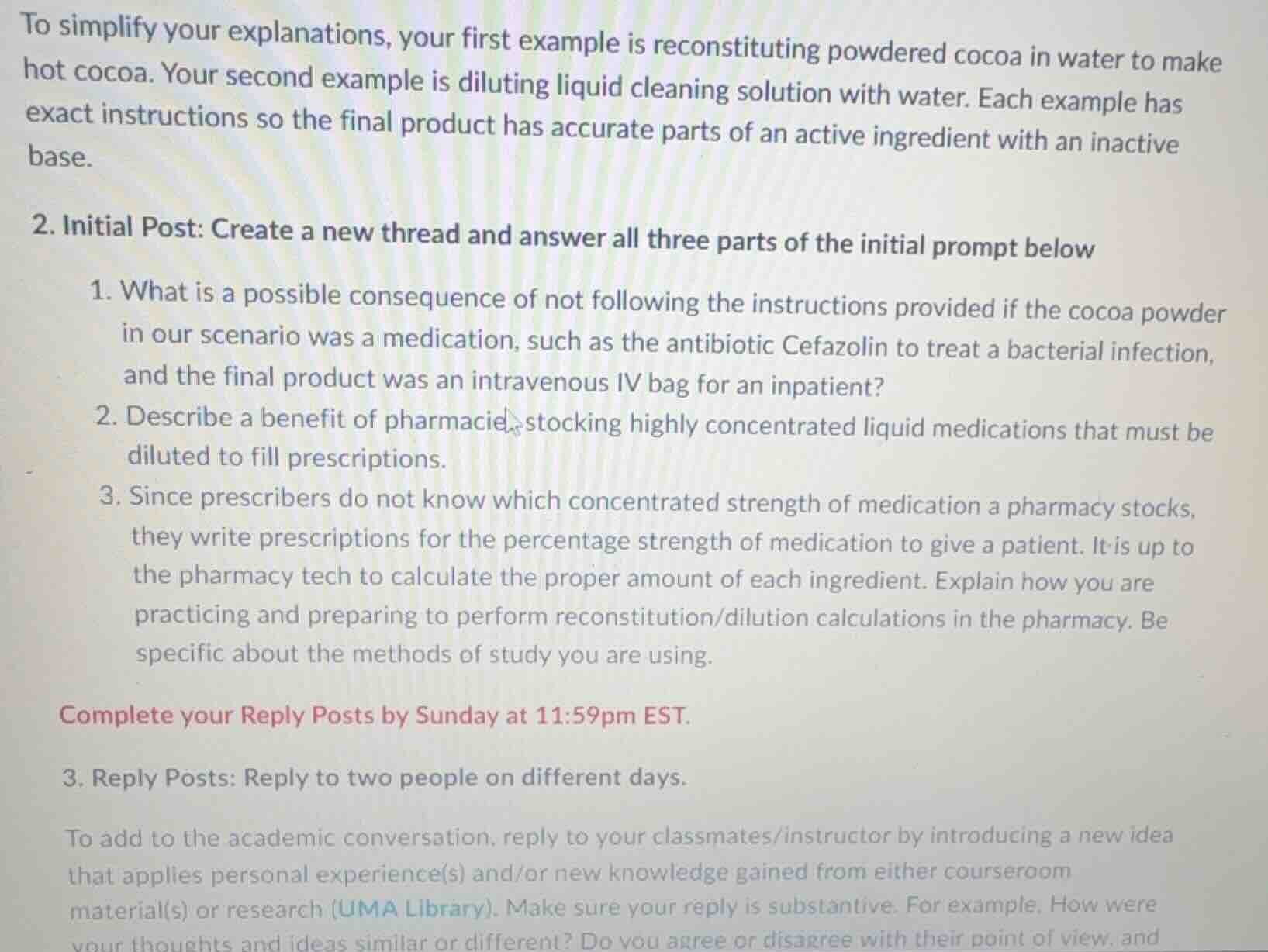
to simplify your explanations, your first example is reconstituting powdered cocoa in water to make hot cocoa. your second example is diluting liquid cleaning solution with water. each example has exact instructions so the final product has accurate parts of an active ingredient with an inactive base.
- initial post: create a new thread and answer all three parts of the initial prompt below
- what is a possible consequence of not following the instructions provided if the cocoa powder in our scenario was a medication, such as the antibiotic cefazolin to treat a bacterial infection, and the final product was an intravenous iv bag for an inpatient?
- describe a benefit of pharmacies stocking highly concentrated liquid medications that must be diluted to fill prescriptions.
- since prescribers do not know which concentrated strength of medication a pharmacy stocks, they write prescriptions for the percentage strength of medication to give a patient. it is up to the pharmacy tech to calculate the proper amount of each ingredient. explain how you are practicing and preparing to perform reconstitution/dilution calculations in the pharmacy. be specific about the methods of study you are using.
complete your reply posts by sunday at 11:59pm est.
- reply posts: reply to two people on different days.
to add to the academic conversation, reply to your classmates/instructor by introducing a new idea that applies personal experience(s) and/or new knowledge gained from either courseroom material(s) or research (uma library). make sure your reply is substantive. for example, how were your thoughts and ideas similar or different? do you agree or disagree with their point of view, and
Part 1
If instructions for reconstituting/diluting a medication like Cefazolin in an IV bag are not followed, the dosage of the active ingredient (antibiotic) will be incorrect. An underdose could lead to the bacterial infection not being treated effectively, allowing the bacteria to multiply or develop resistance. An overdose could cause adverse effects like kidney damage (Cefazolin can have nephrotoxicity) or allergic reactions, and disrupt the patient's normal physiological processes.
Stocking highly concentrated liquid medications reduces storage space requirements as a small volume of concentrated solution can be diluted to make multiple doses. It also increases inventory flexibility, as the same concentrated stock can be used to prepare different dosages by adjusting the dilution, and reduces costs associated with storing larger volumes of less - concentrated solutions.
To perform reconstitution/dilution calculations, I use the formula $C_1V_1 = C_2V_2$ (where $C_1$ = initial concentration, $V_1$ = initial volume, $C_2$ = final concentration, $V_2$ = final volume). I practice by solving sample pharmacy - related problems (e.g., from textbooks or online resources) that involve calculating the amount of concentrated medication and diluent needed. I also create flashcards with different concentration - volume scenarios to memorize the formula and improve my speed in applying it. Additionally, I review the principles of pharmacokinetics to understand why accurate dosing (from correct dilution) is important, which motivates me to get the calculations right.

Snap & solve any problem in the app
Get step-by-step solutions on Sovi AI
Photo-based solutions with guided steps
Explore more problems and detailed explanations
A possible consequence is incorrect dosage of the antibiotic. An underdose may fail to treat the bacterial infection (allowing it to worsen or develop resistance), while an overdose may cause adverse effects (e.g., nephrotoxicity, allergic reactions) and harm the patient.