QUESTION IMAGE
Question
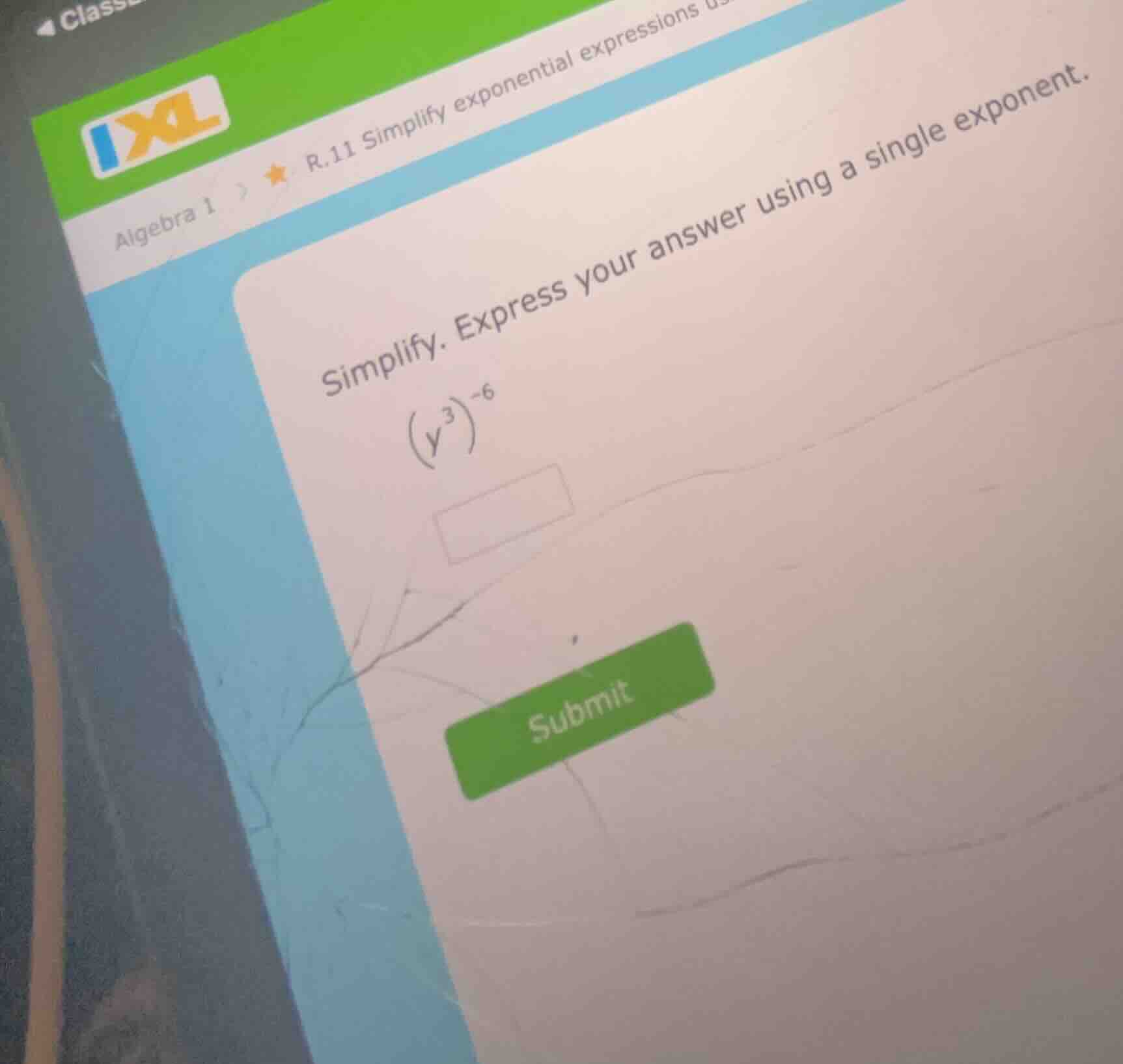
simplify. express your answer using a single exponent. ((y^{3})^{-6})
Step1: Recall exponent rule
When raising a power to a power, we multiply the exponents: \((a^m)^n = a^{m\times n}\).
Step2: Apply the rule to \((y^3)^{-6}\)
Here, \(a = y\), \(m = 3\), and \(n=-6\). So we multiply the exponents: \(3\times(-6)= - 18\). Thus, \((y^3)^{-6}=y^{-18}\) or we can also write it as \(\frac{1}{y^{18}}\) (using the rule \(a^{-n}=\frac{1}{a^n}\)), but since the problem says "express your answer using a single exponent", \(y^{-18}\) is also acceptable. But usually, if we consider positive exponents, \(\frac{1}{y^{18}}\) is also with a single exponent (the exponent of \(y\) in the denominator is \(18\)). However, following the rule of multiplying exponents directly: \((y^3)^{-6}=y^{3\times(-6)} = y^{-18}\) or \(\frac{1}{y^{18}}\).

Snap & solve any problem in the app
Get step-by-step solutions on Sovi AI
Photo-based solutions with guided steps
Explore more problems and detailed explanations
\(y^{-18}\) (or \(\frac{1}{y^{18}}\))