QUESTION IMAGE
Question
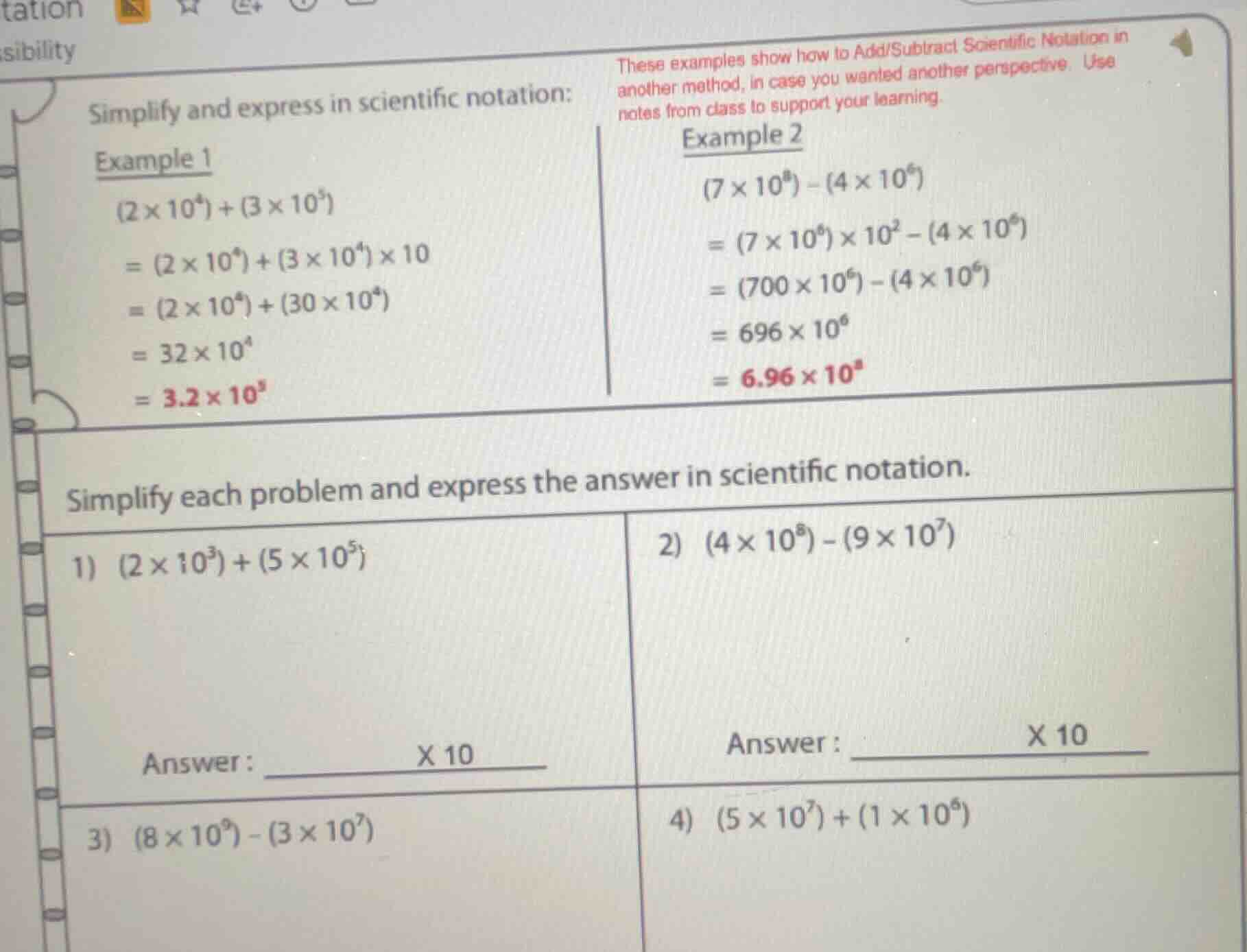
simplify and express in scientific notation:
example 1
$(2 \times 10^4) + (3 \times 10^5)$
$= (2 \times 10^4) + (3 \times 10^4) \times 10$
$= (2 \times 10^4) + (30 \times 10^4)$
$= 32 \times 10^4$
$= 3.2 \times 10^5$
these examples show how to add/subtract scientific notation in another method, in case you wanted another perspective. use notes from class to support your learning.
example 2
$(7 \times 10^8) - (4 \times 10^6)$
$= (7 \times 10^6) \times 10^2 - (4 \times 10^6)$
$= (700 \times 10^6) - (4 \times 10^6)$
$= 696 \times 10^6$
$= 6.96 \times 10^8$
simplify each problem and express the answer in scientific notation.
- $(2 \times 10^3) + (5 \times 10^5)$
answer: \underline{\hspace{2cm}} $\times 10$ \underline{\hspace{1cm}}
- $(4 \times 10^8) - (9 \times 10^7)$
answer: \underline{\hspace{2cm}} $\times 10$ \underline{\hspace{1cm}}
- $(8 \times 10^9) - (3 \times 10^7)$
- $(5 \times 10^7) + (1 \times 10^6)$
Problem 1: \((2 \times 10^3) + (5 \times 10^5)\)
Step 1: Adjust exponents to be equal
We want to make the exponents of \(10\) the same. We can rewrite \(5 \times 10^5\) as \(500 \times 10^3\) (since \(10^5=10^{3 + 2}=10^3\times10^2 = 10^3\times100\), so \(5\times10^5=5\times100\times10^3 = 500\times10^3\))
So the expression becomes \((2\times 10^3)+(500\times 10^3)\)
Step 2: Add the coefficients
When the exponents of \(10\) are the same, we add the coefficients. So \(2 + 500=502\)
The expression is now \(502\times 10^3\)
Step 3: Convert to scientific notation
Scientific notation is of the form \(a\times 10^n\) where \(1\leqslant a< 10\) and \(n\) is an integer. We rewrite \(502\times 10^3\) as \(5.02\times 10^2\times 10^3\) (since \(502 = 5.02\times100=5.02\times 10^2\))
Using the rule of exponents \(a^m\times a^n=a^{m + n}\), we have \(5.02\times 10^{2+3}=5.02\times 10^5\)
Step 1: Adjust exponents to be equal
Rewrite \(4\times 10^8\) as \(40\times 10^7\) (since \(10^8=10^{7+ 1}=10^7\times10\), so \(4\times 10^8=4\times10\times 10^7=40\times 10^7\))
The expression becomes \((40\times 10^7)-(9\times 10^7)\)
Step 2: Subtract the coefficients
When the exponents of \(10\) are the same, we subtract the coefficients. So \(40-9 = 31\)
The expression is now \(31\times 10^7\)
Step 3: Convert to scientific notation
Rewrite \(31\times 10^7\) as \(3.1\times 10^1\times 10^7\) (since \(31=3.1\times 10\))
Using the rule of exponents \(a^m\times a^n=a^{m + n}\), we get \(3.1\times 10^{1 + 7}=3.1\times 10^8\)
Step 1: Adjust exponents to be equal
Rewrite \(8\times 10^9\) as \(800\times 10^7\) (since \(10^9=10^{7+2}=10^7\times10^2 = 10^7\times100\), so \(8\times 10^9=8\times100\times 10^7=800\times 10^7\))
The expression becomes \((800\times 10^7)-(3\times 10^7)\)
Step 2: Subtract the coefficients
When the exponents of \(10\) are the same, we subtract the coefficients. So \(800 - 3=797\)
The expression is now \(797\times 10^7\)
Step 3: Convert to scientific notation
Rewrite \(797\times 10^7\) as \(7.97\times 10^2\times 10^7\) (since \(797 = 7.97\times 100=7.97\times 10^2\))
Using the rule of exponents \(a^m\times a^n=a^{m + n}\), we get \(7.97\times 10^{2+7}=7.97\times 10^9\)

Snap & solve any problem in the app
Get step-by-step solutions on Sovi AI
Photo-based solutions with guided steps
Explore more problems and detailed explanations
\(5.02\times 10^5\) (In the form \(\underline{5.02}\times 10^{\underline{5}}\))