QUESTION IMAGE
Question
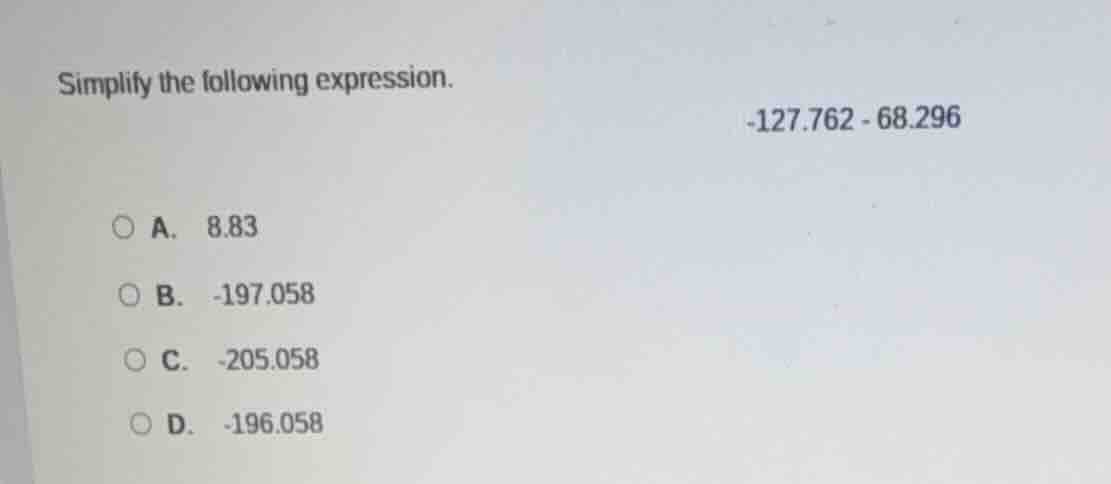
simplify the following expression. -127.762 - 68.296 a. 8.83 b. -197.058 c. -205.058 d. -196.058
Step1: Recall subtraction of decimals
To simplify \(-127.762 - 68.296\), we can rewrite it as \(-(127.762 + 68.296)\) because subtracting a number is the same as adding its negative.
Step2: Add the two positive numbers
First, add \(127.762\) and \(68.296\):
\[
127.762+68.296 = 196.058
\]
Step3: Apply the negative sign
Now, apply the negative sign from Step 1: \(-(196.058)= - 196.058\)? Wait, no, wait. Wait, \(127.762 + 68.296\): let's calculate again. \(127.762+68.296\):
- Add the whole numbers: \(127 + 68=195\)
- Add the decimals: \(0.762+0.296 = 1.058\)
- Then total is \(195 + 1.058=196.058\)? Wait, no, \(127.762+68.296\):
\(127.762+68.296\):
\(127.762+68.296 = (127 + 0.762)+(68 + 0.296)=(127 + 68)+(0.762 + 0.296)=195+1.058 = 196.058\). Wait, but wait, the original expression is \(-127.762-68.296=- (127.762 + 68.296)\). Wait, no, wait, maybe I made a mistake. Wait, \(127.762+68.296\):
Wait, \(127.762+68.296\):
Let's do the addition digit by digit:
- Thousands place: 0
- Hundreds place: 0
- Tens place: \(1 + 6 = 7\)? No, wait, \(127.762\) is \(127\) and \(0.762\), \(68.296\) is \(68\) and \(0.296\). Wait, no, \(127.762\) is \(127 + 0.762\), \(68.296\) is \(68+0.296\). So \(127 + 68 = 195\), \(0.762+0.296 = 1.058\), so total is \(195 + 1.058 = 196.058\). Then \(-127.762 - 68.296=- (127.762 + 68.296)=-196.058\)? But wait, let's check the options. Option D is \(-196.058\)? Wait, but wait, maybe I miscalculated. Wait, \(127.762+68.296\):
Wait, \(127.762+68.296\):
\(127.762+68.296\):
\(127.762+68.296 = 196.058\), so \(-127.762 - 68.296=-196.058\)? But wait, let's check the options. Option D is \(-196.058\). Wait, but let's check again. Wait, maybe I made a mistake in addition. Let's do \(127.762+68.296\):
\(127.762\)
\(+\ 68.296\)
\(\overline{196.058}\)
Yes, that's correct. So \(-127.762 - 68.296=-196.058\), which is option D. Wait, but wait, wait, the options: D is \(-196.058\). So that's the answer.
Wait, but let's check again. Wait, \(127.762+68.296\):
\(127.762 + 68.296\):
- Units place: \(7 + 8 = 15\), carryover 1, write 5? No, wait, no, \(127.762\) is \(1\) (hundreds), \(2\) (tens), \(7\) (units), \(.\), \(7\) (tenths), \(6\) (hundredths), \(2\) (thousandths). \(68.296\) is \(0\) (hundreds), \(6\) (tens), \(8\) (units), \(.\), \(2\) (tenths), \(9\) (hundredths), \(6\) (thousandths).
Adding units place: \(7 + 8 = 15\), write 5, carryover 1.
Tens place: \(2 + 6 + 1 = 9\), write 9.
Hundreds place: \(1 + 0 = 1\), write 1.
Tenths place: \(7 + 2 = 9\), write 9? Wait, no, I messed up the place values. Let's do decimal addition properly:
\(127.762\)
\(+\ 68.296\)
\(=\)
Align the decimal points:
\(127.762\)
\(+\ 68.296\)
\(\overline{}\)
Add from right to left (thousandths place first):
Thousandths: \(2 + 6 = 8\)
Hundredths: \(6 + 9 = 15\), write 5, carryover 1
Tenths: \(7 + 2 + 1 = 10\), write 0, carryover 1
Units: \(7 + 8 + 1 = 16\), write 6, carryover 1
Tens: \(2 + 6 + 1 = 9\)
Hundreds: \(1 + 0 = 1\)
Wait, that gives \(196.058\). Yes, so the sum is \(196.058\), so the original expression \(-127.762 - 68.296=-196.058\), which is option D.

Snap & solve any problem in the app
Get step-by-step solutions on Sovi AI
Photo-based solutions with guided steps
Explore more problems and detailed explanations
D. -196.058