QUESTION IMAGE
Question
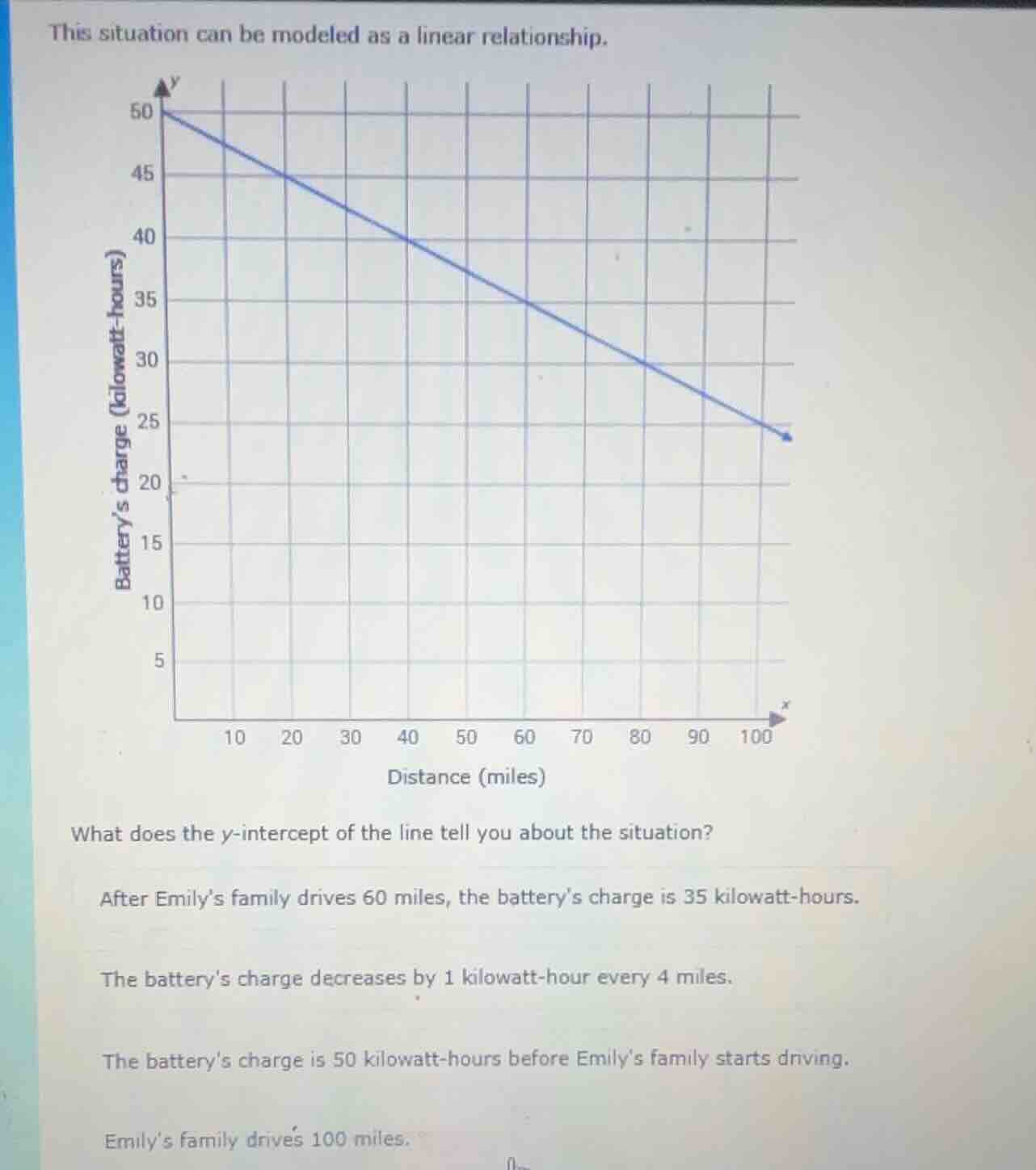
this situation can be modeled as a linear relationship.
what does the y-intercept of the line tell you about the situation?
after emily’s family drives 60 miles, the battery’s charge is 35 kilowatt-hours.
the battery’s charge decreases by 1 kilowatt-hour every 4 miles.
the battery’s charge is 50 kilowatt-hours before emily’s family starts driving.
emily’s family drives 100 miles.
Step1: Recall y - intercept definition
The y - intercept of a linear equation \(y = mx + b\) (where \(m\) is the slope and \(b\) is the y - intercept) occurs at \(x = 0\). In the context of this graph, the \(x\) - axis represents the distance (in miles) driven, and the \(y\) - axis represents the battery's charge (in kilowatt - hours).
Step2: Analyze the x = 0 case
When \(x = 0\), it means the distance driven is 0 miles (i.e., before starting to drive). Looking at the graph, the y - intercept is at \((0,50)\), which means when the distance \(x = 0\) (no miles driven yet), the battery's charge \(y = 50\) kilowatt - hours.
Now let's analyze the other options:
- "After Emily’s family drives 60 miles, the battery’s charge is 35 kilowatt - hours." This is a point on the line \((60,35)\), not the y - intercept.
- "The battery's charge decreases by 1 kilowatt - hour every 4 miles." This describes the slope of the line (rate of change), not the y - intercept.
- "Emily’s family drives 100 miles." This is a value on the \(x\) - axis, not related to the y - intercept.

Snap & solve any problem in the app
Get step-by-step solutions on Sovi AI
Photo-based solutions with guided steps
Explore more problems and detailed explanations
The battery's charge is 50 kilowatt - hours before Emily's family starts driving.