QUESTION IMAGE
Question
sketching shapes
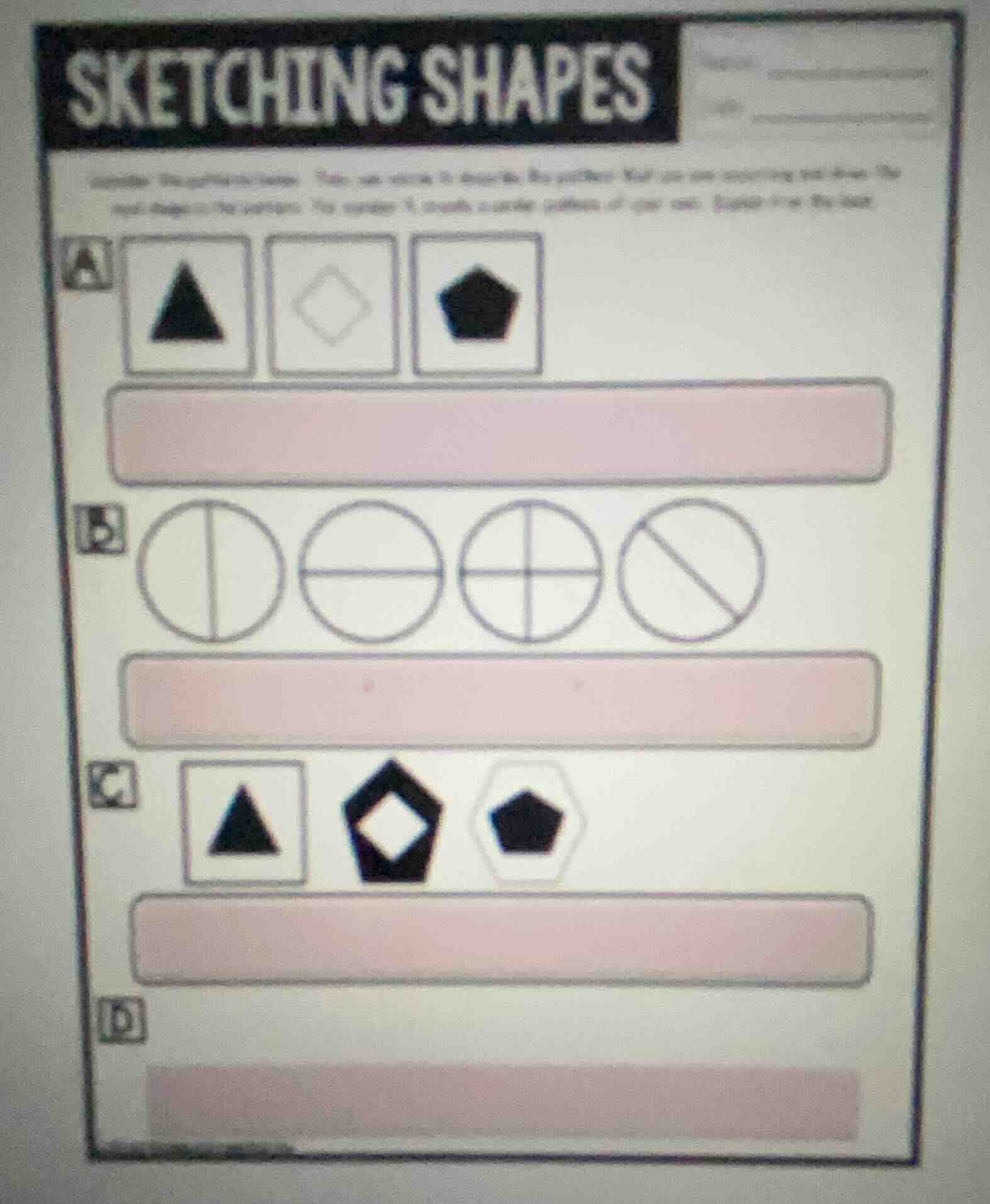
the text below the title is unclear, and the image-related content is as follows: there are four parts labeled a, b, c, d. part a has three figures: a black triangle, a white diamond, a black pentagon; part b has four circles with different line segments inside; part c has three figures: a black triangle, a black pentagon with a white diamond inside, a black pentagon inside a white hexagon; part d has a blank area for drawing.
To solve the problem of identifying the pattern in each set of shapes (A, B, C, and potentially D for creating a pattern), we analyze each section:
Part A:
Step 1: Identify the shapes
- First shape: Black triangle (3 - sided polygon).
- Second shape: Outlined rhombus (4 - sided polygon).
- Third shape: Black pentagon (5 - sided polygon).
Step 2: Analyze the pattern
The number of sides increases by 1: \( 3
ightarrow 4
ightarrow 5 \). The fill alternates: black (3 - sided) → outlined (4 - sided) → black (5 - sided).
Part B:
Step 1: Identify the lines in circles
- First circle: Vertical line (1 line, 90° orientation).
- Second circle: Horizontal line (1 line, 0° orientation).
- Third circle: Cross (2 lines: vertical + horizontal).
- Fourth circle: Diagonal line (1 line, 45° orientation).
Step 2: Analyze the pattern
The lines represent different orientations (vertical, horizontal, cross, diagonal) or a sequence of line counts (1, 1, 2, 1) with varying angles.
Part C:
Step 1: Identify the shapes and fills
- First shape: Black triangle (3 - sided, solid fill).
- Second shape: Black pentagon (5 - sided) with a white rhombus (4 - sided) inside.
- Third shape: Black pentagon (5 - sided? No, hexagon outline) with a black pentagon (5 - sided) inside. Wait, re - examining:
- First: Black triangle (3 - sided) in a square.
- Second: Black pentagon (5 - sided) with a white rhombus (4 - sided) inside.
- Third: Black pentagon (5 - sided) in a hexagon (6 - sided) outline.
Step 2: Analyze the pattern
The inner shape’s sides: \( 3
ightarrow 4
ightarrow 5 \) (triangle → rhombus → pentagon). The outer shape’s sides: \( 4 \) (square) \(
ightarrow 5 \) (pentagon) \(
ightarrow 6 \) (hexagon) (increasing by 1).
Part D: Create a pattern
To extend the pattern, follow the logic of increasing sides, alternating fills, or orientation. For example, using Part A’s pattern (increasing sides, alternating fill):
- Next shape: Outlined hexagon (6 - sided, 6 = 5 + 1), then black heptagon (7 - sided, 7 = 6 + 1), etc.
Final Answer (for pattern - making in D, using Part A’s logic):
A possible pattern for D:
- First shape: Black heptagon (7 - sided, solid fill).
- Second shape: Outlined octagon (8 - sided, outlined fill).
- Third shape: Black nonagon (9 - sided, solid fill).
This follows the sequence: \( 7
ightarrow 8
ightarrow 9 \) sides, alternating fill (black → outlined → black).

Snap & solve any problem in the app
Get step-by-step solutions on Sovi AI
Photo-based solutions with guided steps
Explore more problems and detailed explanations
To solve the problem of identifying the pattern in each set of shapes (A, B, C, and potentially D for creating a pattern), we analyze each section:
Part A:
Step 1: Identify the shapes
- First shape: Black triangle (3 - sided polygon).
- Second shape: Outlined rhombus (4 - sided polygon).
- Third shape: Black pentagon (5 - sided polygon).
Step 2: Analyze the pattern
The number of sides increases by 1: \( 3
ightarrow 4
ightarrow 5 \). The fill alternates: black (3 - sided) → outlined (4 - sided) → black (5 - sided).
Part B:
Step 1: Identify the lines in circles
- First circle: Vertical line (1 line, 90° orientation).
- Second circle: Horizontal line (1 line, 0° orientation).
- Third circle: Cross (2 lines: vertical + horizontal).
- Fourth circle: Diagonal line (1 line, 45° orientation).
Step 2: Analyze the pattern
The lines represent different orientations (vertical, horizontal, cross, diagonal) or a sequence of line counts (1, 1, 2, 1) with varying angles.
Part C:
Step 1: Identify the shapes and fills
- First shape: Black triangle (3 - sided, solid fill).
- Second shape: Black pentagon (5 - sided) with a white rhombus (4 - sided) inside.
- Third shape: Black pentagon (5 - sided? No, hexagon outline) with a black pentagon (5 - sided) inside. Wait, re - examining:
- First: Black triangle (3 - sided) in a square.
- Second: Black pentagon (5 - sided) with a white rhombus (4 - sided) inside.
- Third: Black pentagon (5 - sided) in a hexagon (6 - sided) outline.
Step 2: Analyze the pattern
The inner shape’s sides: \( 3
ightarrow 4
ightarrow 5 \) (triangle → rhombus → pentagon). The outer shape’s sides: \( 4 \) (square) \(
ightarrow 5 \) (pentagon) \(
ightarrow 6 \) (hexagon) (increasing by 1).
Part D: Create a pattern
To extend the pattern, follow the logic of increasing sides, alternating fills, or orientation. For example, using Part A’s pattern (increasing sides, alternating fill):
- Next shape: Outlined hexagon (6 - sided, 6 = 5 + 1), then black heptagon (7 - sided, 7 = 6 + 1), etc.
Final Answer (for pattern - making in D, using Part A’s logic):
A possible pattern for D:
- First shape: Black heptagon (7 - sided, solid fill).
- Second shape: Outlined octagon (8 - sided, outlined fill).
- Third shape: Black nonagon (9 - sided, solid fill).
This follows the sequence: \( 7
ightarrow 8
ightarrow 9 \) sides, alternating fill (black → outlined → black).