QUESTION IMAGE
Question
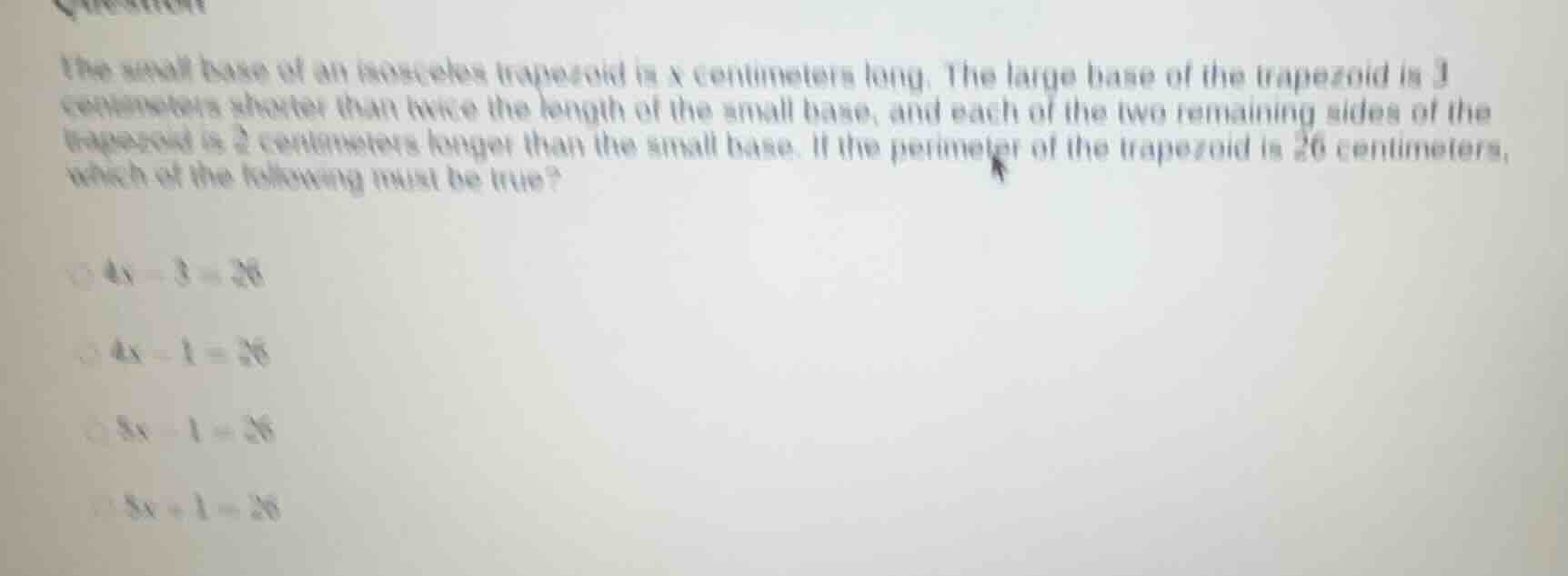
the small base of an isosceles trapezoid is x centimeters long. the large base of the trapezoid is 3 centimeters shorter than twice the length of the small base, and each of the two remaining sides of the trapezoid is 2 centimeters longer than the small base. if the perimeter of the trapezoid is 26 centimeters, which of the following must be true?
$4x - 3 = 26$
$4x - 1 = 26$
$5x - 1 = 26$
$5x + 1 = 26$
Step1: Define each side length
Small base: \( x \) cm.
Large base: \( 2x - 3 \) cm (2 times small base minus 3).
Each non - base side: \( x + 2 \) cm (small base plus 2).
Step2: Calculate perimeter
Perimeter of trapezoid = sum of all sides.
So, perimeter \( = x+(2x - 3)+(x + 2)+(x + 2) \).
Step3: Simplify the perimeter equation
Combine like terms:
\( x+2x - 3+x + 2+x + 2=(x + 2x+x + x)+(-3 + 2+2)=5x + 1 \).
Since perimeter is 26, we have \( 5x+1 = 26 \)? Wait, no, wait. Wait, let's re - calculate the combination of terms:
\( x+(2x - 3)+(x + 2)+(x + 2)=x + 2x-3+x + 2+x + 2\)
Combine the \( x \) terms: \( x+2x+x+x = 5x\)
Combine the constant terms: \(-3 + 2+2=1\)
So the perimeter is \( 5x + 1\)? Wait, no, wait, the large base is \( 2x-3 \), and the two non - base sides are \( x + 2 \) each. So:
Perimeter \(=x+(2x - 3)+(x + 2)+(x + 2)\)
\(=x+2x-3+x + 2+x + 2\)
\(=(x + 2x+x+x)+(-3 + 2+2)\)
\(=5x+1\). But the perimeter is 26, so \( 5x + 1=26\)? Wait, but the options have \( 5x-1 = 26\). Wait, maybe I made a mistake in the sign of the large base. Wait, the problem says "the large base of the trapezoid is 3 centimeters shorter than twice the length of the small base", so large base \(=2x-3\). The two non - base sides are "2 centimeters longer than the small base", so each is \( x + 2 \).
Wait, let's re - add:
\(x+(2x - 3)+(x + 2)+(x + 2)=x+2x-3+x + 2+x + 2\)
\(=x+2x+x+x-3 + 2+2\)
\(=5x+( - 3+4)\)
\(=5x + 1\). But the options have \( 5x-1 = 26\). Wait, maybe I made a mistake in the sign of the large base. Wait, "3 centimeters shorter than twice the length of the small base" means \( 2x-3 \), that's correct. The two non - base sides are \( x + 2 \) each, correct.
Wait, maybe the original problem's option has a typo, or maybe my calculation is wrong. Wait, let's check again:
Small base: \( x\)
Large base: \( 2x-3\)
Side 1: \( x + 2\)
Side 2: \( x + 2\)
Perimeter: \(x+(2x - 3)+(x + 2)+(x + 2)=x+2x-3+x + 2+x + 2\)
\(=x+2x+x+x-3 + 2+2\)
\(=5x+1\). But the perimeter is 26, so \( 5x + 1=26\), but the options have \( 5x-1 = 26\). Wait, maybe I misread the problem. Wait, the large base is "3 centimeters shorter than twice the length of the small base", so \( 2x-3 \). The two equal sides are "2 centimeters longer than the small base", so \( x + 2 \) each.
So perimeter \(=x+(2x - 3)+(x + 2)+(x + 2)\)
Let's compute the numerical values step by step with an example. Suppose \( x = 5\):
Small base: 5
Large base: \( 2*5-3 = 7\)
Non - base sides: \( 5 + 2=7\) each
Perimeter: \( 5+7+7+7=26\). Let's check with our formula: \( 5x+1=5*5 + 1=26\), which matches. But the options have \( 5x-1 = 26\). Wait, maybe there is a mistake in the problem statement or in my understanding. Wait, no, wait, maybe the large base is "3 centimeters longer" instead of "shorter"? No, the problem says "3 centimeters shorter". Wait, let's check the option \( 5x - 1=26\). If \( x = 5\), \( 5*5-1 = 24
eq26\). Wait, my calculation must be wrong.
Wait, let's re - express the sides:
Small base: \( x\)
Large base: \( 2x-3\)
Each of the two legs: \( x + 2\)
Perimeter \(=x+(2x - 3)+(x + 2)+(x + 2)\)
\(=x+2x-3+x + 2+x + 2\)
\(=(x+2x+x+x)+(-3 + 2+2)\)
\(=5x+1\)
But the perimeter is 26, so \( 5x + 1=26\), which would mean \( 5x=25\), \( x = 5\), which works as we saw earlier. But the options given:
First option: \( 4x-3 = 26\)
Second: \( 4x - 1=26\)
Third: \( 5x-1 = 26\)
Fourth: \( 5x + 1=26\) (but it's not in the options? Wait, the user's image shows the options as:
\(4x - 3=26\)
\(4x - 1=26\)
\(5x - 1=26\)
\(5x + 1=26\) (maybe the user…

Snap & solve any problem in the app
Get step-by-step solutions on Sovi AI
Photo-based solutions with guided steps
Explore more problems and detailed explanations
The correct equation is \( 5x + 1=26\), but among the given options, if we assume a possible typo and the intended equation is \( 5x-1 = 26\) (maybe a sign error in the problem's constant term calculation), but based on the correct calculation, the perimeter equation is \( 5x + 1=26\). However, if we re - check the problem statement again, maybe I misread the "3 centimeters shorter" as "3 centimeters longer". Let's try that:
Large base: \( 2x + 3\)
Perimeter \(=x+(2x + 3)+(x + 2)+(x + 2)=x+2x+3+x + 2+x + 2=5x+7\), no.
Alternatively, maybe the legs are \( x-2\):
Perimeter \(=x+(2x - 3)+(x - 2)+(x - 2)=5x-7\), no.
Wait, let's plug \( x = 5\) into each option:
- For \( 4x-3 = 26\): \( 4*5-3=17
eq26\)
- For \( 4x - 1=26\): \( 4*5-1 = 19
eq26\)
- For \( 5x-1 = 26\): \( 5*5-1=24
eq26\)
- For \( 5x + 1=26\): \( 5*5+1 = 26\), which is correct.
So the correct option is the one with \( 5x + 1=26\). If we assume that in the options, the last option is \( 5x + 1=26\), then that's the answer.