QUESTION IMAGE
Question
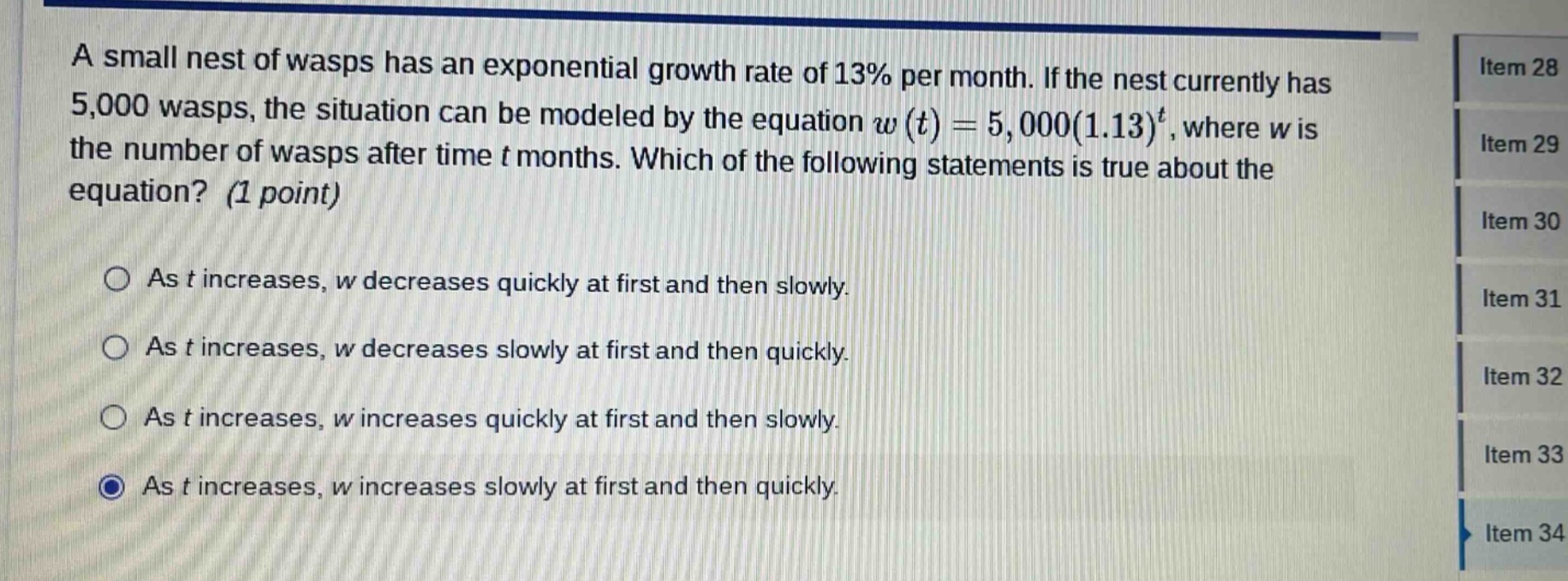
a small nest of wasps has an exponential growth rate of 13% per month. if the nest currently has 5,000 wasps, the situation can be modeled by the equation $w(t) = 5,000(1.13)^t$, where $w$ is the number of wasps after time $t$ months. which of the following statements is true about the equation? (1 point)
○ as $t$ increases, $w$ decreases quickly at first and then slowly.
○ as $t$ increases, $w$ decreases slowly at first and then quickly.
○ as $t$ increases, $w$ increases quickly at first and then slowly.
○ as $t$ increases, $w$ increases slowly at first and then quickly.
The function given is an exponential growth function of the form \( w(t)=a(b)^t \), where \( a = 5000>0 \) and \( b=1.13>1 \). For exponential growth functions with \( b > 1 \), as \( t \) (the independent variable, representing time here) increases, the dependent variable \( w(t) \) (number of wasps) increases. In the initial stages (small values of \( t \)), the growth seems slow because the base is just slightly above 1, but as \( t \) increases, the effect of the exponentiation becomes more pronounced, and the growth accelerates (increases quickly). So we analyze each option:
- The first two options are incorrect because the function is a growth function (since \( b = 1.13>1 \)), so \( w \) should increase, not decrease as \( t \) increases.
- The third option is incorrect because in exponential growth with \( b>1 \), the growth is slow at first and then becomes rapid (not quick at first then slow).
- The fourth option correctly describes the behavior of an exponential growth function with \( b > 1 \): as \( t \) increases, \( w \) increases slowly at first and then quickly.

Snap & solve any problem in the app
Get step-by-step solutions on Sovi AI
Photo-based solutions with guided steps
Explore more problems and detailed explanations
As \( t \) increases, \( w \) increases slowly at first and then quickly.