QUESTION IMAGE
Question
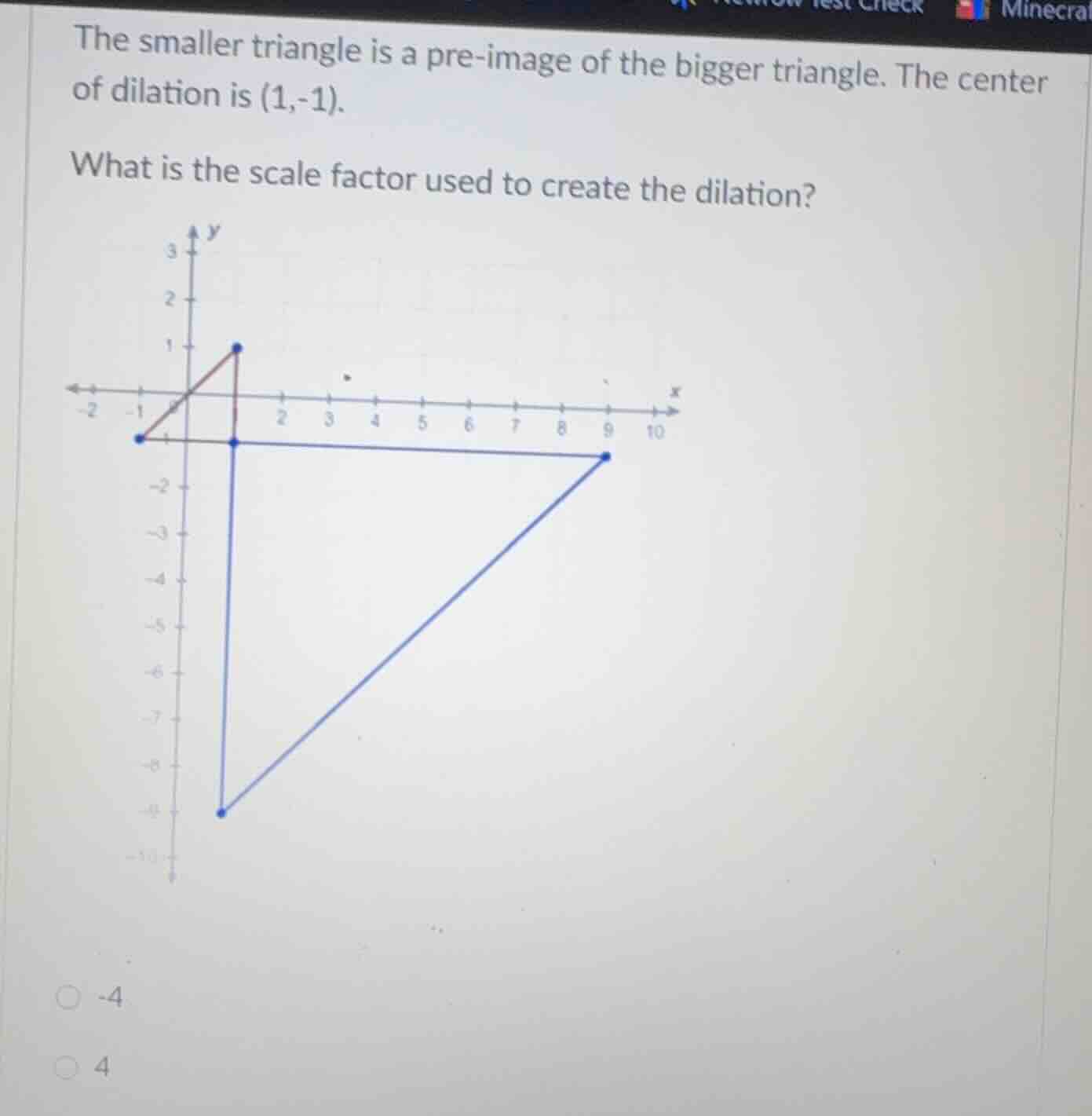
the smaller triangle is a pre - image of the bigger triangle. the center of dilation is (1, - 1). what is the scale factor used to create the dilation? options: - 4, 4
Step1: Identify coordinates of pre - image and image points
Let's take a vertex of the smaller (pre - image) triangle and the corresponding vertex of the larger (image) triangle. Let's consider the left - most vertex of the smaller triangle: from the graph, its coordinates (relative to the center of dilation \((1,-1)\)) can be found. Wait, actually, let's find the coordinates of a vertex of the pre - image and the image. Let's take the vertex of the smaller triangle at \((-1,-1)\) (wait, no, looking at the graph, the smaller triangle has a vertex at \((-1,-1)\)? Wait, no, the center of dilation is \((1,-1)\). Let's take a vertex of the pre - image (smaller triangle) and the image (larger triangle). Let's take the vertex of the smaller triangle: let's say the top vertex of the smaller triangle is \((1,1)\) (wait, no, the y - axis: the smaller triangle has a vertex at \((1,1)\) (since it's at x = 1, y = 1) and the left - most vertex at \((-1,-1)\), and the bottom vertex at \((1,-1)\)? Wait, no, the smaller triangle: let's find the length of a side. Wait, the center of dilation is \((1,-1)\). Let's take the vector from the center of dilation to a pre - image point and the vector from the center of dilation to the corresponding image point.
Let's take the vertex of the pre - image (smaller triangle) at \((1,1)\) (distance from center \((1,-1)\): the vertical distance is \(1-(-1)=2\), horizontal distance is \(1 - 1=0\)). The corresponding vertex of the image (larger triangle) at \((1,-9)\): the vertical distance from center \((1,-1)\) is \(-9-(-1)=-8\), horizontal distance is \(1 - 1 = 0\). Wait, the length from center to pre - image point: \(d_{pre}=\vert1 - (-1)\vert=2\) (vertical distance). The length from center to image point: \(d_{image}=\vert-9-(-1)\vert=\vert-8\vert = 8\). The scale factor \(k=\frac{d_{image}}{d_{pre}}\).
Alternatively, let's take the horizontal side. The pre - image (smaller triangle) has a horizontal side from \(x=-1\) to \(x = 1\) (length \(1-(-1)=2\)). The image (larger triangle) has a horizontal side from \(x=-1\) to \(x = 9\)? Wait, no, the center of dilation is \((1,-1)\). Wait, the bottom side of the larger triangle: from \(x = 1\) to \(x = 9\), length \(9 - 1=8\). The bottom side of the smaller triangle: from \(x=-1\) to \(x = 1\), length \(1-(-1)=2\). Wait, no, the center of dilation is \((1,-1)\). Let's use the formula for dilation: if \((x,y)\) is a point in the pre - image, and \((x',y')\) is the image point, and the center of dilation is \((h,k)\), then \(x'=h + k_{x}(x - h)\), \(y'=k + k_{y}(y - k)\), where \(k_{x}\) and \(k_{y}\) are the scale factors (since it's a dilation, \(k_{x}=k_{y}=k\)).
Let's take the vertex of the pre - image: let's find a vertex of the smaller triangle. Let's take the vertex at \((-1,-1)\) (pre - image) and the corresponding vertex of the larger triangle. Wait, the center of dilation is \((1,-1)\). The vector from center to pre - image point: \((-1 - 1,-1-(-1))=(-2,0)\). The vector from center to image point: let's take the corresponding vertex of the larger triangle. Looking at the graph, the larger triangle's left - most vertex? No, the larger triangle's bottom - left vertex is at \((1,-9)\)? Wait, no, the bottom - left vertex of the larger triangle is at \((1,-9)\), and the center is \((1,-1)\). The vector from center to image point is \((1 - 1,-9-(-1))=(0,-8)\). Wait, maybe a better approach: take the vertical side. The smaller triangle has a vertical side length. The smaller triangle: from \(y=-1\) to \(y = 1\), so length \(1-(-1)=2\). The larger triangle: from…

Snap & solve any problem in the app
Get step-by-step solutions on Sovi AI
Photo-based solutions with guided steps
Explore more problems and detailed explanations
\(4\)