QUESTION IMAGE
Question
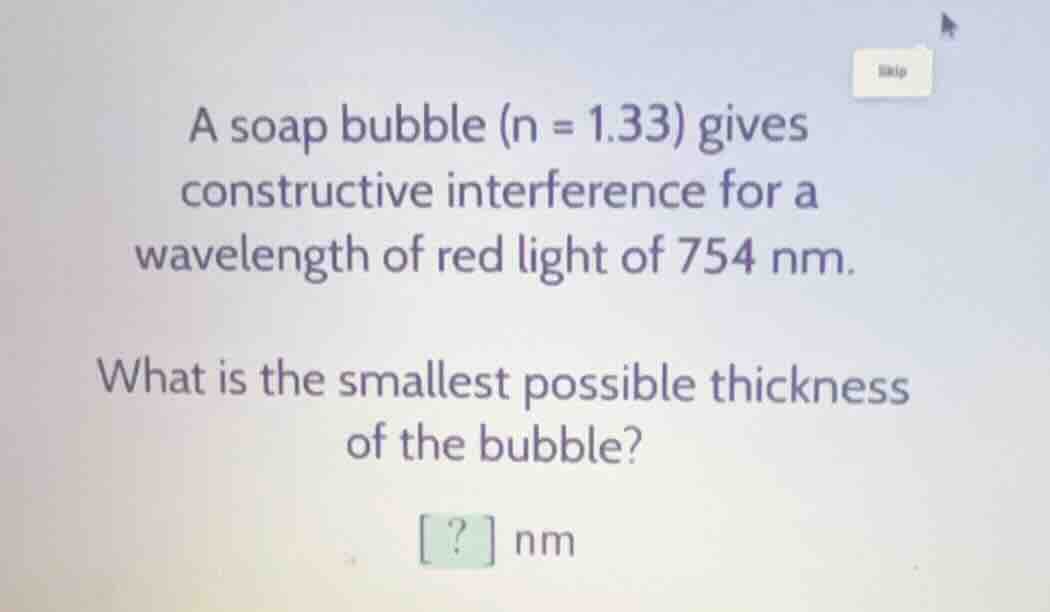
a soap bubble (n = 1.33) gives constructive interference for a wavelength of red light of 754 nm. what is the smallest possible thickness of the bubble? ? nm
Step1: Recall constructive interference formula
For thin films with phase shifts (soap bubble has two phase shifts, so the condition is $2nt = m\lambda$, where $m=1$ for smallest thickness)
Step2: Rearrange for thickness $t$
$t = \frac{m\lambda}{2n}$
Step3: Substitute values ($m=1$, $\lambda=754$ nm, $n=1.33$)
$t = \frac{1 \times 754}{2 \times 1.33} = \frac{754}{2.66} \approx 141$ nm

Snap & solve any problem in the app
Get step-by-step solutions on Sovi AI
Photo-based solutions with guided steps
Explore more problems and detailed explanations
141 nm