QUESTION IMAGE
Question
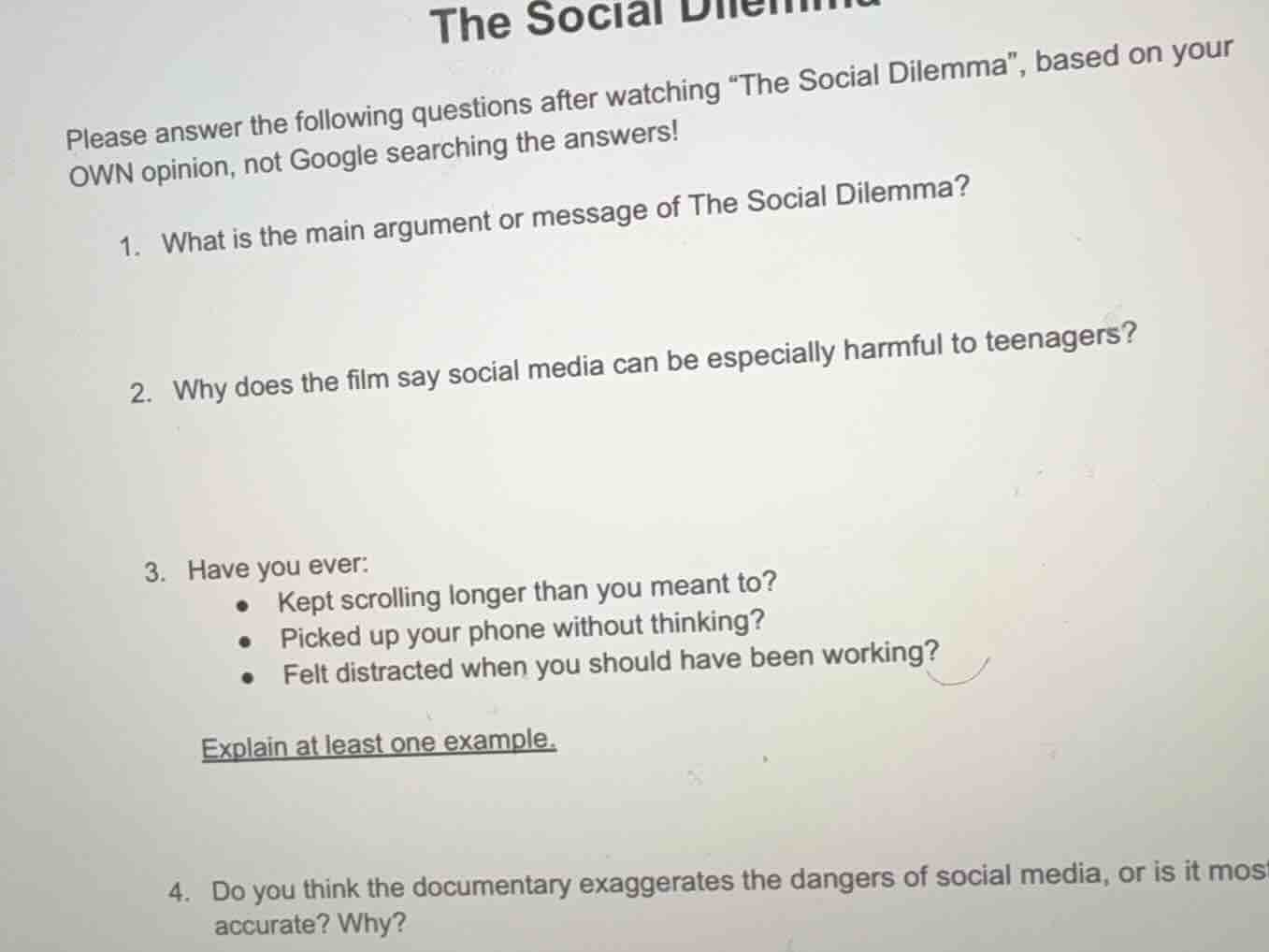
the social dilemma
please answer the following questions after watching “the social dilemma”, based on your
own opinion, not google searching the answers!
- what is the main argument or message of the social dilemma?
- why does the film say social media can be especially harmful to teenagers?
- have you ever:
- kept scrolling longer than you meant to?
- picked up your phone without thinking?
- felt distracted when you should have been working?
explain at least one example.
- do you think the documentary exaggerates the dangers of social media, or is it most
accurate? why?
Brief Explanations
- The main message centers on how social media platforms are designed to exploit human psychology for profit, prioritizing user engagement over well-being, and causing widespread societal harms like polarization, mental health issues, and erosion of truth.
- Teenagers are still developing their identity and impulse control; social media's algorithmic focus on engagement exposes them to harmful content, distorts self-perception via curated feeds, and disrupts critical developmental processes like in-person socialization and emotional regulation.
- This is a personal reflection: an example could be mindlessly scrolling a social media feed during a work break, intending to stop after 5 minutes, but losing track of time and scrolling for 45 minutes, leading to missed work deadlines.
- The documentary is mostly accurate: while it focuses on the most severe harms, it aligns with documented links between social media use and mental health struggles, and the core mechanism of algorithmic exploitation is a confirmed design feature of major platforms. It may amplify risks for dramatic effect, but its core claims are evidence-based.

Snap & solve any problem in the app
Get step-by-step solutions on Sovi AI
Photo-based solutions with guided steps
Explore more problems and detailed explanations
- The main argument is that social media platforms are intentionally designed to prioritize profit and user engagement over human well-being, creating widespread negative impacts on mental health, societal polarization, and the spread of misinformation.
- Teenagers face heightened harm because their developing brains are more vulnerable to addictive design features, their identity formation is easily distorted by curated, unrealistic social media content, and their limited impulse control makes it harder to disengage from harmful or distracting platforms.
- Yes, I have experienced all three. For example, last week I sat down to work on a school assignment and told myself I would check my social media for just 5 minutes to take a quick break. I ended up scrolling through short videos for over an hour, completely losing track of time, which made me miss my initial deadline for the assignment.
- I think the documentary is mostly accurate. While it emphasizes the most extreme negative outcomes, its core claims about social media's exploitative design and links to mental health issues, polarization, and reduced attention spans are supported by real research and real-world observations. It may frame risks in a dramatic way to grab attention, but it does not exaggerate the fundamental, systemic problems with how these platforms operate.