QUESTION IMAGE
Question
social studies
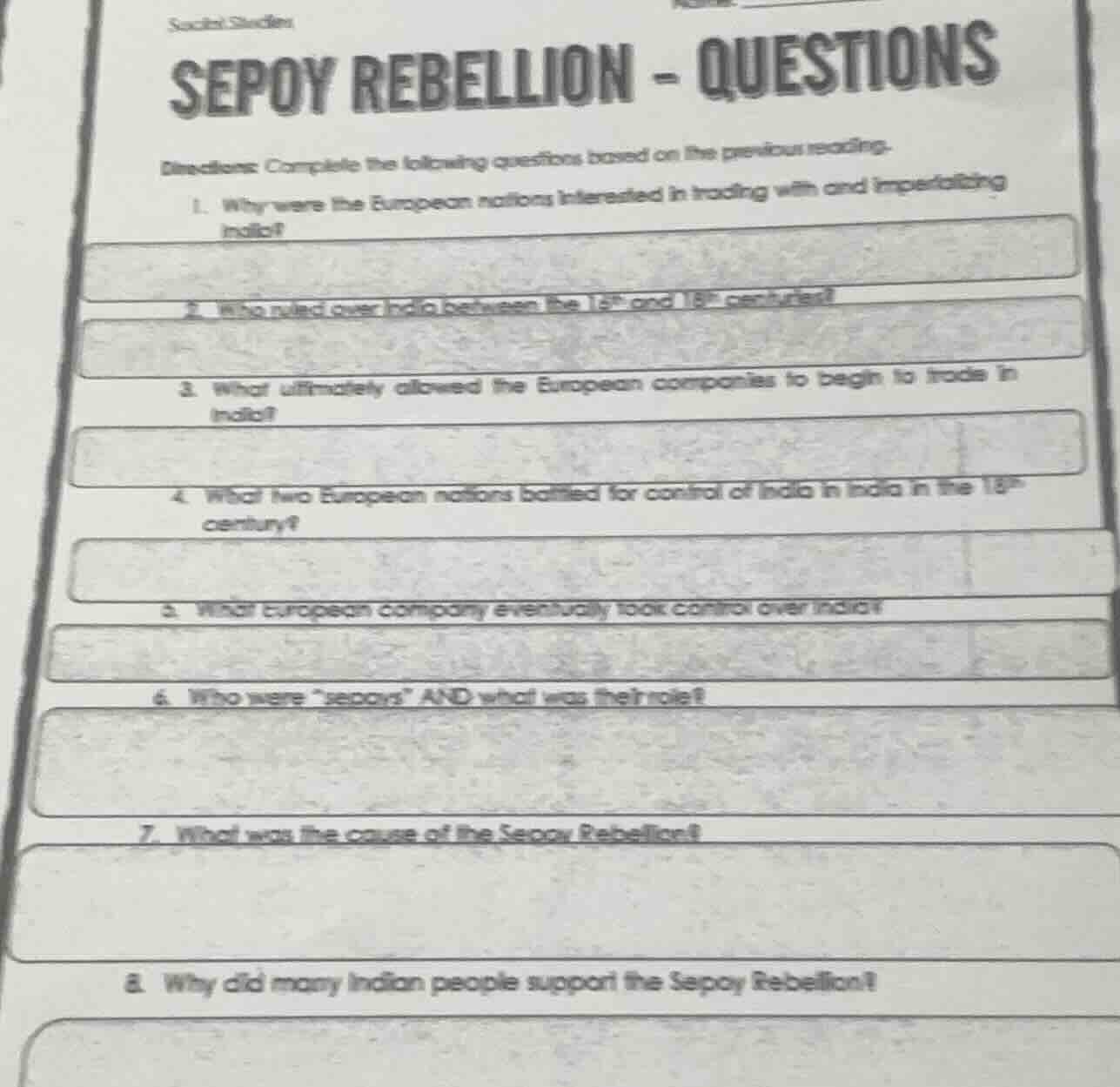
sepoy rebellion - questions
directions: complete the following questions based on the previous reading.
- why were the european nations interested in trading with and imperializing india?
- who ruled over india between the 16th and 18th centuries?
- what ultimately allowed the european companies to begin to trade in india?
- what two european nations battled for control of india in india in the 18th century?
- what european company eventually took control over india?
- who were \sepoys\ and what was their role?
- what was the cause of the sepoy rebellion?
- why did many indian people support the sepoy rebellion?
Brief Explanations
- European nations sought India's valuable raw materials (like cotton, spices) and a large market for their manufactured goods, along with strategic geopolitical advantages.
- The Mughal Empire was the dominant ruling power across most of India during this period, maintaining centralized control and a vast territory.
- The decline of the Mughal Empire created power vacuums, and European companies secured trade permissions (farman) from local rulers to establish trading posts.
- Britain (via the British East India Company) and France (via the French East India Company) fought a series of wars across India for colonial control.
- The British East India Company defeated rival powers and expanded its control to become the dominant European power ruling over most of India.
- Sepoys were Indian soldiers recruited into the armies of European (primarily British East India Company) colonial forces; they served as infantry, cavalry, and support troops to enforce colonial control.
- The immediate cause was the introduction of the Pattern 1853 Enfield rifle, whose cartridges were greased with beef and pork fat—offensive to both Hindu and Muslim sepoys, as it violated their religious dietary laws.
- Many Indians resented British colonial exploitation (land seizures, high taxes), cultural disrespect, and the erosion of traditional Indian political and social systems, seeing the rebellion as a chance to end British control.

Snap & solve any problem in the app
Get step-by-step solutions on Sovi AI
Photo-based solutions with guided steps
Explore more problems and detailed explanations
- To access valuable raw materials (spices, cotton) and a large market for European manufactured goods, plus geopolitical power.
- The Mughal Empire.
- The decline of the Mughal Empire and trade permissions from local rulers.
- Great Britain and France.
- The British East India Company.
- Sepoys were Indian soldiers hired by European colonial powers (mostly the British East India Company); their role was to serve as the primary fighting force for colonial expansion and control in India.
- The immediate cause was the introduction of rifle cartridges greased with beef and pork fat, which violated the religious beliefs of Hindu and Muslim sepoys.
- They opposed British colonial exploitation (taxes, land loss), cultural insensitivity, and the destruction of traditional Indian social and political structures, and wanted to end British rule.