QUESTION IMAGE
Question
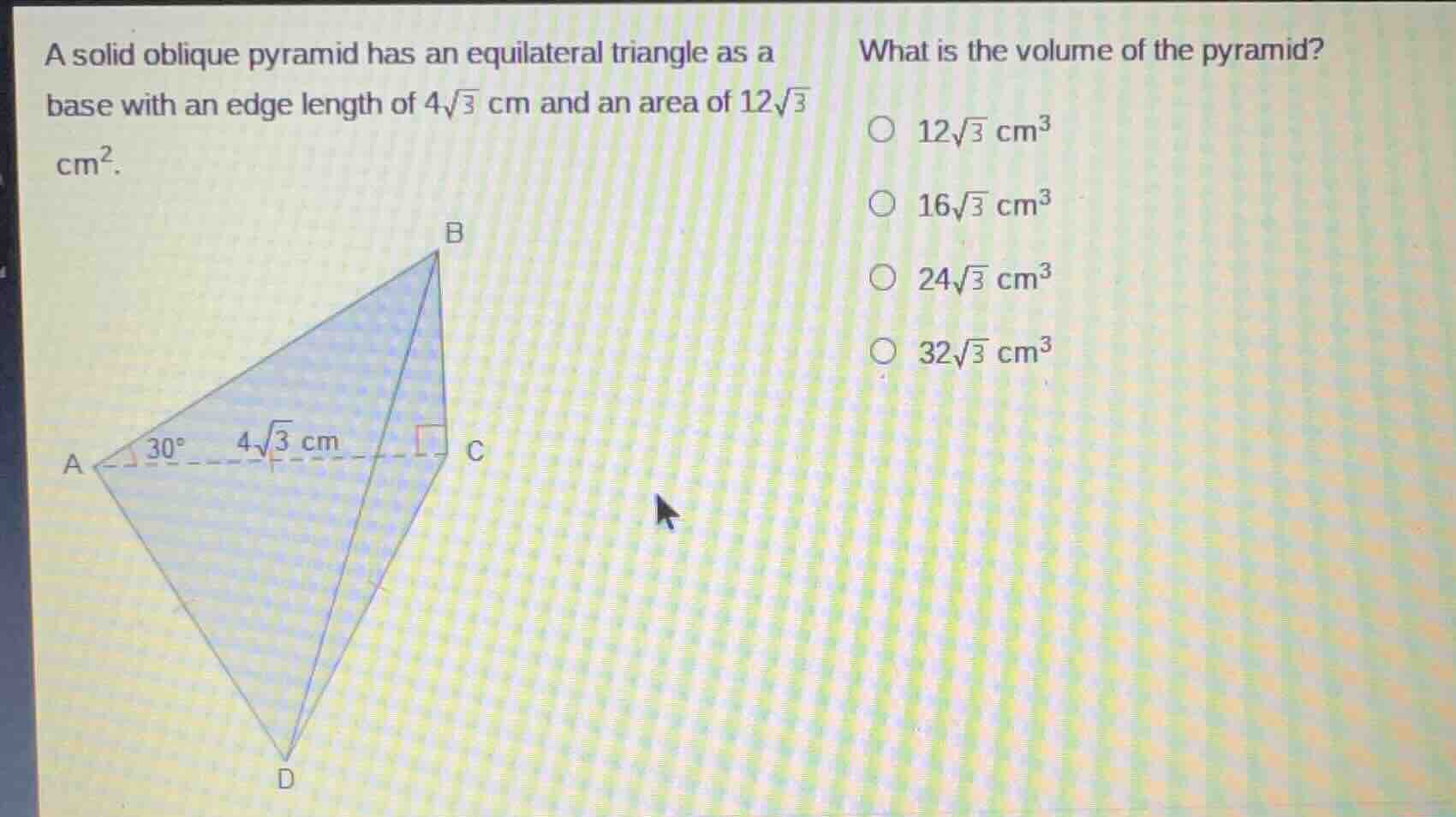
a solid oblique pyramid has an equilateral triangle as a base with an edge length of $4\sqrt{3}$ cm and an area of $12\sqrt{3}$ $\mathrm{cm}^2$. what is the volume of the pyramid? $\bigcirc$ $12\sqrt{3}\\ \mathrm{cm}^3$ $\bigcirc$ $16\sqrt{3}\\ \mathrm{cm}^3$ $\bigcirc$ $24\sqrt{3}\\ \mathrm{cm}^3$ $\bigcirc$ $32\sqrt{3}\\ \mathrm{cm}^3$
Step1: Recall the volume formula for a pyramid
The volume \( V \) of a pyramid is given by the formula \( V=\frac{1}{3}Bh \), where \( B \) is the area of the base and \( h \) is the height of the pyramid.
Step2: Determine the height of the pyramid
From the diagram, we have a right triangle with angle \( 30^\circ \), hypotenuse (the slant height related to the height) and the adjacent side \( 4\sqrt{3} \) cm. In a \( 30^\circ - 60^\circ - 90^\circ \) triangle, the side opposite \( 30^\circ \) is half the hypotenuse, but here we can use the sine function. Wait, actually, the height \( h \) of the pyramid (the perpendicular height) can be found using the right triangle at \( A \), \( C \), and the height vertex. The angle at \( A \) is \( 30^\circ \), and the adjacent side (the horizontal distance) is \( 4\sqrt{3} \) cm. Wait, no, the height \( h \) is opposite the \( 30^\circ \) angle? Wait, no, let's see: the triangle \( ABC \) (right - angled at \( C \)) has angle at \( A \) as \( 30^\circ \), and the side \( AC = 4\sqrt{3} \) cm. We know that in a right triangle, \( \sin(30^\circ)=\frac{h}{AB} \)? No, wait, actually, the height \( h \) (the vertical height of the pyramid) is related to the angle \( 30^\circ \) and the side \( AC = 4\sqrt{3} \) cm. Wait, \( \tan(30^\circ)=\frac{h}{4\sqrt{3}} \)? No, wait, \( \sin(30^\circ)=\frac{h}{AB} \), but maybe a better way: in a right triangle with angle \( 30^\circ \), the side opposite \( 30^\circ \) is half the hypotenuse, but here, if we consider the right triangle where the angle is \( 30^\circ \), and the adjacent side is \( 4\sqrt{3} \), no, wait, actually, the height \( h \) can be found as follows: we know that in a right triangle, if the angle is \( 30^\circ \), and the side adjacent to \( 30^\circ \) is \( 4\sqrt{3} \), then the side opposite (the height \( h \)) is \( h = 4\sqrt{3}\times\tan(30^\circ) \)? Wait, no, \( \tan(30^\circ)=\frac{1}{\sqrt{3}} \), so \( h = 4\sqrt{3}\times\frac{1}{\sqrt{3}}=4 \)? Wait, no, that's not right. Wait, actually, the height \( h \) of the pyramid (the perpendicular height) is the side opposite the \( 30^\circ \) angle in the right triangle with hypotenuse? Wait, no, let's re - examine. The length from \( A \) to the projection of \( B \) on the base is \( 4\sqrt{3} \) cm, and the angle between the line from \( A \) to the projection and the line from \( A \) to \( B \) is \( 30^\circ \). So, using \( \sin(30^\circ)=\frac{h}{AB} \), but we can also use the fact that in a right triangle, if the angle is \( 30^\circ \), the height \( h \) (opposite \( 30^\circ \)) is related to the adjacent side. Wait, maybe a simpler approach: the height \( h \) of the pyramid is \( 4 \) cm? Wait, no, let's calculate:
We know that in a right triangle, \( \sin(30^\circ)=\frac{h}{l} \), but maybe the length of the side opposite \( 30^\circ \) is half the hypotenuse, but here, the adjacent side is \( 4\sqrt{3} \), and we can use \( \tan(30^\circ)=\frac{h}{4\sqrt{3}} \), so \( h = 4\sqrt{3}\times\tan(30^\circ) \). Since \( \tan(30^\circ)=\frac{1}{\sqrt{3}} \), then \( h = 4\sqrt{3}\times\frac{1}{\sqrt{3}} = 4 \) cm. Wait, that makes sense. So the height \( h = 4 \) cm.
Step3: Substitute the values of \( B \) and \( h \) into the volume formula
We are given that the area of the base \( B = 12\sqrt{3}\space cm^{2} \) and we found that the height \( h = 4 \) cm.
Now, substitute into the volume formula \( V=\frac{1}{3}Bh \):
\( V=\frac{1}{3}\times(12\sqrt{3})\times4 \)
First, calculate \( \frac{1}{3}\times12\sqrt{3}=4\sqrt{3} \)
Then, \( 4\sqrt{3}\times4 = 1…

Snap & solve any problem in the app
Get step-by-step solutions on Sovi AI
Photo-based solutions with guided steps
Explore more problems and detailed explanations
\( 16\sqrt{3}\space cm^{3} \) (corresponding to the option \( 16\sqrt{3}\space cm^{3} \))