QUESTION IMAGE
Question
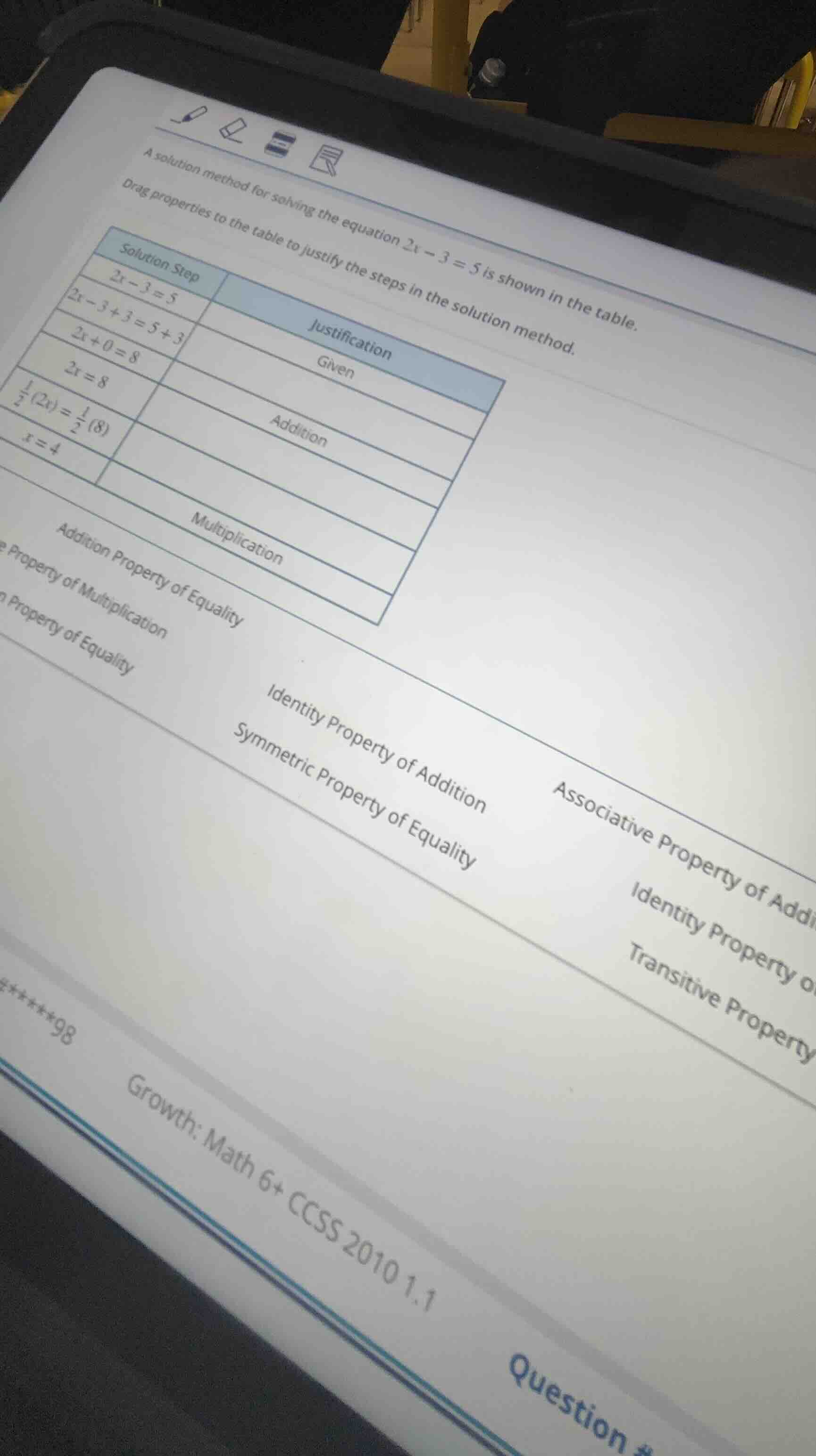
a solution method for solving the equation $2x - 3 = 5$ is shown in the table. drag properties to the table to justify the steps in the solution method. \
\
| solution step | justification | \ |
| --- | --- | \ |
| $2x - 3 = 5$ | given | \ |
| $2x - 3 + 3 = 5 + 3$ | \ | |
| $2x + 0 = 8$ | \ | |
| $2x = 8$ | \ | |
| $\frac{1}{2}(2x) = \frac{1}{2}(8)$ | \ | |
| $x = 4$ | \ |
\
properties: addition, multiplication, addition property of equality, property of multiplication, property of equality, identity property of addition, symmetric property of equality, associative property of add, identity property o, transitive property
Step1: Match step to equality property
The step $2x - 3 + 3 = 5 + 3$ uses the Addition Property of Equality (adding the same value to both sides of an equation preserves equality).
Step2: Match step to addition identity
The step $2x + 0 = 8$ uses the Identity Property of Addition (adding 0 to a number leaves it unchanged, since $-3+3=0$).
Step3: Match step to simplification
The step $2x = 8$ is a simplification of $2x+0=8$, which is justified by the Identity Property of Addition result (no new property, just restating the simplified form).
Step4: Match step to equality property
The step $\frac{1}{2}(2x) = \frac{1}{2}(8)$ uses the Multiplication Property of Equality (multiplying both sides of an equation by the same non-zero value preserves equality).
Step5: Match step to multiplication identity
The step $x = 4$ uses the Identity Property of Multiplication (multiplying a number by its reciprocal gives 1, since $\frac{1}{2} \times 2 = 1$, so $1 \times x = x$).

Snap & solve any problem in the app
Get step-by-step solutions on Sovi AI
Photo-based solutions with guided steps
Explore more problems and detailed explanations
| Solution Step | Justification |
|---|---|
| $2x - 3 + 3 = 5 + 3$ | Addition Property of Equality |
| $2x + 0 = 8$ | Identity Property of Addition |
| $2x = 8$ | Simplification (Identity Property result) |
| $\frac{1}{2}(2x) = \frac{1}{2}(8)$ | Multiplication Property of Equality |
| $x = 4$ | Identity Property of Multiplication |