QUESTION IMAGE
Question
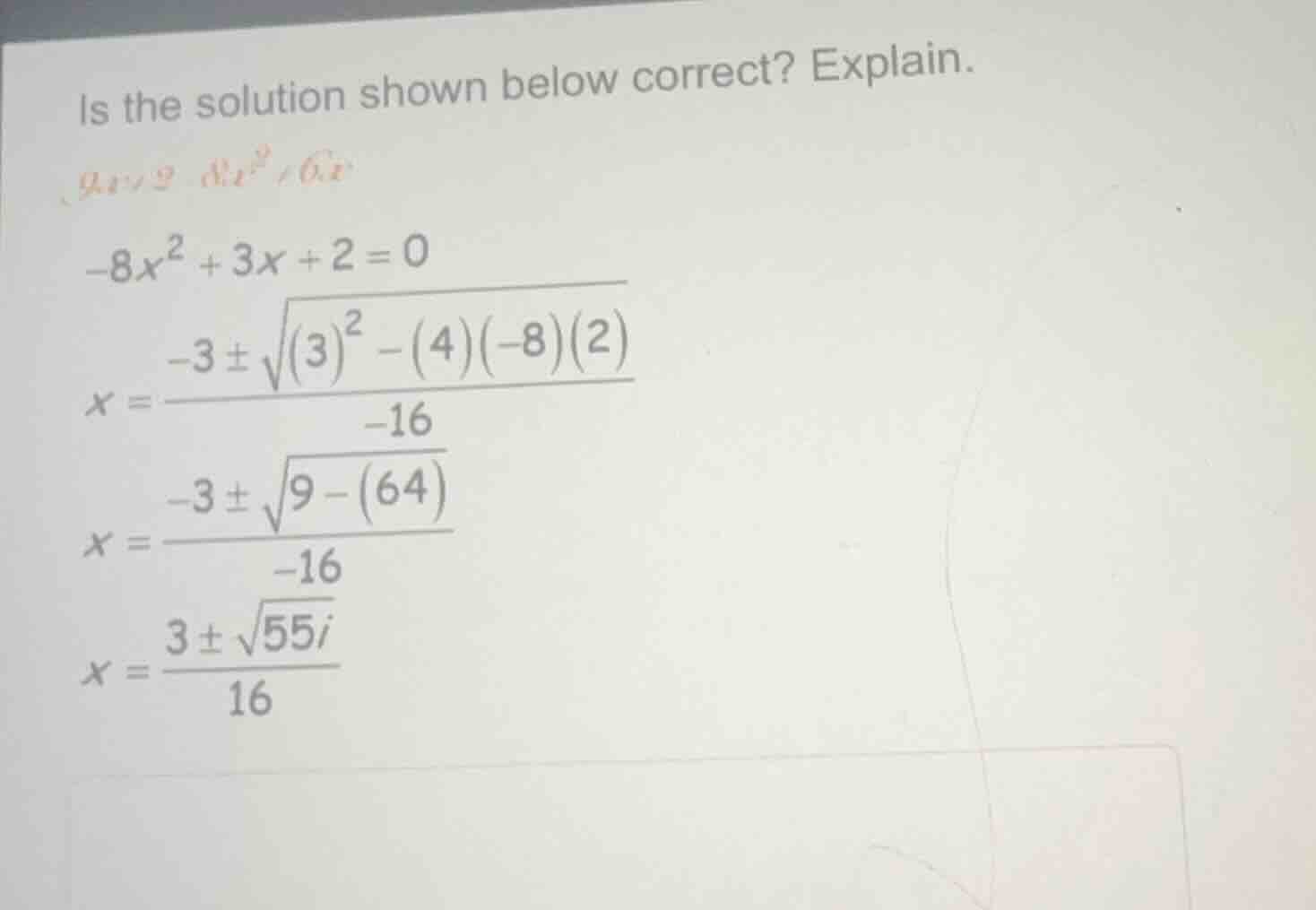
is the solution shown below correct? explain.
$-8x^2 + 3x + 2 = 0$
$x = \frac{-3 \pm \sqrt{(3)^2 - (4)(-8)(2)}}{-16}$
$x = \frac{-3 \pm \sqrt{9 - (64)}}{-16}$
$x = \frac{3 \pm \sqrt{55}i}{16}$
Step1: Recall quadratic formula
For $ax^2+bx+c=0$, $x=\frac{-b\pm\sqrt{b^2-4ac}}{2a}$
Step2: Check discriminant calculation
$b^2-4ac=(3)^2-4(-8)(2)=9+64=73$
Step3: Identify errors in given work
- Discriminant miscalculation: $9-(64)$ is wrong; it should be $9+64$.
- Final sign/imaginary error: $\sqrt{73}$ is real, no $i$ needed. Also, $\frac{-3\pm\sqrt{73}}{-16}=\frac{3\mp\sqrt{73}}{16}$, not $\frac{3\pm\sqrt{55i}}{16}$.

Snap & solve any problem in the app
Get step-by-step solutions on Sovi AI
Photo-based solutions with guided steps
Explore more problems and detailed explanations
The solution is not correct.
- The discriminant calculation has an error: $b^2-4ac = (3)^2 - 4(-8)(2) = 9 + 64 = 73$, not $9 - 64 = -55$.
- The discriminant is positive ($73>0$), so there are real solutions, not imaginary ones. The final expression incorrectly introduces an imaginary unit $i$ and uses the wrong discriminant value.
- The correct solutions are $x=\frac{3\pm\sqrt{73}}{16}$ (or equivalently $x=\frac{-3\pm\sqrt{73}}{-16}$).