QUESTION IMAGE
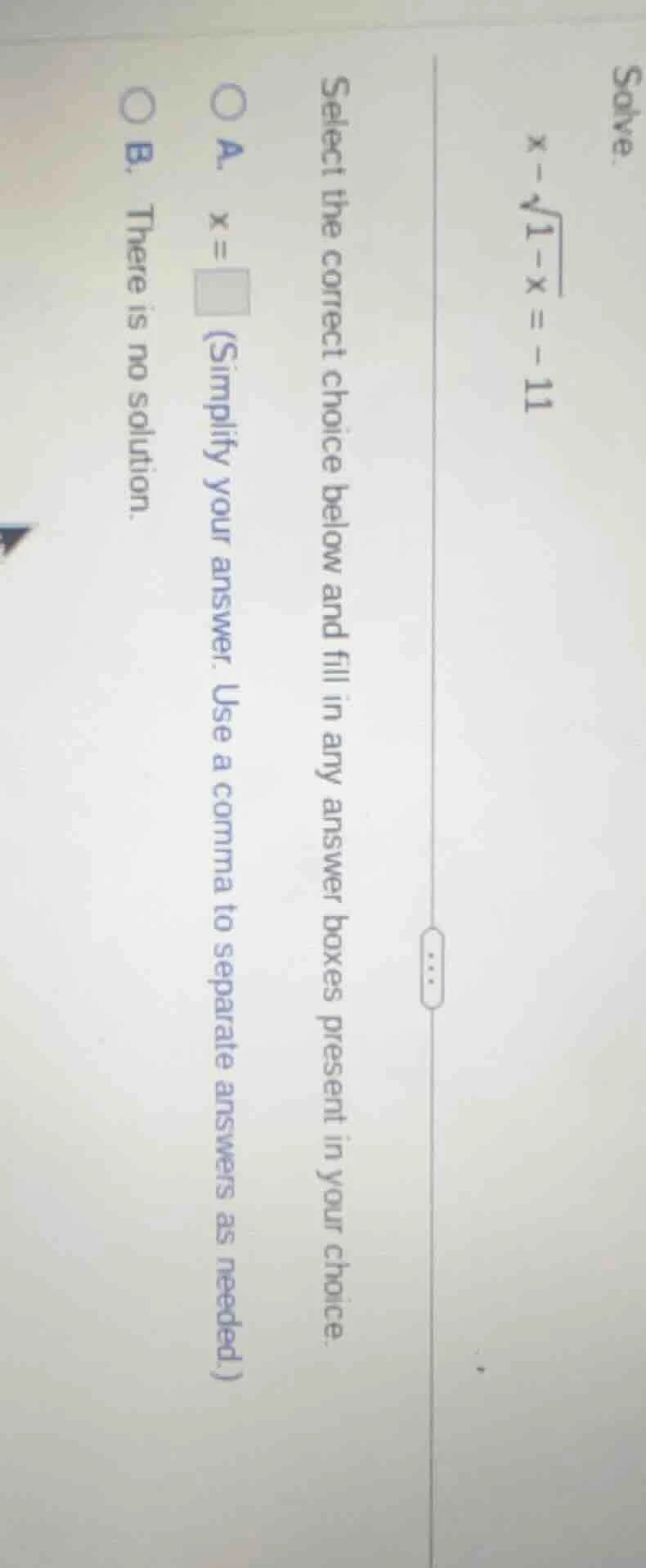
Question
solve.
x - \sqrt{1 - x} = -11
select the correct choice below and fill in any answer boxes present in your choice.
a. x = \square (simplify your answer. use a comma to separate answers as needed.)
b. there is no solution.
Step1: Isolate the square root
Start with the equation \( x - \sqrt{1 - x} = -11 \).
Add \( \sqrt{1 - x} \) to both sides and add 11 to both sides:
\( x + 11 = \sqrt{1 - x} \)
Step2: Square both sides
Square both sides to eliminate the square root:
\( (x + 11)^2 = (\sqrt{1 - x})^2 \)
Expand the left side: \( x^2 + 22x + 121 = 1 - x \)
Step3: Rearrange into quadratic equation
Bring all terms to the left side:
\( x^2 + 22x + 121 - 1 + x = 0 \)
Simplify: \( x^2 + 23x + 120 = 0 \)
Step4: Solve the quadratic equation
Factor the quadratic:
\( (x + 8)(x + 15) = 0 \)
Set each factor equal to zero:
\( x + 8 = 0 \) or \( x + 15 = 0 \)
So \( x = -8 \) or \( x = -15 \)
Step5: Check for extraneous solutions
Check \( x = -8 \):
Left side of original equation: \( -8 - \sqrt{1 - (-8)} = -8 - \sqrt{9} = -8 - 3 = -11 \), which matches the right side. Wait, but wait, let's check the domain of the square root: \( 1 - x \geq 0 \implies x \leq 1 \). Both -8 and -15 are ≤1. Wait, but wait, when we squared, we might have extraneous solutions. Wait, let's check \( x = -15 \):
Left side: \( -15 - \sqrt{1 - (-15)} = -15 - \sqrt{16} = -15 - 4 = -19
eq -11 \). So \( x = -15 \) is extraneous.
Wait, but wait, when we checked \( x = -8 \), we got -11, which is correct. But wait, hold on, let's re-examine the original equation: \( x - \sqrt{1 - x} = -11 \). If \( x = -8 \), then \( -8 - \sqrt{9} = -8 - 3 = -11 \), which is correct. But wait, the problem is, when we squared, we might have introduced a solution, but in this case, \( x = -8 \) is valid? Wait, no, wait, the domain is \( x \leq 1 \), which -8 is. But wait, let's check again. Wait, the original equation: \( x - \sqrt{1 - x} = -11 \). If \( x = -8 \), then \( -8 - 3 = -11 \), which is correct. But wait, the answer options: A is x=..., B is no solution. Wait, but maybe I made a mistake. Wait, let's check the quadratic solution again. Wait, \( x^2 + 23x + 120 = 0 \). Discriminant: \( 23^2 - 4*1*120 = 529 - 480 = 49 \). Square root of 49 is 7. So solutions: \( x = \frac{-23 \pm 7}{2} \). So \( \frac{-23 + 7}{2} = \frac{-16}{2} = -8 \), \( \frac{-23 - 7}{2} = \frac{-30}{2} = -15 \). Then checking \( x = -15 \): \( -15 - \sqrt{1 - (-15)} = -15 - \sqrt{16} = -15 - 4 = -19
eq -11 \). So \( x = -15 \) is extraneous. \( x = -8 \) is valid? Wait, but the answer options: A is x=..., B is no solution. But according to the calculation, \( x = -8 \) is a solution. But wait, maybe I made a mistake. Wait, let's re-express the original equation: \( x - \sqrt{1 - x} = -11 \implies \sqrt{1 - x} = x + 11 \). The right side \( x + 11 \) must be non-negative because it's equal to a square root (which is non-negative). So \( x + 11 \geq 0 \implies x \geq -11 \). So \( x = -8 \) is ≥ -11, and \( x = -15 \) is < -11, so \( x = -15 \) is invalid because the right side would be negative, but the square root is non-negative. So \( x = -8 \) is valid. But wait, the answer options: A is x=..., B is no solution. But according to the calculation, \( x = -8 \) is a solution. But maybe the problem is that when we squared, we have to check the sign. Wait, the square root is non-negative, so \( \sqrt{1 - x} \geq 0 \), so \( x + 11 \geq 0 \implies x \geq -11 \). \( x = -8 \) is ≥ -11, so it's valid. So the solution is \( x = -8 \). But wait, the original problem's options: A is x=..., B is no solution. So the correct answer is A, with \( x = -8 \). Wait, but maybe I made a mistake. Wait, let's check again. Original equation: \( x - \sqrt{1 - x} = -11 \). If \( x = -8 \), then \( -8 - \sqrt{9} = -8 - 3 = -11 \), which is…

Snap & solve any problem in the app
Get step-by-step solutions on Sovi AI
Photo-based solutions with guided steps
Explore more problems and detailed explanations
A. \( x = -8 \)