QUESTION IMAGE
Question
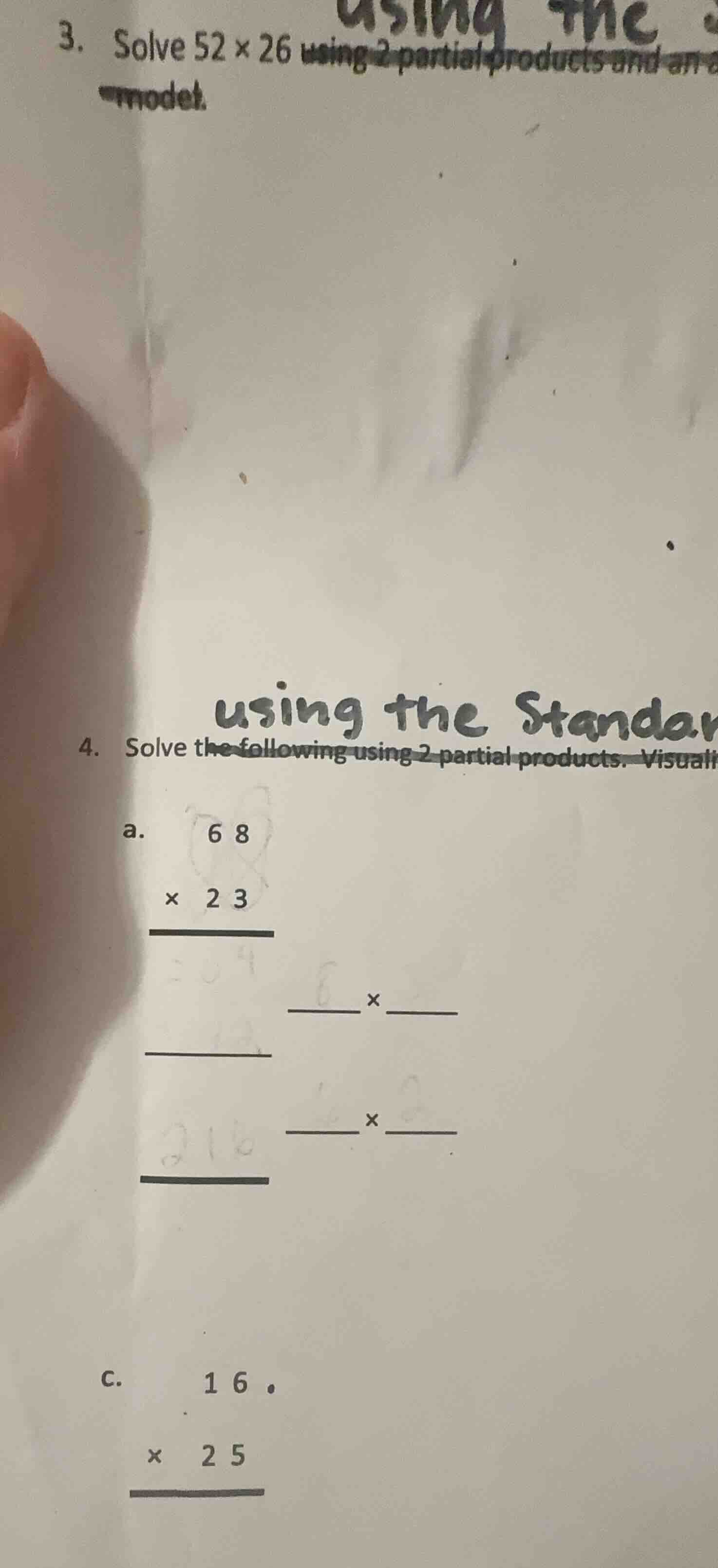
- solve 52 × 26 using 2 partial products and an area model.
- solve the following using 2 partial products. visualize
a.
68
× 23
______
__ × __
______
__ × __
______
c.
16
× 25
______
3. Solve \( 52 \times 26 \) using partial products and an area model.
Step 1: Decompose the numbers
Decompose \( 52 \) into \( 50 + 2 \) and \( 26 \) into \( 20 + 6 \).
Step 2: Find partial products (area model)
- Multiply \( 50 \times 20 = 1000 \) (area of the large rectangle)
- Multiply \( 50 \times 6 = 300 \) (area of one smaller rectangle)
- Multiply \( 2 \times 20 = 40 \) (area of another smaller rectangle)
- Multiply \( 2 \times 6 = 12 \) (area of the smallest rectangle)
Step 3: Sum the partial products
Add all the partial products: \( 1000 + 300 + 40 + 12 = 1352 \)
Step 1: Decompose the numbers
Decompose \( 68 \) into \( 60 + 8 \) and \( 23 \) into \( 20 + 3 \). We will use two partial products (multiplying by the tens and then the ones, or vice versa). Let's use multiplying \( 68 \) by \( 20 \) and \( 68 \) by \( 3 \).
Step 2: Calculate first partial product
Multiply \( 68 \times 20 \). \( 68 \times 20 = 1360 \) (this can also be thought of as \( 60 \times 20 + 8 \times 20 = 1200 + 160 = 1360 \))
Step 3: Calculate second partial product
Multiply \( 68 \times 3 \). \( 68 \times 3 = 204 \) (this can also be thought of as \( 60 \times 3 + 8 \times 3 = 180 + 24 = 204 \))
Step 4: Sum the partial products
Add the two partial products: \( 1360 + 204 = 1564 \)
For the blanks (if we decompose \( 23 \) into \( 20 + 3 \) and multiply each by \( 68 \)):
- First partial product: \( 68 \times 20 \)
- Second partial product: \( 68 \times 3 \)
Or if we decompose \( 68 \) into \( 60 + 8 \) and \( 23 \) into \( 20 + 3 \), and take two partial products (e.g., \( 60 \times 23 \) and \( 8 \times 23 \)):
- First partial product: \( 60 \times 23 = 1380 \)
- Second partial product: \( 8 \times 23 = 184 \)
Then \( 1380 + 184 = 1564 \)
Step 1: Decompose the numbers
Decompose \( 16 \) into \( 10 + 6 \) and \( 25 \) is already a whole number, or decompose \( 25 \) into \( 20 + 5 \) and multiply by \( 16 \). Let's use decomposing \( 25 \) into \( 20 + 5 \).
Step 2: Find partial products
- Multiply \( 16 \times 20 = 320 \)
- Multiply \( 16 \times 5 = 80 \)
Step 3: Sum the partial products
Add the partial products: \( 320 + 80 = 400 \)

Snap & solve any problem in the app
Get step-by-step solutions on Sovi AI
Photo-based solutions with guided steps
Explore more problems and detailed explanations
\( 52 \times 26 = 1352 \)