QUESTION IMAGE
Question
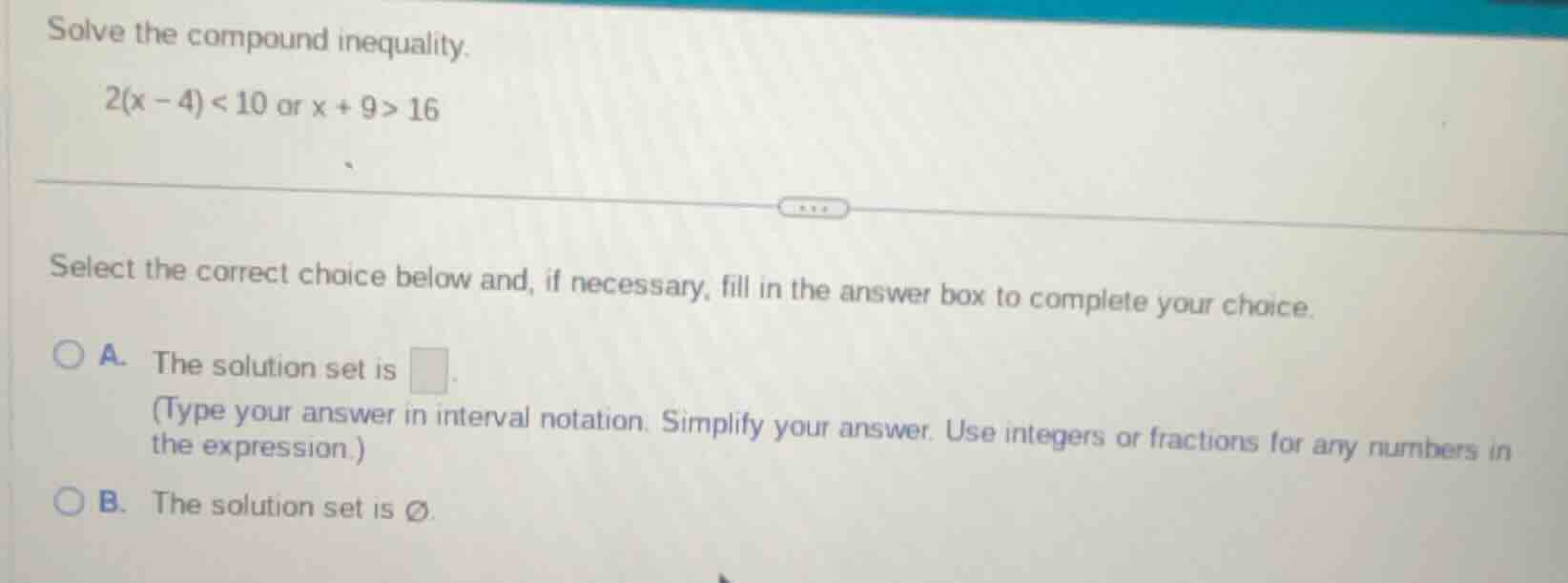
solve the compound inequality.
2(x - 4) < 10 or x + 9 > 16
select the correct choice below and, if necessary, fill in the answer box to complete your choice.
a. the solution set is
(type your answer in interval notation. simplify your answer. use integers or fractions for any numbers in the expression.)
b. the solution set is ∅.
Step1: Solve the first inequality \(2(x - 4) < 10\)
Divide both sides by 2: \(x - 4 < 5\)
Add 4 to both sides: \(x < 9\)
Step2: Solve the second inequality \(x + 9 > 16\)
Subtract 9 from both sides: \(x > 7\)
Step3: Combine the solutions for "or" compound inequality
For an "or" compound inequality, the solution set is the union of the two solution sets. The first solution is \(x < 9\) and the second is \(x > 7\). The union of all real numbers less than 9 and all real numbers greater than 7 is all real numbers (since every real number is either less than 9 or greater than 7, or both). In interval notation, this is \((-\infty, \infty)\). Wait, no, wait. Wait, no, let's re - check. Wait, the first inequality: \(2(x - 4)<10\) gives \(x - 4 < 5\) so \(x < 9\). The second inequality \(x + 9>16\) gives \(x>7\). The "or" means that a number is in the solution set if it satisfies either of the inequalities. So the solution set is all real numbers because any real number is either less than 9 or greater than 7 (in fact, most numbers are both, but even numbers like \(x = 10\) satisfy \(x>7\), \(x = 5\) satisfy \(x < 9\), and \(x = 8\) satisfies both). Wait, but let's do it again.
Wait, first inequality:
\(2(x - 4)<10\)
Divide both sides by 2: \(x - 4 < 5\)
Add 4: \(x < 9\)
Second inequality:
\(x+9 > 16\)
Subtract 9: \(x>7\)
The compound inequality is \(x < 9\) or \(x>7\). The solution to "or" is the set of all numbers that are in either of the two sets. The set \(\{x|x < 9\}\) and \(\{x|x>7\}\) together cover all real numbers because for any real number \(r\), if \(r\leqslant7\), then \(r < 9\) (so it's in the first set), if \(7 < r<9\), it's in both sets, and if \(r\geqslant9\), then \(r > 7\) (so it's in the second set). So the solution set is all real numbers, which in interval notation is \((-\infty, \infty)\).
Wait, but maybe I made a mistake. Let's take a number like \(x = 10\): \(2(10 - 4)=12\), \(12<10\)? No, \(12>10\), but \(x = 10\) satisfies \(x + 9=19>16\), so it's in the solution set. \(x = 5\): \(2(5 - 4)=2<10\), so it's in the solution set. \(x = 8\): \(2(8 - 4)=8<10\) and \(8 + 9 = 17>16\), so it's in the solution set. \(x=100\): satisfies \(x>7\), \(x=- 10\): satisfies \(x < 9\). So yes, all real numbers are in the solution set.

Snap & solve any problem in the app
Get step-by-step solutions on Sovi AI
Photo-based solutions with guided steps
Explore more problems and detailed explanations
The solution set is \((-\infty, \infty)\) (so option A, with the answer in interval notation as \((-\infty, \infty)\))