QUESTION IMAGE
Question
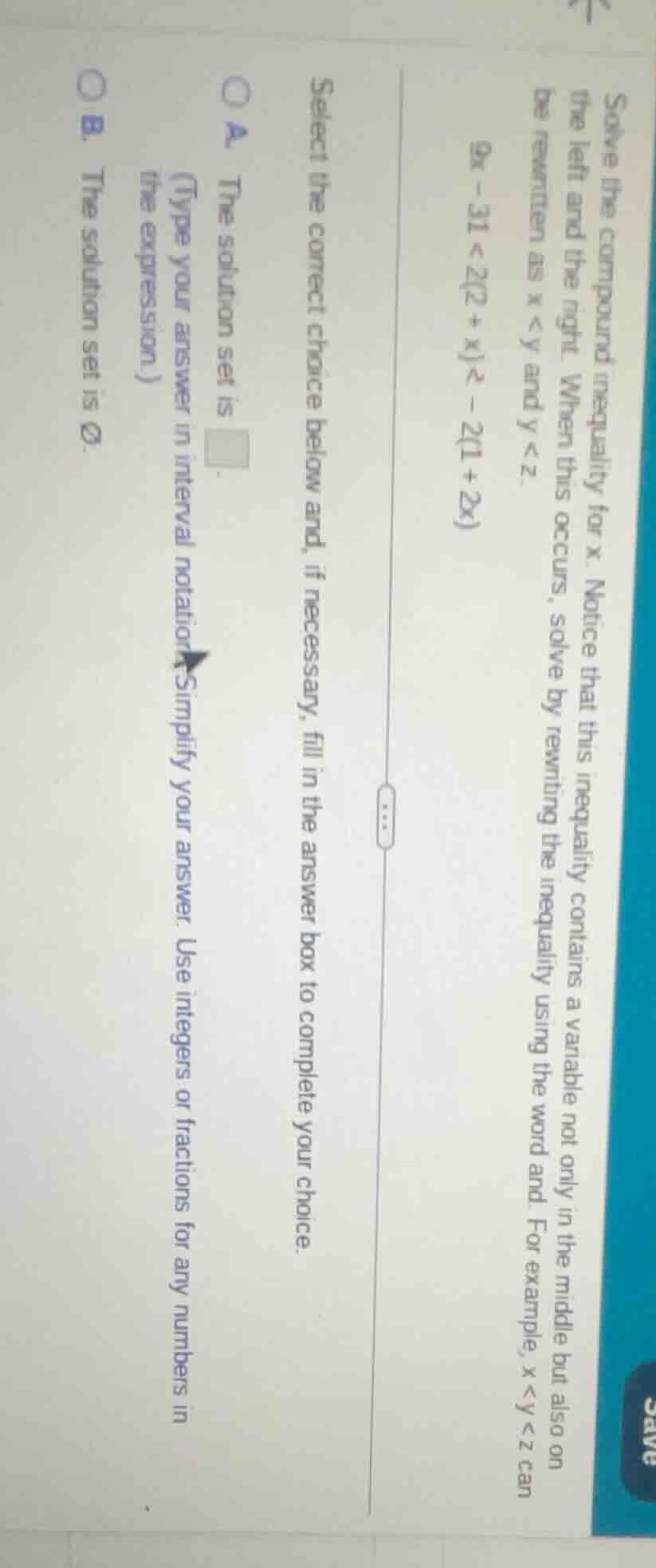
solve the compound inequality for x. notice that this inequality contains a variable not only in the middle but also on the left and the right. when this occurs, solve by rewriting the inequality using the word and. for example, x < y and y < z can be rewritten as x < y < z.
6x - 31 < 2(2 + x) - 2(1 + 2x)
select the correct choice below and, if necessary, fill in the answer box to complete your choice.
a. the solution set is
(type your answer in interval notation. simplify your answer. use integers or fractions for any numbers in the expression.)
b. the solution set is ∅.
Step1: Simplify the right side
First, expand the right - hand side of the inequality \(9x - 31<2(2 + x)-2(1 + 2x)\).
Using the distributive property \(a(b + c)=ab+ac\), we have:
\(2(2 + x)=4 + 2x\) and \(-2(1 + 2x)=-2-4x\).
Then \(2(2 + x)-2(1 + 2x)=(4 + 2x)+(-2-4x)=4 + 2x-2-4x=2 - 2x\).
So the inequality becomes \(9x-31 < 2-2x\).
Step2: Move all x terms to the left and constants to the right
Add \(2x\) to both sides of the inequality: \(9x+2x-31<2-2x + 2x\), which simplifies to \(11x-31 < 2\).
Then add 31 to both sides: \(11x-31 + 31<2 + 31\), so \(11x<33\).
Step3: Solve for x
Divide both sides of the inequality \(11x<33\) by 11: \(\frac{11x}{11}<\frac{33}{11}\), which gives \(x < 3\).
But we also need to check if there are other conditions. Wait, the original problem seems to be a compound inequality, but the given inequality is \(9x - 31<2(2 + x)-2(1 + 2x)\) (maybe there was a mis - transcription, but based on the given expression, we solved the single inequality). Wait, if we assume that the compound inequality was supposed to be something like \(a<9x - 31<2(2 + x)-2(1 + 2x)\), but from the given problem, we only have \(9x - 31<2(2 + x)-2(1 + 2x)\). After solving, we get \(x < 3\). In interval notation, the solution set is \((-\infty,3)\). But wait, maybe I misread the problem. Wait, the user's problem says "compound inequality", but the given inequality is \(9x - 31<2(2 + x)-2(1 + 2x)\). Let's re - check the expansion:
\(2(2 + x)=4 + 2x\), \(-2(1 + 2x)=-2-4x\). Then \(4 + 2x-2-4x=2-2x\). So \(9x-31<2 - 2x\).
\(9x + 2x<2 + 31\)
\(11x<33\)
\(x < 3\). So the solution set in interval notation is \((-\infty,3)\).
Wait, but maybe the original compound inequality was supposed to have two parts, but the given problem's right - hand side is \(2(2 + x)-2(1 + 2x)\) and maybe the left - hand side was missing. But based on the given expression \(9x - 31<2(2 + x)-2(1 + 2x)\), we solve it as above.

Snap & solve any problem in the app
Get step-by-step solutions on Sovi AI
Photo-based solutions with guided steps
Explore more problems and detailed explanations
The solution set is \((-\infty,3)\)