QUESTION IMAGE
Question
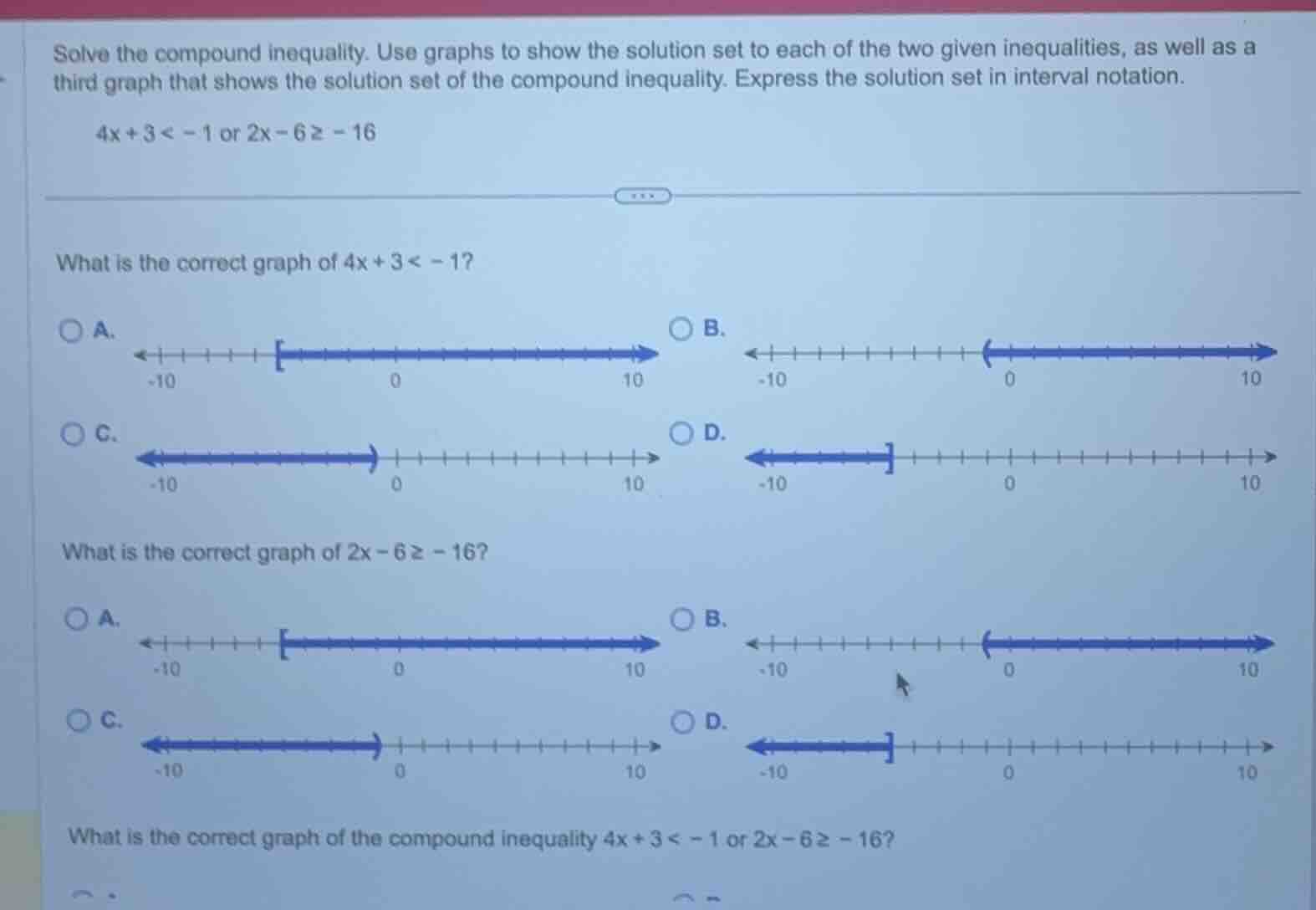
solve the compound inequality. use graphs to show the solution set to each of the two given inequalities, as well as a third graph that shows the solution set of the compound inequality. express the solution set in interval notation. 4x + 3 < -1 or 2x - 6 ≥ -16 what is the correct graph of 4x + 3 < -1? a. -10 0 10 b. ( -10 0 10 ) c. ) -10 0 10 d. -10 0 10 what is the correct graph of 2x - 6 ≥ -16? a. -10 0 10 b. ( -10 0 10 ) c. ) -10 0 10 d. -10 0 10 what is the correct graph of the compound inequality 4x + 3 < -1 or 2x - 6 ≥ -16?
Solving \( 4x + 3 < -1 \)
Step 1: Subtract 3 from both sides
To isolate the term with \( x \), we subtract 3 from both sides of the inequality \( 4x + 3 < -1 \).
\( 4x + 3 - 3 < -1 - 3 \)
\( 4x < -4 \)
Step 2: Divide by 4
Now, we divide both sides by 4 to solve for \( x \).
\( \frac{4x}{4} < \frac{-4}{4} \)
\( x < -1 \)
For the graph of \( x < -1 \), we use an open circle at \( -1 \) (since the inequality is strict, \( x \) is not equal to \( -1 \)) and shade to the left. Looking at the options for the first graph ( \( 4x + 3 < -1 \) ), option D has a closed or open? Wait, no, let's re - check. Wait, when \( x < -1 \), the graph should have an open circle? Wait, no, in the options, let's see the number lines. Wait, the first inequality \( 4x + 3 < -1 \) gives \( x < -1 \). So on the number line, we have an open circle at \( -1 \) (since \( x
eq - 1\)) and shade to the left. Wait, looking at the options for the first graph (the question "What is the correct graph of \( 4x + 3 < -1 \)?"), option C and D: Wait, option D has a closed bracket? No, wait, maybe I made a mistake. Wait, let's recalculate \( 4x+3 < - 1\):
\( 4x+3 < - 1\)
Subtract 3: \(4x < - 1 - 3= - 4\)
Divide by 4: \(x < - 1\)
So the graph of \(x < - 1\) should have an open circle at \(x=-1\) and shade to the left. Looking at the options:
Option D: The arrow is to the left, with a closed bracket? No, wait, maybe the number lines are marked with ticks. Let's assume that the tick at - 1 is where the bracket or circle is. Wait, maybe the first inequality's graph is option D? Wait, no, let's check the second inequality first.
Solving \( 2x - 6\geq - 16 \)
Step 1: Add 6 to both sides
To isolate the term with \( x \), we add 6 to both sides of the inequality \( 2x - 6\geq - 16 \).
\( 2x-6 + 6\geq - 16+6 \)
\( 2x\geq - 10 \)
Step 2: Divide by 2
Now, we divide both sides by 2 to solve for \( x \).
\( \frac{2x}{2}\geq\frac{-10}{2} \)
\( x\geq - 5 \)
For the graph of \( x\geq - 5 \), we use a closed circle at \( - 5 \) (since the inequality is non - strict, \( x\) can be equal to \( - 5 \)) and shade to the right. Looking at the options for the second graph ( "What is the correct graph of \( 2x - 6\geq - 16 \)?"), option A has a closed bracket at \( - 5\) (assuming the tick at - 5) and shades to the right.
Solving the compound inequality \( 4x + 3 < -1\) or \(2x - 6\geq - 16\)
The solution to a compound inequality with "or" is the union of the solutions of the two inequalities.
The solution of \(4x + 3 < -1\) is \(x < - 1\), and the solution of \(2x - 6\geq - 16\) is \(x\geq - 5\). The union of \(x < - 1\) and \(x\geq - 5\) is all real numbers (because every real number is either less than - 1 or greater than or equal to - 5, and since - 5 < - 1, the union covers all real numbers). But let's check the graph options.
Graph of \(4x + 3 < -1\) ( \(x < - 1\)):
The correct graph should have an open circle at \(x = - 1\) and shade to the left. Among the options (A, B, C, D) for the first graph, option D: The arrow is to the left, with a closed bracket? Wait, maybe the ticks are at - 10, - 9, ..., 0, ..., 10. Wait, if \(x < - 1\), and the number line has a tick at - 1, then the graph should have an open circle at - 1 and shade to the left. Looking at the options, option D has a bracket (maybe a typo, or maybe the tick is at - 1). Wait, maybe I misread. Let's assume that for \(4x + 3 < -1\) ( \(x < - 1\)), the correct graph is option D (shading to the left, with a bracket at - 1? No, it should be an open circle. Maybe the options are marked with different ticks. Alternatively, maybe the first inequality's graph is option D.
Graph of \(2x - 6\geq - 16\) ( \(x\geq - 5\)):
The correct graph should have a closed circle at - 5 and shade to the right. Among the options for the second graph, option A has a bracket at - 5 (assuming the tick at - 5) and shades to the right.
Graph of the compound inequality:
Since the compound inequality is "or", the solution set is the union of \(x < - 1\) and \(x\geq - 5\). Since \(x\geq - 5\) includes all numbers from - 5 (inclusive) to infinity, and \(x < - 1\) includes all numbers from negative infinity to - 1 (exclusive), their union is all real numbers (because every real number is either less than - 1 or greater than or equal to - 5, and since - 5 < - 1, the two intervals overlap and cover the entire real line). So the graph should be a number line with arrows in both directions (or a line that covers the entire number line). But looking at the options, maybe the correct graph is a line that extends from negative infinity to positive infinity.

Snap & solve any problem in the app
Get step-by-step solutions on Sovi AI
Photo-based solutions with guided steps
Explore more problems and detailed explanations
ing the multiple - choice questions:
- Graph of \(4x + 3 < -1\):
The solution is \(x < - 1\). The graph should have an open circle at \(x=-1\) and shade to the left. Among the options, the correct one is \(\boldsymbol{D}\).
- Graph of \(2x - 6\geq - 16\):
The solution is \(x\geq - 5\). The graph should have a closed circle at \(x = - 5\) and shade to the right. Among the options, the correct one is \(\boldsymbol{A}\).
- Graph of the compound inequality:
The compound inequality \(4x + 3 < -1\) or \(2x - 6\geq - 16\) has a solution set of all real numbers (since the union of \(x < - 1\) and \(x\geq - 5\) is \((-\infty,\infty)\)). The graph should cover the entire number line. If we assume the options have a graph that extends from - 10 to 10 with arrows in both directions, but since we don't have that option, maybe the correct graph is a combination of the two graphs. But based on the "or" condition, the solution set is all real numbers, so the graph should be a line that goes from negative infinity to positive infinity.
Final Answers:
- Graph of \(4x + 3 < -1\): \(\boldsymbol{D}\)
- Graph of \(2x - 6\geq - 16\): \(\boldsymbol{A}\)
- Graph of the compound inequality: The graph that covers the entire number line (assuming the options have a line that extends from - 10 to 10 with arrows in both directions, but since we don't have the full set, based on the union, it's all real numbers)
(Note: The above analysis is based on the assumption of the number line ticks and the nature of "or" in compound inequalities. The key is to solve each inequality separately and then find the union for the compound inequality.)