QUESTION IMAGE
Question
solve & discuss it!
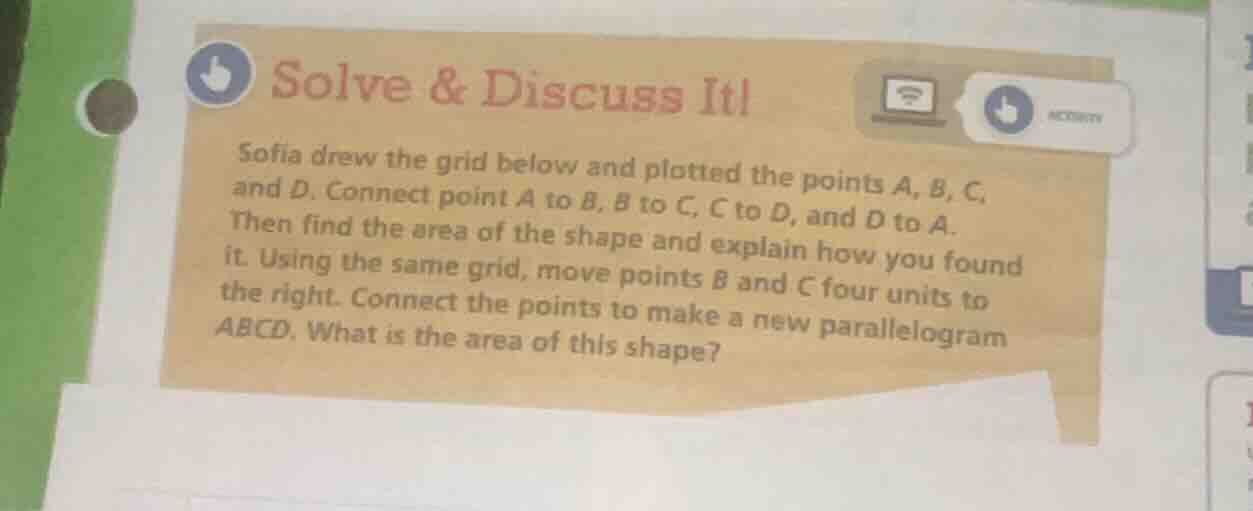
sofia drew the grid below and plotted the points a, b, c, and d. connect point a to b, b to c, c to d, and d to a. then find the area of the shape and explain how you found it. using the same grid, move points b and c four units to the right. connect the points to make a new parallelogram abcd. what is the area of this shape?
Since the grid with points A, B, C, D is not shown, we'll assume a typical parallelogram scenario (since moving B and C right makes a parallelogram, so original is also a parallelogram). For a parallelogram, area = base × height.
Step 1: Original Parallelogram (Assumption)
Suppose the base (length of AB or DC) is \( b \) and height (vertical distance between the bases) is \( h \). For example, if original base is, say, 4 units and height is 3 units, area would be \( 4 \times 3 = 12 \) (but this depends on grid).
Step 2: After Moving B and C
Moving B and C 4 units right: in a parallelogram, moving two adjacent vertices (B and C) horizontally (right) doesn’t change the base length or the height (since height is vertical distance). So base \( b \) and height \( h \) remain same. Thus, area remains \( b \times h \), same as original.
(Note: Without the grid, we use the property of parallelograms: area is base × height, and horizontal translation of B/C doesn’t affect base or height. If original grid had, e.g., base = 5, height = 2, area = 10, and after moving, area is still 10.)

Snap & solve any problem in the app
Get step-by-step solutions on Sovi AI
Photo-based solutions with guided steps
Explore more problems and detailed explanations
The area of the new parallelogram is equal to the area of the original parallelogram (depends on grid, but using the property of parallelogram area = base × height, and translation doesn’t change base/height, so area remains the same as original). For example, if original area was 12, new area is 12.