QUESTION IMAGE
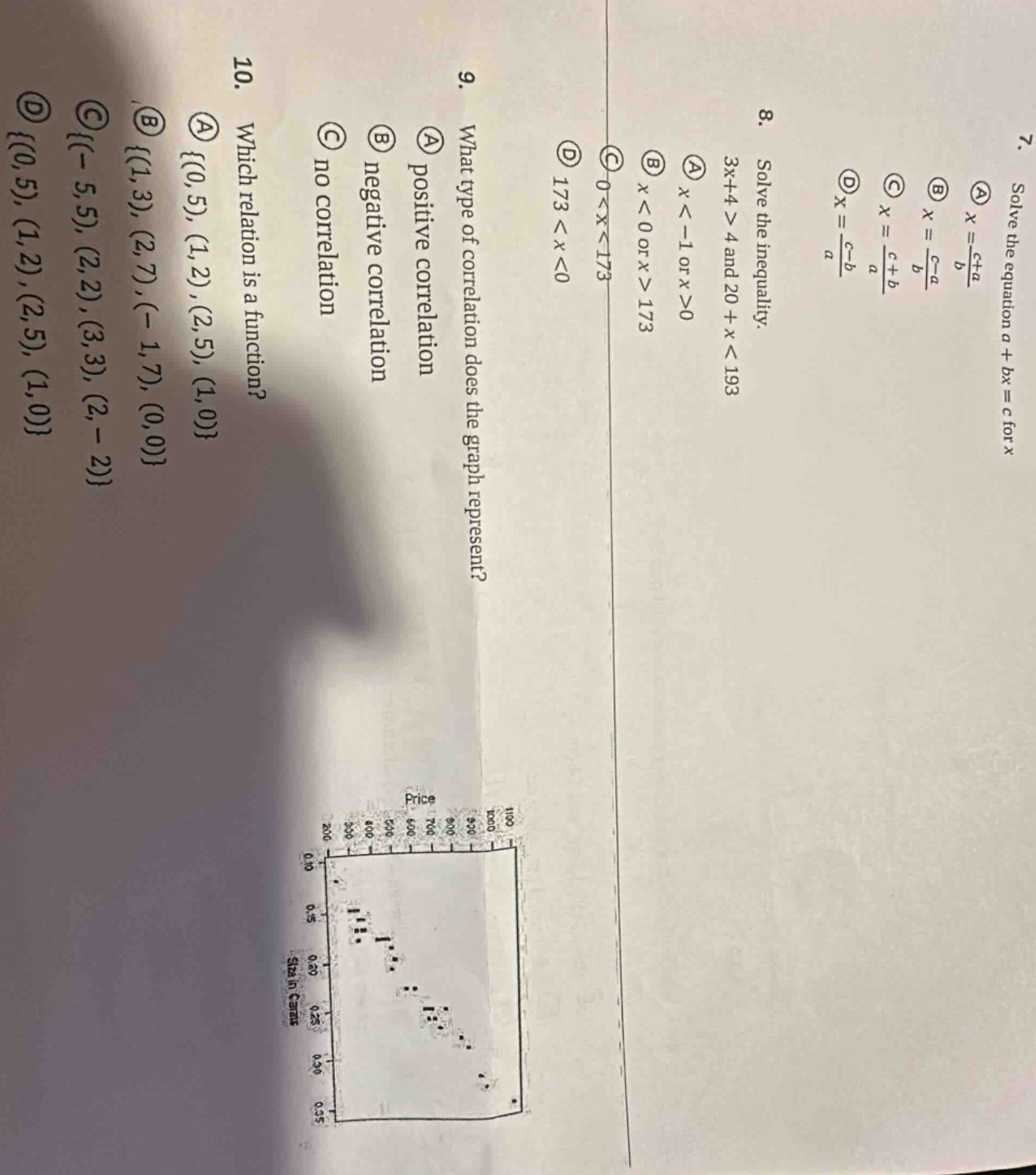
Question
- solve the equation ( a + bx = c ) for ( x )
a ( x = \frac{c + a}{b} )
b ( x = \frac{c - a}{b} )
c ( x = \frac{c + b}{a} )
d ( x = \frac{c - b}{a} )
- solve the inequality. ( 3x + 4 > 4 ) and ( 20 + x < 193 )
a ( x < -1 ) or ( x > 0 )
b ( x < 0 ) or ( x > 173 )
c ( 0 < x < 173 )
d ( 173 < x < 0 )
- what type of correlation does the graph represent?
(there is a scatter plot with price on one axis and size in years on the other, with points showing a trend)
a positive correlation
b negative correlation
c no correlation
- which relation is a function?
a ( {(0, 5), (1, 2), (2, 5), (1, 0)} )
b ( {(1, 3), (2, 7), (-1, 7), (0, 0)} )
c ( {(-5, 5), (2, 2), (3, 3), (2, -2)} )
d ( {(0, 5), (1, 2), (2, 5), (1, 0)} )
Question 7
Step1: Isolate the x term
$a + bx = c \implies bx = c - a$
Step2: Solve for x
$x = \frac{c - a}{b}$
Step1: Split the compound inequality
We have two inequalities: $3x + 4 > 4$ and $20 + x < 193$
Step2: Solve first inequality
$3x + 4 > 4 \implies 3x > 0 \implies x > 0$
Step3: Solve second inequality
$20 + x < 193 \implies x < 193 - 20 \implies x < 173$
Step4: Combine the solutions
$0 < x < 173$
The scatter plot shows that as the x-axis value increases, the y-axis value decreases. This pattern defines a negative correlation.

Snap & solve any problem in the app
Get step-by-step solutions on Sovi AI
Photo-based solutions with guided steps
Explore more problems and detailed explanations
$\boldsymbol{B.\ x = \frac{c-a}{b}}$
---