QUESTION IMAGE
Question
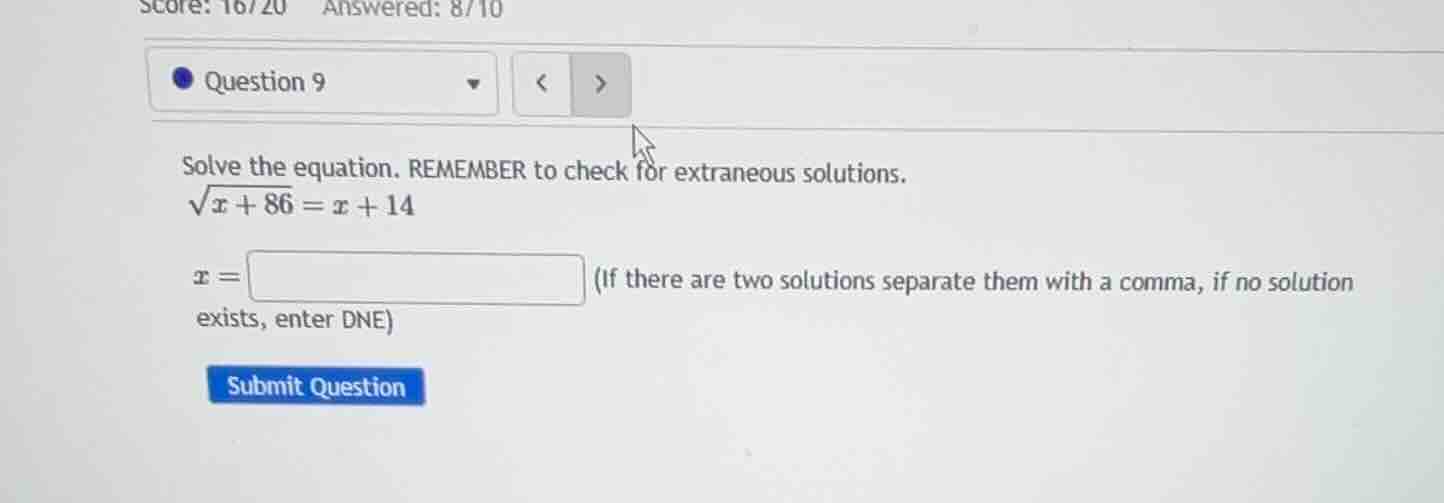
solve the equation. remember to check for extraneous solutions. (sqrt{x + 86} = x + 14) (x =) (if there are two solutions separate them with a comma, if no solution exists, enter dne)
Step1: Square both sides to eliminate the square root
To solve the equation \(\sqrt{x + 86}=x + 14\), we first square both sides. Squaring the left side \((\sqrt{x + 86})^2\) gives \(x + 86\), and squaring the right side \((x + 14)^2\) using the formula \((a + b)^2=a^2+2ab + b^2\) (where \(a = x\) and \(b = 14\)) gives \(x^2+28x + 196\). So we get the equation:
\[x + 86=x^2+28x + 196\]
Step2: Rearrange into standard quadratic form
Subtract \(x\) and \(86\) from both sides to set the equation to zero:
\[x^2+27x + 110 = 0\]
Step3: Factor the quadratic equation
We need to find two numbers that multiply to \(110\) and add up to \(27\). The numbers are \(2\) and \(55\)? Wait, no, \(2\times55 = 110\) and \(2 + 55=57\), that's not right. Wait, \(10\times11 = 110\) and \(10+11 = 21\), no. Wait, maybe I made a mistake in step 2. Let's go back.
From \(x + 86=x^2+28x + 196\), subtract \(x\) and \(86\) from both sides:
\(x^2+28x - x+196 - 86=0\)
\(x^2 + 27x+110 = 0\). Wait, maybe factoring is not easy, let's use quadratic formula. The quadratic formula for \(ax^2+bx + c = 0\) is \(x=\frac{-b\pm\sqrt{b^2 - 4ac}}{2a}\). Here, \(a = 1\), \(b = 27\), \(c = 110\).
First, calculate the discriminant \(D=b^2-4ac=(27)^2-4\times1\times110=729 - 440 = 289\).
Then \(x=\frac{-27\pm\sqrt{289}}{2\times1}=\frac{-27\pm17}{2}\).
So we have two solutions:
\(x_1=\frac{-27 + 17}{2}=\frac{-10}{2}=- 5\)
\(x_2=\frac{-27-17}{2}=\frac{-44}{2}=-22\)
Step4: Check for extraneous solutions
Now we need to check these solutions in the original equation \(\sqrt{x + 86}=x + 14\) because squaring both sides can introduce extraneous solutions.
For \(x=-5\):
Left side: \(\sqrt{-5 + 86}=\sqrt{81}=9\)
Right side: \(-5 + 14 = 9\)
So \(x = - 5\) is a valid solution.
For \(x=-22\):
Left side: \(\sqrt{-22 + 86}=\sqrt{64}=8\)
Right side: \(-22 + 14=-8\)
Since \(8
eq - 8\), \(x=-22\) is an extraneous solution.

Snap & solve any problem in the app
Get step-by-step solutions on Sovi AI
Photo-based solutions with guided steps
Explore more problems and detailed explanations
\(-5\)