QUESTION IMAGE
Question
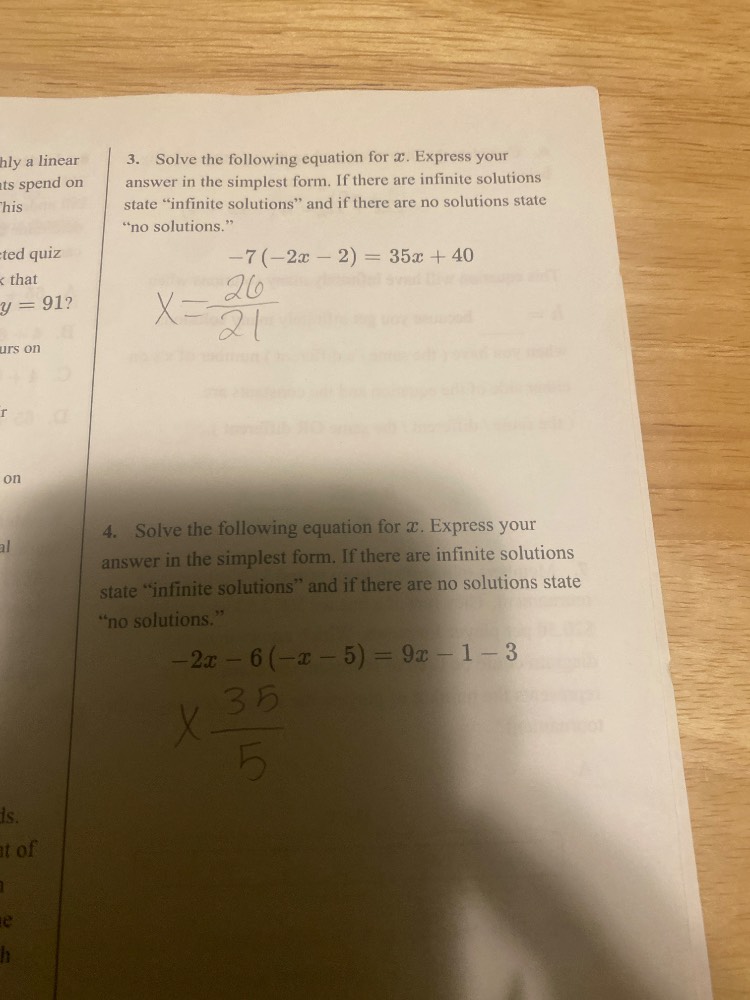
- solve the following equation for ( x ). express your answer in the simplest form. if there are infinite solutions state \infinite solutions\ and if there are no solutions state
o solutions.\
( -7(-2x - 2) = 35x + 40 )
- solve the following equation for ( x ). express your answer in the simplest form. if there are infinite solutions state \infinite solutions\ and if there are no solutions state
o solutions.\
( -2x - 6(-x - 5) = 9x - 1 - 3 )
Problem 3:
Step 1: Distribute the -7
We start by applying the distributive property to the left side of the equation \(-7(-2x - 2)\). The distributive property states that \(a(b + c)=ab+ac\), so here \(a = - 7\), \(b=-2x\) and \(c = - 2\).
\[
\]
So the equation becomes \(14x + 14=35x + 40\).
Step 2: Move all x terms to one side
Subtract \(14x\) from both sides of the equation:
\[
14x+14 - 14x=35x + 40-14x
\]
Simplifying both sides, we get \(14 = 21x+40\).
Step 3: Move constant terms to the other side
Subtract 40 from both sides:
\[
14-40=21x + 40-40
\]
Simplifying, we have \(- 26=21x\) (Wait, there was a mistake in the original hand - written answer. Let's correct it). Wait, \(14 - 40=-26\), so \(-26 = 21x\), then \(x=-\frac{26}{21}=-\frac{2\times13}{3\times7}\), but let's re - do the steps correctly.
Wait, original equation: \(-7(-2x - 2)=35x + 40\)
Step 1: Distribute \(-7\): \(14x+14 = 35x+40\)
Step 2: Subtract \(14x\) from both sides: \(14=21x + 40\)
Step 3: Subtract 40 from both sides: \(14 - 40=21x\)
\(-26 = 21x\)
\(x=-\frac{26}{21}\)
Wait, the hand - written answer was \(x = \frac{26}{21}\) with a negative sign missing. Let's do it again:
Starting over:
Equation: \(-7(-2x - 2)=35x + 40\)
Distribute left side: \(14x + 14=35x+40\)
Subtract \(35x\) from both sides: \(14x-35x + 14=35x-35x + 40\)
\(-21x+14 = 40\)
Subtract 14 from both sides: \(-21x+14 - 14=40 - 14\)
\(-21x=26\)
Divide both sides by \(-21\): \(x=-\frac{26}{21}\)
Problem 4:
Step 1: Distribute the -6
We apply the distributive property to the left side of the equation \(-2x-6(-x - 5)\). Using \(a(b + c)=ab+ac\) with \(a=-6\), \(b=-x\) and \(c=-5\):
\[
\]
Simplify the left side: \((-2x + 6x)+30 = 4x+30\)
Simplify the right side: \(9x-1 - 3=9x-4\)
So the equation becomes \(4x + 30=9x-4\)
Step 2: Move x terms to one side
Subtract \(4x\) from both sides:
\[
4x+30 - 4x=9x-4 - 4x
\]
Simplifying, we get \(30 = 5x-4\)
Step 3: Move constant terms to the other side
Add 4 to both sides:
\[
30 + 4=5x-4 + 4
\]
Simplifying, we have \(34 = 5x\) (Wait, the hand - written answer was \(x=\frac{35}{5}\), which is wrong. Let's do it correctly)
Wait, original equation: \(-2x-6(-x - 5)=9x-1 - 3\)
Left side after distribution: \(-2x + 6x+30=4x + 30\)
Right side: \(9x-4\)
Equation: \(4x + 30=9x-4\)
Subtract \(4x\) from both sides: \(30 = 5x-4\)
Add 4 to both sides: \(30 + 4=5x\)
\(34 = 5x\)
\(x=\frac{34}{5}=6.8\)
Wait, let's re - check the right side: \(9x-1 - 3=9x-(1 + 3)=9x - 4\), correct. Left side: \(-2x-6(-x - 5)=-2x + 6x + 30=4x + 30\), correct. Then \(4x+30=9x - 4\), subtract \(4x\): \(30 = 5x-4\), add 4: \(34 = 5x\), so \(x=\frac{34}{5}\)
Correct Answers:
Problem 3:
Step 1: Distribute \(-7\)
Using the distributive property \(a(b + c)=ab+ac\) on \(-7(-2x-2)\), we get \(14x + 14=35x + 40\).
Step 2: Subtract \(14x\) from both sides
\(14=21x + 40\)
Step 3: Subtract 40 from both sides
\(-26 = 21x\)
Step 4: Solve for \(x\)
\(x=-\frac{26}{21}\)

Snap & solve any problem in the app
Get step-by-step solutions on Sovi AI
Photo-based solutions with guided steps
Explore more problems and detailed explanations
\(x = -\frac{26}{21}\)