QUESTION IMAGE
Question
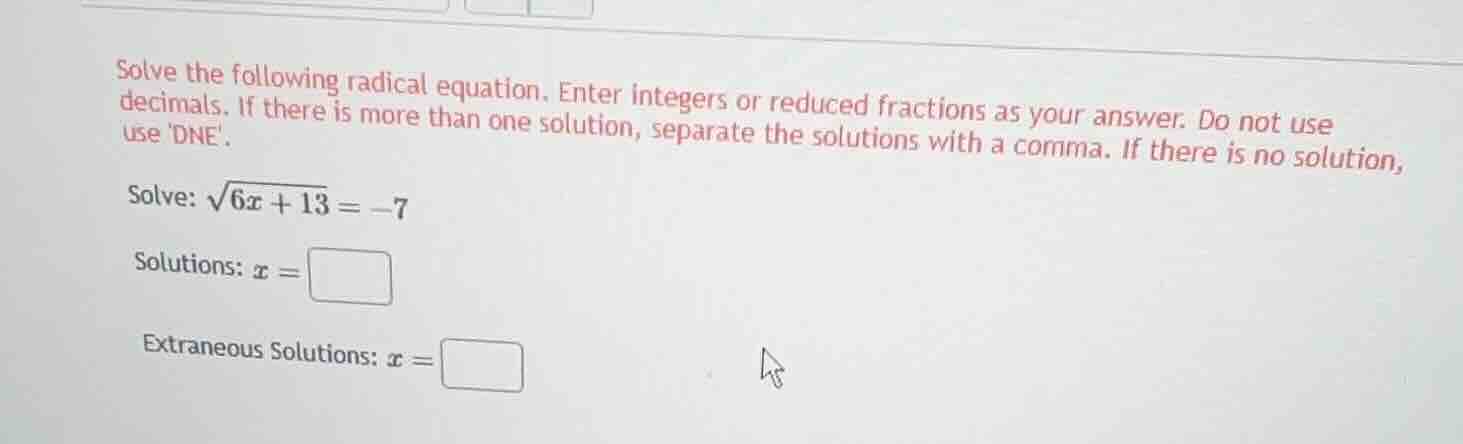
solve the following radical equation. enter integers or reduced fractions as your answer. do not use decimals. if there is more than one solution, separate the solutions with a comma. if there is no solution, use dne.
solve: \\(\sqrt{6x + 13} = -7\\)
solutions: \\(x = \square\\)
extraneous solutions: \\(x = \square\\)
Step1: Analyze the square root property
The square root of a real number is always non - negative, i.e., for any real number \(y\), \(\sqrt{y}\geq0\) when \(y\) is in the domain of the square root function. In the equation \(\sqrt{6x + 13}=-7\), the left - hand side \(\sqrt{6x+13}\) represents a square root, so \(\sqrt{6x + 13}\geq0\) for all \(x\) in its domain. But the right - hand side is \(- 7\), which is negative.
However, let's try to solve the equation algebraically to check for extraneous solutions.
First, square both sides of the equation \(\sqrt{6x + 13}=-7\) to get rid of the square root.
\((\sqrt{6x + 13})^2=(-7)^2\)
Step2: Simplify both sides
Simplifying, we have \(6x+13 = 49\).
Then, subtract 13 from both sides: \(6x=49 - 13\)
\(6x=36\)
Divide both sides by 6: \(x = 6\)
Step3: Check for extraneous solutions
Now, substitute \(x = 6\) back into the original equation \(\sqrt{6x+13}\).
When \(x = 6\), \(6x+13=6\times6 + 13=36 + 13 = 49\), and \(\sqrt{49}=7
eq-7\). So \(x = 6\) is an extraneous solution, and the original equation has no solution.

Snap & solve any problem in the app
Get step-by-step solutions on Sovi AI
Photo-based solutions with guided steps
Explore more problems and detailed explanations
Solutions: DNE
Extraneous Solutions: \(6\)