QUESTION IMAGE
Question
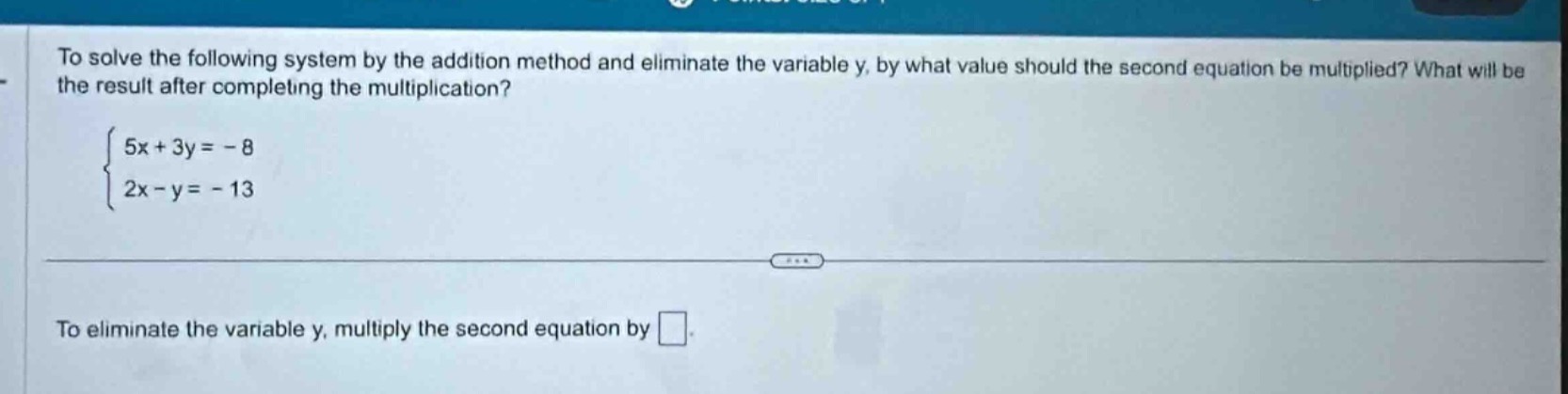
to solve the following system by the addition method and eliminate the variable y, by what value should the second equation be multiplied? what will be the result after completing the multiplication?\
\to eliminate the variable y, multiply the second equation by \square.
Step1: Analyze coefficients of y
In the first equation, the coefficient of \( y \) is \( 3 \), and in the second equation, it is \( -1 \). To eliminate \( y \), we need the coefficients of \( y \) to be opposites (or equal in magnitude and opposite in sign) so that when we add the equations, the \( y \)-terms cancel out.
Step2: Determine the multiplier
We want to make the coefficient of \( y \) in the second equation equal to \( -3 \) (so that when added to \( 3y \) from the first equation, they sum to \( 0 \)). Currently, the coefficient of \( y \) in the second equation is \( -1 \). To get from \( -1 \) to \( -3 \), we multiply by \( 3 \) (because \( -1\times3 = -3 \), and \( 3y + (-3y)=0 \) when we add the equations).

Snap & solve any problem in the app
Get step-by-step solutions on Sovi AI
Photo-based solutions with guided steps
Explore more problems and detailed explanations
\( 3 \)