QUESTION IMAGE
Question
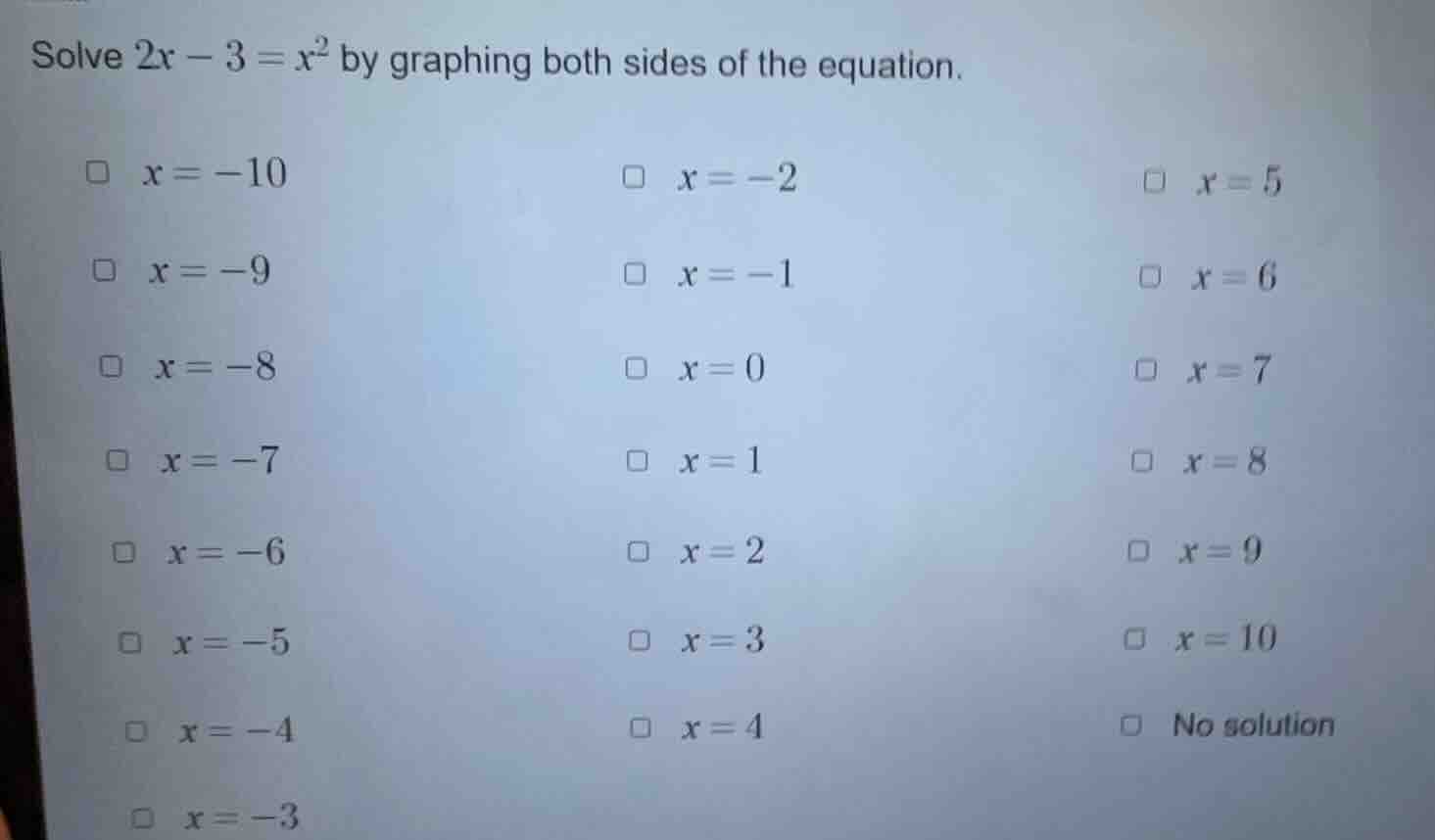
solve $2x - 3 = x^2$ by graphing both sides of the equation. \
$\square$ $x = -10$ $\square$ $x = -2$ $\square$ $x = 5$ \
$\square$ $x = -9$ $\square$ $x = -1$ $\square$ $x = 6$ \
$\square$ $x = -8$ $\square$ $x = 0$ $\square$ $x = 7$ \
$\square$ $x = -7$ $\square$ $x = 1$ $\square$ $x = 8$ \
$\square$ $x = -6$ $\square$ $x = 2$ $\square$ $x = 9$ \
$\square$ $x = -5$ $\square$ $x = 3$ $\square$ $x = 10$ \
$\square$ $x = -4$ $\square$ $x = 4$ $\square$ no solution \
$\square$ $x = -3$
Step1: Rewrite the equation
Rewrite \(2x - 3 = x^2\) as \(x^2-2x + 3 = 0\). We can also consider the two functions \(y = 2x-3\) (a linear function) and \(y=x^2\) (a quadratic function, a parabola opening upwards with vertex at \((0,0)\)).
Step2: Analyze the discriminant of the quadratic equation
For a quadratic equation \(ax^2+bx + c = 0\) (\(a = 1\), \(b=- 2\), \(c = 3\) here), the discriminant \(\Delta=b^2-4ac\).
Calculate \(\Delta=(-2)^2-4\times1\times3=4 - 12=-8<0\).
Step3: Interpret the discriminant result
Since the discriminant of the quadratic equation \(x^2 - 2x+3 = 0\) is negative, the quadratic function \(y = x^2\) and the linear function \(y=2x - 3\) do not intersect (because the solutions of \(2x - 3=x^2\) are the \(x\)-coordinates of the intersection points of \(y = 2x-3\) and \(y=x^2\)). So there are no real solutions.

Snap & solve any problem in the app
Get step-by-step solutions on Sovi AI
Photo-based solutions with guided steps
Explore more problems and detailed explanations
No solution