QUESTION IMAGE
Question
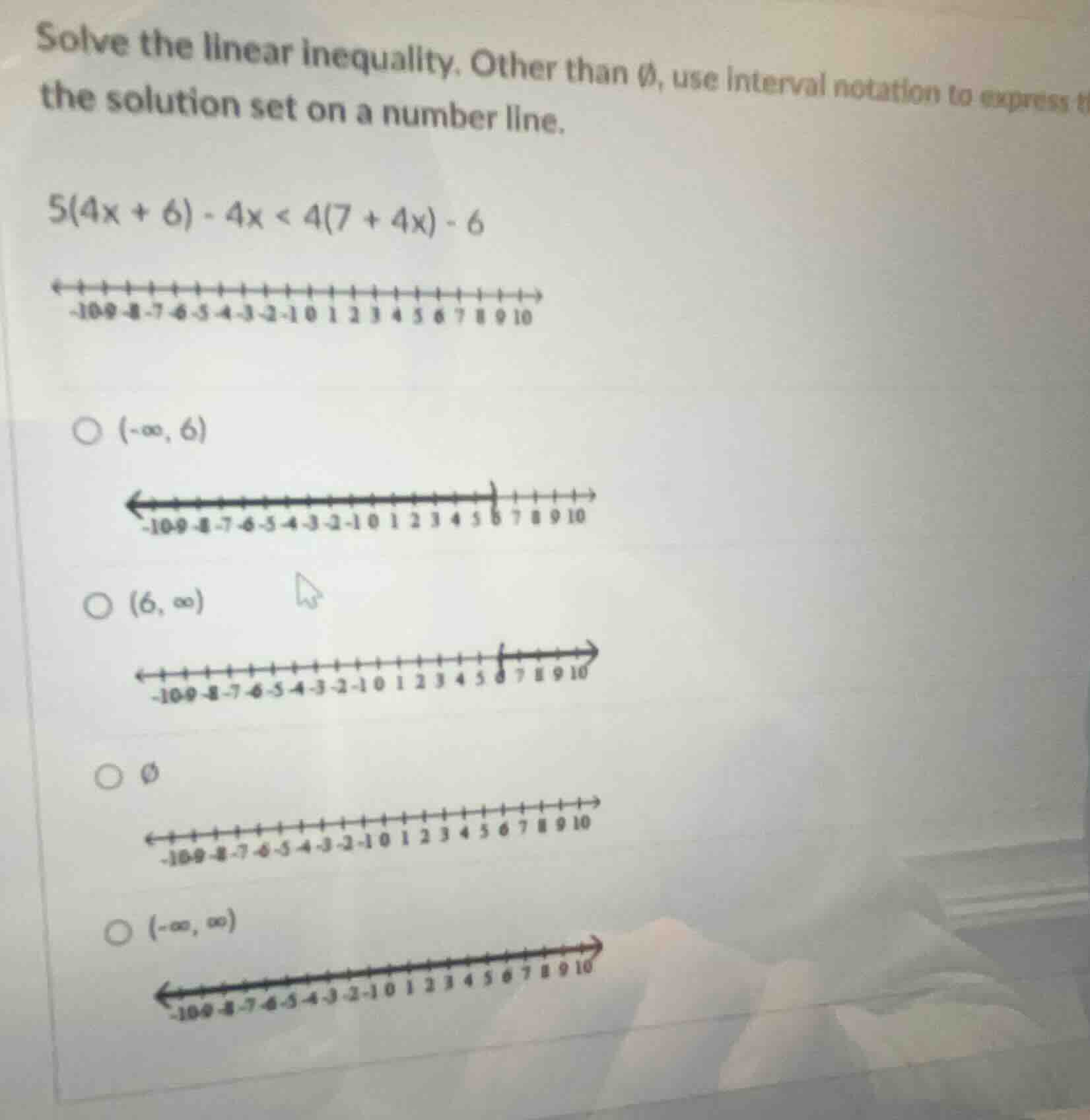
solve the linear inequality. other than ∅, use interval notation to express the solution set on a number line.
5(4x + 6) - 4x < 4(7 + 4x) - 6
○ (-∞, 6)
○ (6, ∞)
○ ∅
○ (-∞, ∞)
Step1: Expand both sides
Expand the left - hand side: \(5(4x + 6)-4x=20x+30 - 4x=16x + 30\)
Expand the right - hand side: \(4(7 + 4x)-6=28+16x-6 = 16x+22\)
So the inequality becomes \(16x + 30<16x+22\)
Step2: Subtract \(16x\) from both sides
Subtract \(16x\) from both sides of the inequality \(16x + 30<16x+22\), we get \(16x-16x + 30<16x-16x+22\)
Simplifying, we have \(30 < 22\)
Since \(30<22\) is a false statement, there are no values of \(x\) that satisfy the inequality. So the solution set is the empty set \(\varnothing\)

Snap & solve any problem in the app
Get step-by-step solutions on Sovi AI
Photo-based solutions with guided steps
Explore more problems and detailed explanations
\(\varnothing\) (corresponding to the option with \(\varnothing\))