QUESTION IMAGE
Question
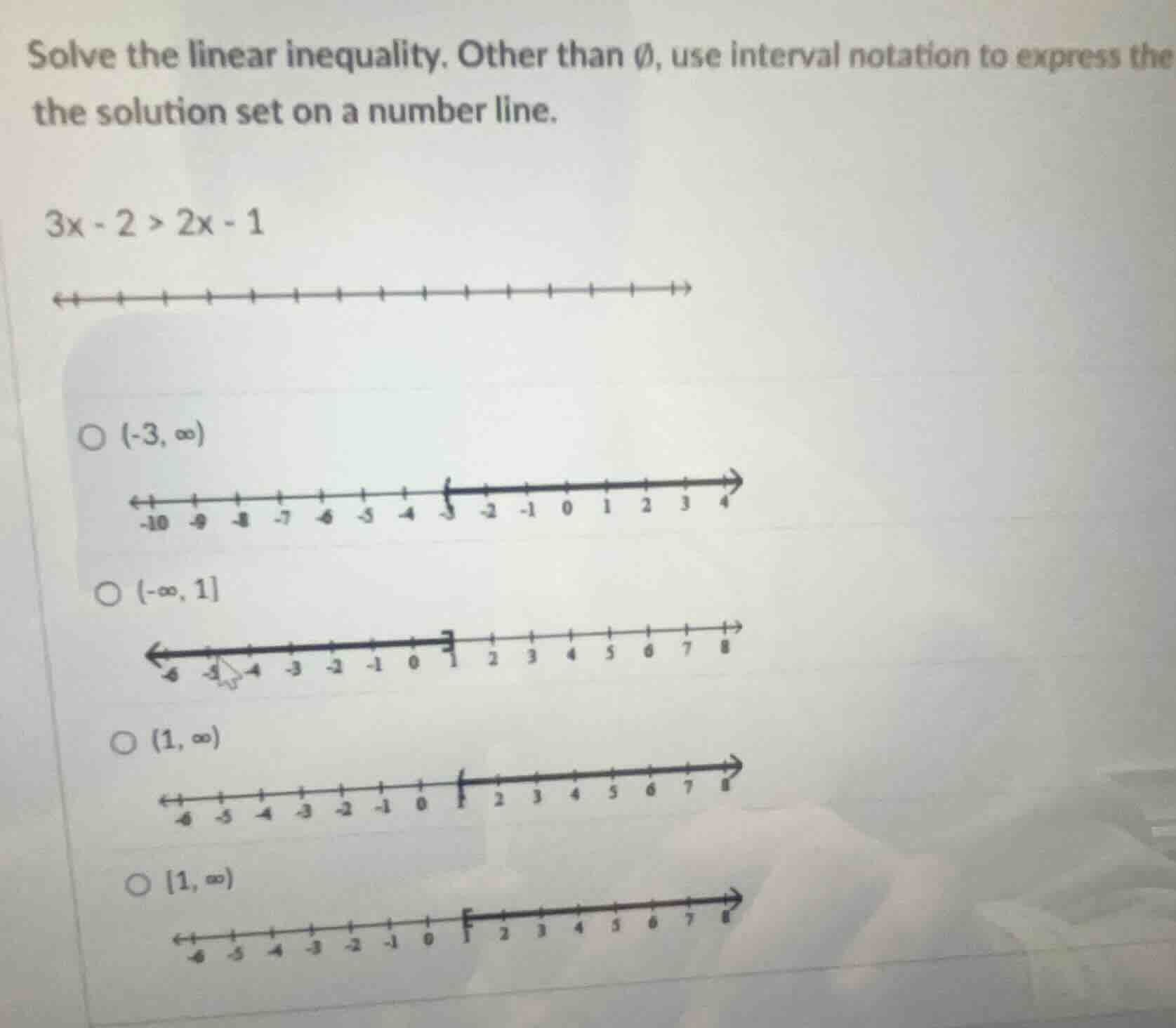
solve the linear inequality. other than ∅, use interval notation to express the the solution set on a number line.
3x - 2 > 2x - 1
options:
(-3, ∞)
(-∞, 1
(1, ∞)
1, ∞)
Step1: Subtract \(2x\) from both sides
To isolate the variable \(x\), we subtract \(2x\) from both sides of the inequality \(3x - 2>2x - 1\). This gives us \(3x-2x - 2>2x - 2x- 1\), which simplifies to \(x - 2>- 1\).
Step2: Add 2 to both sides
Next, we add 2 to both sides of the inequality \(x - 2>- 1\) to solve for \(x\). So, \(x-2 + 2>-1 + 2\), which simplifies to \(x>1\).
In interval notation, the solution to \(x > 1\) is \((1,\infty)\). Looking at the number line representations, the one corresponding to \((1,\infty)\) has an open circle at 1 (since \(x>1\) does not include 1) and an arrow pointing to the right (indicating all numbers greater than 1).

Snap & solve any problem in the app
Get step-by-step solutions on Sovi AI
Photo-based solutions with guided steps
Explore more problems and detailed explanations
\((1, \infty)\) (corresponding to the option with the number line starting with an open circle at 1 and arrow to the right)