QUESTION IMAGE
Question
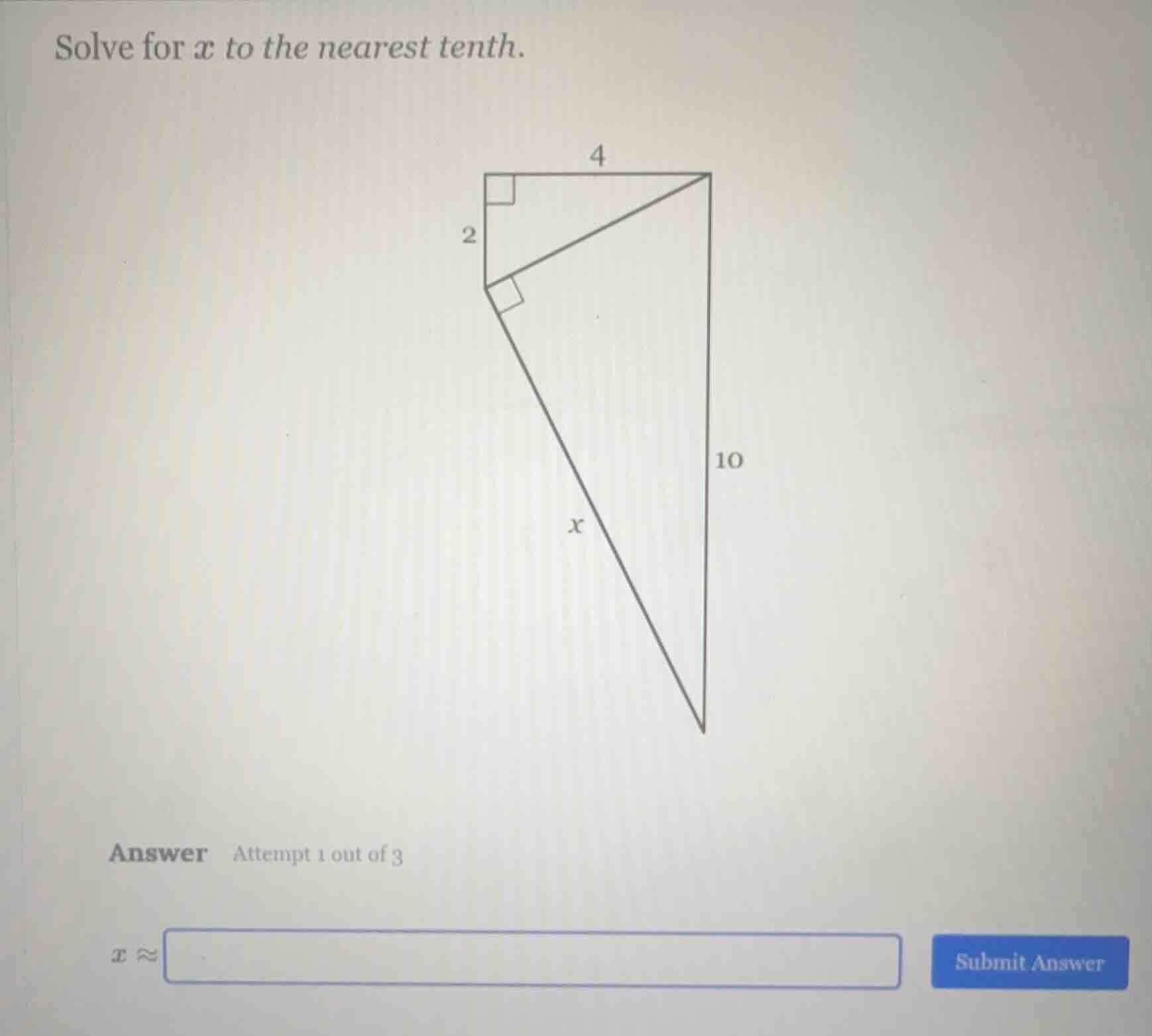
solve for ( x ) to the nearest tenth.
answer attempt 1 out of 3
( x approx )
submit answer
Step1: Find the hypotenuse of the small right triangle.
Using the Pythagorean theorem \( c = \sqrt{a^2 + b^2} \), where \( a = 2 \) and \( b = 4 \).
\( c = \sqrt{2^2 + 4^2} = \sqrt{4 + 16} = \sqrt{20} \)
Step2: Find \( x \) using the geometric mean theorem (or altitude-on-hypotenuse theorem) in the large right triangle.
The geometric mean theorem states that in a right triangle, the length of a leg is the geometric mean of the length of the hypotenuse and the length of the adjacent segment. Here, the vertical side of the large triangle is 10, and the segment adjacent to \( x \) (from the small triangle's hypotenuse) is \( \sqrt{20} \)? Wait, no, actually, let's re - examine. The two right triangles: the small one with legs 2 and 4, and the large one with one leg \( x \) and the other leg related to 10. Wait, another approach: The hypotenuse of the small right triangle is \( \sqrt{2^2 + 4^2}=\sqrt{4 + 16}=\sqrt{20} \). Now, in the large right triangle, we can consider the two right triangles (the small one and the one with leg \( x \)) are similar? Wait, no, actually, the large triangle is a right triangle, and we can use the Pythagorean theorem in a different way. Wait, the vertical side of the large figure is 10, and the horizontal side is 4. Wait, no, the key is that the triangle with leg \( x \) and the other leg (let's say the segment from the right angle of the small triangle to the bottom vertex) and the hypotenuse 10? Wait, no, let's use the geometric mean. The length of the altitude to the hypotenuse of a right triangle is the geometric mean of the lengths of the two segments. Wait, maybe a better way: Let's call the hypotenuse of the small triangle \( h \), so \( h=\sqrt{2^{2}+4^{2}}=\sqrt{4 + 16}=\sqrt{20}=2\sqrt{5}\approx4.472 \). Now, in the large right triangle, we have a right triangle where one leg is \( x \), another leg is related to the vertical side of length 10, and the hypotenuse is 10? No, wait, the large triangle has a vertical side of length 10, and the horizontal side is 4. Wait, actually, the triangle with legs 2 and 4, and the triangle with leg \( x \) and the other leg (let's say the segment from the top right vertex to the bottom vertex) are similar? Wait, no, let's use the Pythagorean theorem in the large right triangle. Wait, the correct approach: The two right triangles (the small one with legs 2 and 4, and the one with leg \( x \)) are similar to the large right triangle? Wait, no, let's consider the following: The length of the segment along the vertical side: the total vertical side is 10, and the upper segment is 2, so the lower segment is \( 10 - 2=8 \)? No, that's not correct. Wait, no, the figure is composed of two right triangles: one with legs 2 and 4 (let's call this triangle A), and another right triangle with leg \( x \) and the other leg being the same as the hypotenuse of triangle A? Wait, no, let's use the geometric mean formula. In a right triangle, if we draw an altitude to the hypotenuse, then \( leg_1^2=segment_1\times hypotenuse \) and \( leg_2^2 = segment_2\times hypotenuse \). But in our case, the triangle with leg \( x \) and the triangle with legs 2 and 4: Let's assume that the triangle with legs 2 and 4 is similar to the triangle with leg \( x \) and the other leg (let's say length \( y \)), and the hypotenuse of the large triangle is 10. Wait, maybe a better way: Let's use the Pythagorean theorem in the large right triangle. The hypotenuse of the large right triangle is 10, one segment of the hypotenuse (from the top right vertex to the right angle of the small triangle…

Snap & solve any problem in the app
Get step-by-step solutions on Sovi AI
Photo-based solutions with guided steps
Explore more problems and detailed explanations
\( x\approx8.9 \)