QUESTION IMAGE
Question
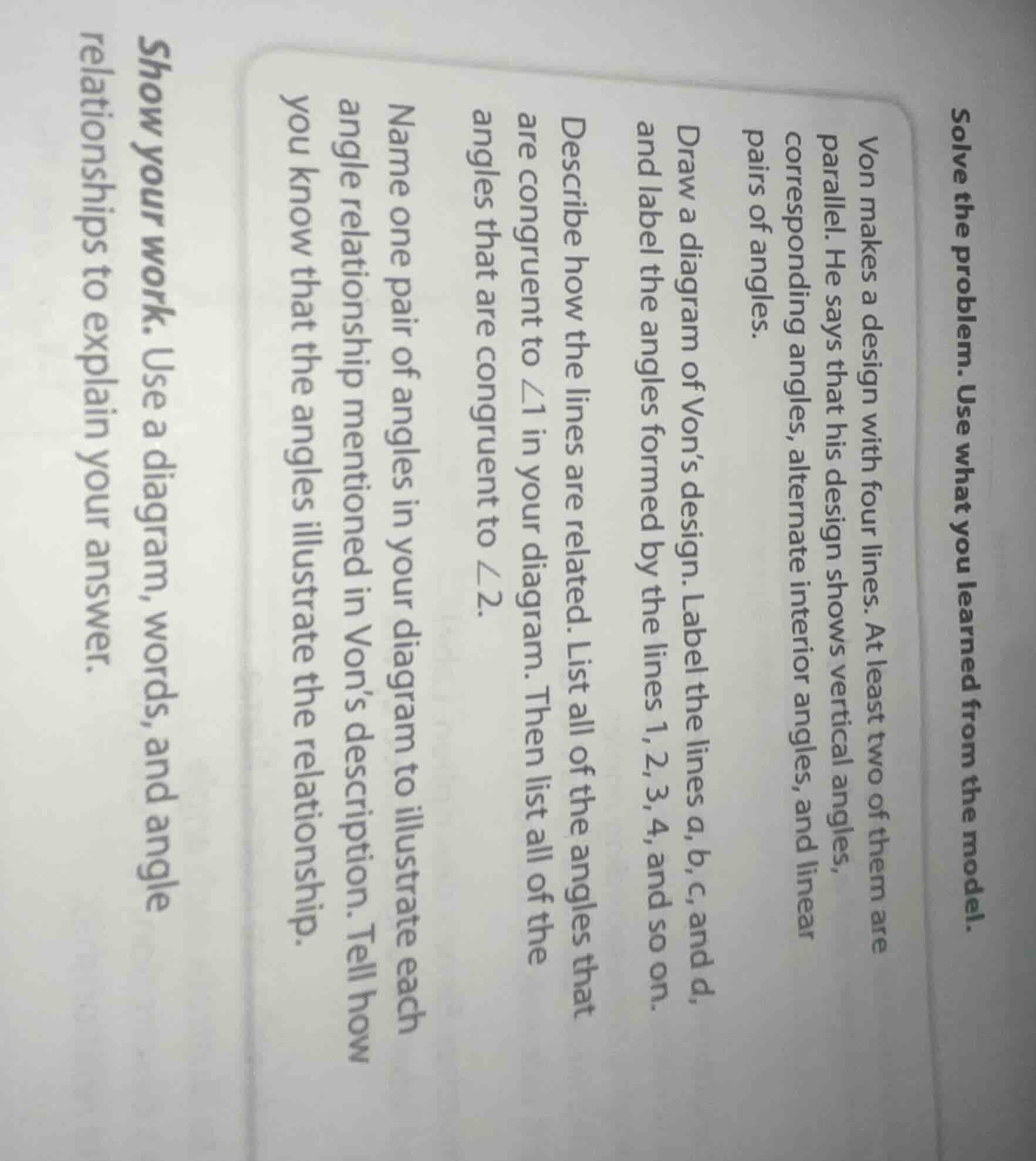
solve the problem. use what you learned from the model. von makes a design with four lines. at least two of them are parallel. he says that his design shows vertical angles, corresponding angles, alternate interior angles, and linear pairs of angles. draw a diagram of von’s design. label the lines a, b, c, and d, and label the angles formed by the lines 1, 2, 3, 4, and so on. describe how the lines are related. list all of the angles that are congruent to ∠1 in your diagram. then list all of the angles that are congruent to ∠2. name one pair of angles in your diagram to illustrate each angle relationship mentioned in von’s description. tell how you know that the angles illustrate the relationship. show your work. use a diagram, words, and angle relationships to explain your answer.
Step 1: Draw the Diagram
Let's assume two parallel lines \( a \) and \( b \), and two transversal lines \( c \) and \( d \). So we have:
- Line \( a \) (top parallel line)
- Line \( b \) (bottom parallel line)
- Line \( c \) (left transversal) intersecting \( a \) and \( b \), forming \( \angle 1 \) (top - left at intersection of \( a \) and \( c \)), \( \angle 2 \) (bottom - left at intersection of \( b \) and \( c \)), \( \angle 3 \) (top - right at intersection of \( a \) and \( c \)), \( \angle 4 \) (bottom - right at intersection of \( b \) and \( c \))
- Line \( d \) (right transversal) intersecting \( a \) and \( b \), forming \( \angle 5 \) (top - left at intersection of \( a \) and \( d \)), \( \angle 6 \) (bottom - left at intersection of \( b \) and \( d \)), \( \angle 7 \) (top - right at intersection of \( a \) and \( d \)), \( \angle 8 \) (bottom - right at intersection of \( b \) and \( d \))
Step 2: Describe Line Relationships
Lines \( a \) and \( b \) are parallel (\( a \parallel b \)). Lines \( c \) and \( d \) are transversals (they intersect the parallel lines).
Step 3: Angles Congruent to \( \angle 1 \)
- Vertical Angles: \( \angle 3 \) is vertical to \( \angle 1 \), so \( \angle 1\cong\angle 3 \) (vertical angles are congruent).
- Corresponding Angles: Since \( a\parallel b \) and \( c \) is a transversal, \( \angle 1 \) and \( \angle 2 \) are alternate interior angles? Wait, no, if we consider transversal \( c \) and parallel lines \( a,b \), \( \angle 1 \) (on \( a \), above \( c \)) and \( \angle 2 \) (on \( b \), above \( c \))? Wait, maybe I mixed up the labeling. Let's re - label: when line \( c \) intersects \( a \) (top) and \( b \) (bottom), \( \angle 1 \) is above \( c \) on \( a \), \( \angle 2 \) is above \( c \) on \( b \). Then \( \angle 1 \) and \( \angle 2 \) are corresponding angles, so \( \angle 1\cong\angle 2 \) (corresponding angles postulate for parallel lines). Also, if we consider transversal \( d \), the angle corresponding to \( \angle 1 \) (same position relative to \( a \) and \( d \)) is \( \angle 5 \)? No, wait, let's use the standard: for parallel lines \( a\parallel b \) and transversal \( c \), \( \angle 1 \) (top - left) and \( \angle 5 \) (top - left at \( d \))? No, better to use the fact that vertical angles are congruent (\( \angle 1\cong\angle 3 \)), alternate interior angles: if \( a\parallel b \) and \( c \) is transversal, \( \angle 1 \) and \( \angle 4 \)? No, I think I made a mistake in labeling. Let's start over.
Let's have two parallel lines \( l_1 \) (horizontal top) and \( l_2 \) (horizontal bottom). A transversal \( t_1 \) (slanted) intersects \( l_1 \) at point \( A \) and \( l_2 \) at point \( B \). At \( A \), we have \( \angle 1 \) (above \( t_1 \), left of \( l_1 \)) and \( \angle 2 \) (below \( t_1 \), left of \( l_1 \)). At \( B \), we have \( \angle 3 \) (above \( t_1 \), left of \( l_2 \)) and \( \angle 4 \) (below \( t_1 \), left of \( l_2 \)). Since \( l_1\parallel l_2 \) and \( t_1 \) is transversal, \( \angle 1\cong\angle 3 \) (alternate interior angles), \( \angle 2\cong\angle 4 \) (alternate interior angles), and \( \angle 1\cong\angle 4 \) (vertical angles? No, \( \angle 1 \) and \( \angle 2 \) are linear pair, \( \angle 3 \) and \( \angle 4 \) are linear pair. \( \angle 1 \) and \( \angle 3 \) are alternate interior, \( \angle 1 \) and \( \angle 2 \) are supplementary.
Now, if we have a second transversal \( t_2 \) intersecting \( l_1 \) at \( C \) and \( l_2 \) at \( D \). At \( C \), we have \( \angle 5 \) (above \( t_2 \)…

Snap & solve any problem in the app
Get step-by-step solutions on Sovi AI
Photo-based solutions with guided steps
Explore more problems and detailed explanations
Step 1: Draw the Diagram
Let's assume two parallel lines \( a \) and \( b \), and two transversal lines \( c \) and \( d \). So we have:
- Line \( a \) (top parallel line)
- Line \( b \) (bottom parallel line)
- Line \( c \) (left transversal) intersecting \( a \) and \( b \), forming \( \angle 1 \) (top - left at intersection of \( a \) and \( c \)), \( \angle 2 \) (bottom - left at intersection of \( b \) and \( c \)), \( \angle 3 \) (top - right at intersection of \( a \) and \( c \)), \( \angle 4 \) (bottom - right at intersection of \( b \) and \( c \))
- Line \( d \) (right transversal) intersecting \( a \) and \( b \), forming \( \angle 5 \) (top - left at intersection of \( a \) and \( d \)), \( \angle 6 \) (bottom - left at intersection of \( b \) and \( d \)), \( \angle 7 \) (top - right at intersection of \( a \) and \( d \)), \( \angle 8 \) (bottom - right at intersection of \( b \) and \( d \))
Step 2: Describe Line Relationships
Lines \( a \) and \( b \) are parallel (\( a \parallel b \)). Lines \( c \) and \( d \) are transversals (they intersect the parallel lines).
Step 3: Angles Congruent to \( \angle 1 \)
- Vertical Angles: \( \angle 3 \) is vertical to \( \angle 1 \), so \( \angle 1\cong\angle 3 \) (vertical angles are congruent).
- Corresponding Angles: Since \( a\parallel b \) and \( c \) is a transversal, \( \angle 1 \) and \( \angle 2 \) are alternate interior angles? Wait, no, if we consider transversal \( c \) and parallel lines \( a,b \), \( \angle 1 \) (on \( a \), above \( c \)) and \( \angle 2 \) (on \( b \), above \( c \))? Wait, maybe I mixed up the labeling. Let's re - label: when line \( c \) intersects \( a \) (top) and \( b \) (bottom), \( \angle 1 \) is above \( c \) on \( a \), \( \angle 2 \) is above \( c \) on \( b \). Then \( \angle 1 \) and \( \angle 2 \) are corresponding angles, so \( \angle 1\cong\angle 2 \) (corresponding angles postulate for parallel lines). Also, if we consider transversal \( d \), the angle corresponding to \( \angle 1 \) (same position relative to \( a \) and \( d \)) is \( \angle 5 \)? No, wait, let's use the standard: for parallel lines \( a\parallel b \) and transversal \( c \), \( \angle 1 \) (top - left) and \( \angle 5 \) (top - left at \( d \))? No, better to use the fact that vertical angles are congruent (\( \angle 1\cong\angle 3 \)), alternate interior angles: if \( a\parallel b \) and \( c \) is transversal, \( \angle 1 \) and \( \angle 4 \)? No, I think I made a mistake in labeling. Let's start over.
Let's have two parallel lines \( l_1 \) (horizontal top) and \( l_2 \) (horizontal bottom). A transversal \( t_1 \) (slanted) intersects \( l_1 \) at point \( A \) and \( l_2 \) at point \( B \). At \( A \), we have \( \angle 1 \) (above \( t_1 \), left of \( l_1 \)) and \( \angle 2 \) (below \( t_1 \), left of \( l_1 \)). At \( B \), we have \( \angle 3 \) (above \( t_1 \), left of \( l_2 \)) and \( \angle 4 \) (below \( t_1 \), left of \( l_2 \)). Since \( l_1\parallel l_2 \) and \( t_1 \) is transversal, \( \angle 1\cong\angle 3 \) (alternate interior angles), \( \angle 2\cong\angle 4 \) (alternate interior angles), and \( \angle 1\cong\angle 4 \) (vertical angles? No, \( \angle 1 \) and \( \angle 2 \) are linear pair, \( \angle 3 \) and \( \angle 4 \) are linear pair. \( \angle 1 \) and \( \angle 3 \) are alternate interior, \( \angle 1 \) and \( \angle 2 \) are supplementary.
Now, if we have a second transversal \( t_2 \) intersecting \( l_1 \) at \( C \) and \( l_2 \) at \( D \). At \( C \), we have \( \angle 5 \) (above \( t_2 \), left of \( l_1 \)) and \( \angle 6 \) (below \( t_2 \), left of \( l_1 \)). At \( D \), we have \( \angle 7 \) (above \( t_2 \), left of \( l_2 \)) and \( \angle 8 \) (below \( t_2 \), left of \( l_2 \)). Since \( l_1\parallel l_2 \), \( \angle 1\cong\angle 5 \) (corresponding angles, same position relative to \( l_1 \), \( t_1 \) and \( l_1 \), \( t_2 \)), \( \angle 3\cong\angle 7 \) (corresponding angles), \( \angle 2\cong\angle 6 \) (corresponding angles), \( \angle 4\cong\angle 8 \) (corresponding angles). Also, \( \angle 5\cong\angle 7 \) (vertical angles), \( \angle 6\cong\angle 8 \) (vertical angles).
So angles congruent to \( \angle 1 \):
- Vertical angle: \( \angle 2 \)? No, wait, vertical angles are opposite each other when two lines intersect. If \( t_1 \) intersects \( l_1 \), the vertical angle of \( \angle 1 \) is the angle opposite to \( \angle 1 \) at the intersection of \( t_1 \) and \( l_1 \), which is \( \angle 2 \)? No, when two lines intersect, they form two pairs of vertical angles. So if \( t_1 \) and \( l_1 \) intersect, \( \angle 1 \) (above \( t_1 \), left) and \( \angle 2 \) (below \( t_1 \), right) are vertical angles? I think my initial labeling was wrong. Let's use the correct vertical angle definition: when two lines intersect, vertical angles are non - adjacent and equal. So if line \( c \) intersects line \( a \), forming \( \angle 1 \) and \( \angle 3 \) (vertical angles), and line \( c \) intersects line \( b \), forming \( \angle 2 \) and \( \angle 4 \) (vertical angles). Then, since \( a\parallel b \), \( \angle 1\cong\angle 2 \) (alternate interior angles, if \( c \) is a transversal), \( \angle 3\cong\angle 4 \) (alternate interior angles). Also, \( \angle 1\cong\angle 3 \) (vertical angles), \( \angle 2\cong\angle 4 \) (vertical angles).
Step 4: Name a Pair of Angles and Their Relationship
Let's take \( \angle 1 \) and \( \angle 2 \). Relationship: alternate interior angles (since \( a\parallel b \) and \( c \) is a transversal, \( \angle 1 \) and \( \angle 2 \) lie between \( a \) and \( b \) (interior) and on alternate sides of \( c \) (transversal)). We know alternate interior angles are congruent when the lines are parallel (\( a\parallel b \)), so \( \angle 1\cong\angle 2 \) by the alternate interior angles theorem.
Step 5: Angles Congruent to \( \angle 2 \)
- Vertical angle: \( \angle 4 \) (since \( c \) intersects \( b \), \( \angle 2 \) and \( \angle 4 \) are vertical angles, so \( \angle 2\cong\angle 4 \))
- Corresponding angle: If we consider transversal \( d \) (another transversal), the angle corresponding to \( \angle 2 \) (same position relative to \( b \) and \( d \)) will be congruent. Also, since \( \angle 1\cong\angle 2 \) (alternate interior) and \( \angle 1\cong\angle 3 \) (vertical), \( \angle 2\cong\angle 3 \) (transitive property of congruence)
Final Answer (Summary)
- Diagram: Two parallel lines (\( a,b \)) and two transversals (\( c,d \)) intersecting them, forming 8 angles (labeled \( \angle 1 - \angle 8 \) as per intersection points).
- Line Relationship: \( a\parallel b \), \( c \) and \( d \) are transversals.
- Angles Congruent to \( \angle 1 \): \( \angle 3 \) (vertical), \( \angle 2 \) (alternate interior), \( \angle 5 \) (corresponding, if \( d \) is considered).
- Angle Pair and Relationship: \( \angle 1 \) and \( \angle 2 \), alternate interior angles, congruent because \( a\parallel b \).
- Angles Congruent to \( \angle 2 \): \( \angle 4 \) (vertical), \( \angle 1 \) (alternate interior), \( \angle 3 \) (transitive from \( \angle 1\cong\angle 2 \) and \( \angle 1\cong\angle 3 \)).
(Note: The answer can be adjusted based on the exact labeling of the diagram, but the key concepts of vertical angles, corresponding angles, alternate interior angles, and the properties of parallel lines are used.)