QUESTION IMAGE
Question
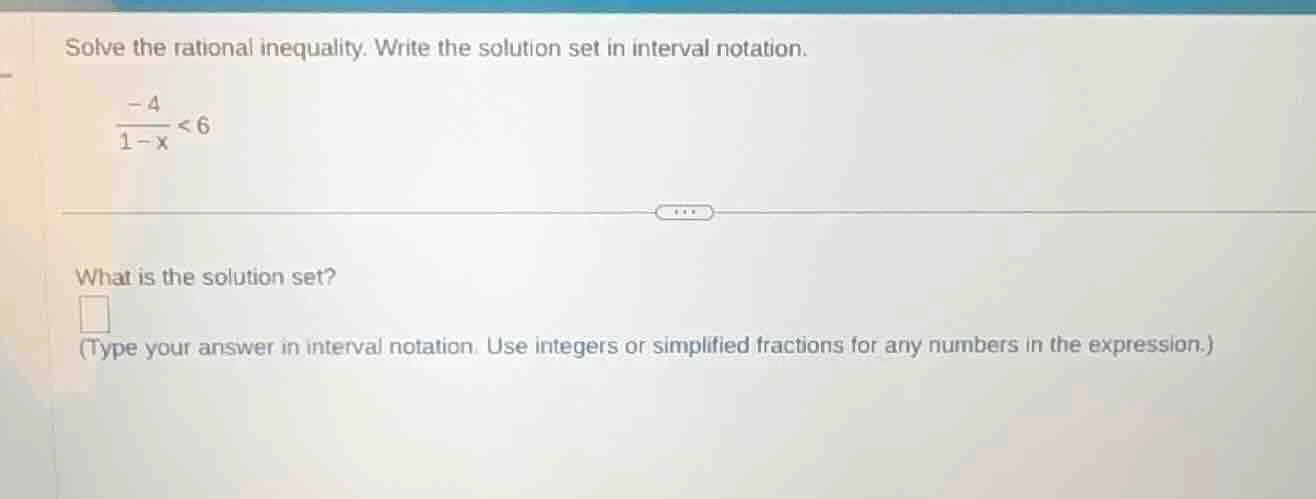
solve the rational inequality. write the solution set in interval notation.\\(\frac{-4}{1 - x} < 6\\)\\(\dots\\)what is the solution set?\\(\square\\)(type your answer in interval notation. use integers or simplified fractions for any numbers in the expression.)
Step1: Move all terms to one side
Subtract 6 from both sides to get \(\frac{-4}{1 - x}-6<0\).
Step2: Combine the fractions
Find a common denominator, which is \(1 - x\). So we have \(\frac{-4-6(1 - x)}{1 - x}<0\).
Simplify the numerator: \(-4-6 + 6x=6x - 10\). So the inequality becomes \(\frac{6x - 10}{1 - x}<0\).
We can factor the numerator: \(2(3x - 5)\), so \(\frac{2(3x - 5)}{1 - x}<0\). Note that the 2 in the numerator doesn't affect the sign, so we can consider \(\frac{3x - 5}{1 - x}<0\) (since 2>0).
Step3: Find critical points
Set the numerator and denominator equal to zero.
For the numerator \(3x - 5 = 0\), we get \(x=\frac{5}{3}\).
For the denominator \(1 - x = 0\), we get \(x = 1\).
These critical points divide the number line into three intervals: \((-\infty,1)\), \((1,\frac{5}{3})\), and \((\frac{5}{3},\infty)\).
Step4: Test intervals
- For the interval \((-\infty,1)\), let's pick \(x = 0\). Then \(\frac{3(0)-5}{1 - 0}=\frac{-5}{1}=-5<0\), so this interval is part of the solution.
- For the interval \((1,\frac{5}{3})\), let's pick \(x=\frac{3}{2}\). Then \(\frac{3(\frac{3}{2})-5}{1-\frac{3}{2}}=\frac{\frac{9}{2}-5}{-\frac{1}{2}}=\frac{-\frac{1}{2}}{-\frac{1}{2}} = 1>0\), so this interval is not part of the solution.
- For the interval \((\frac{5}{3},\infty)\), let's pick \(x = 2\). Then \(\frac{3(2)-5}{1 - 2}=\frac{6 - 5}{-1}=\frac{1}{-1}=-1<0\), so this interval is part of the solution.
We also need to check the critical points. The denominator cannot be zero, so \(x
eq1\). For the numerator, when \(x = \frac{5}{3}\), the fraction is zero, and we want the fraction to be less than zero, so \(x=\frac{5}{3}\) is not included.

Snap & solve any problem in the app
Get step-by-step solutions on Sovi AI
Photo-based solutions with guided steps
Explore more problems and detailed explanations
\((-\infty,1)\cup(\frac{5}{3},\infty)\)