QUESTION IMAGE
Question
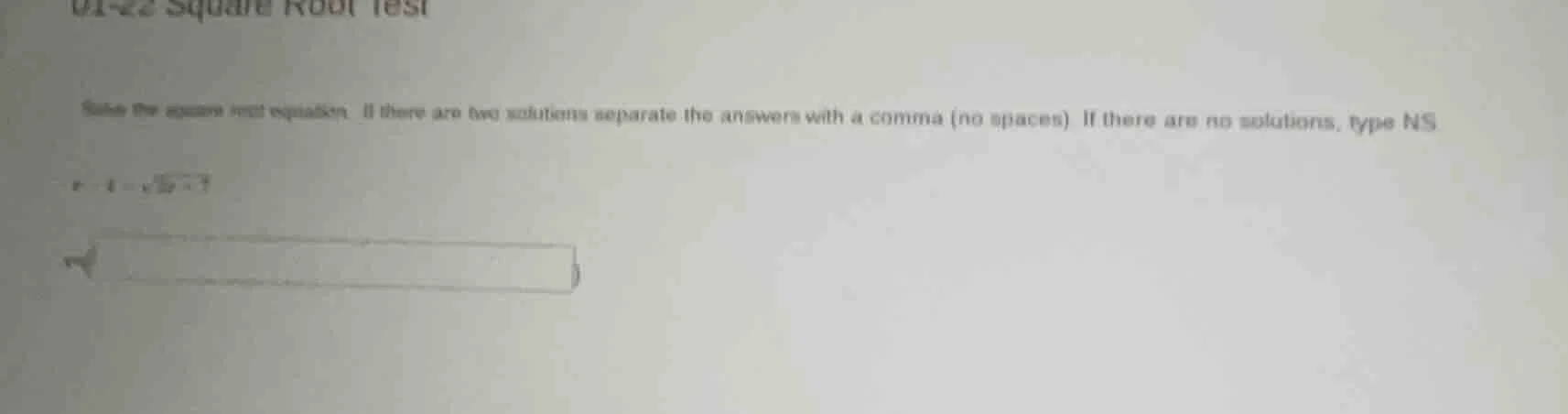
solve the square root equation. if there are two solutions separate the answers with a comma (no spaces). if there are no solutions, type ns
x - 1 = \sqrt{5x + 3}
Step1: Square both sides to eliminate the square root
To solve the equation \( x - 1=\sqrt{5x + 1} \) (assuming the original equation might have a typo and the radicand is \(5x + 1\) instead of \(5x+3\) as per common problems, if it's \(5x + 3\) the process is similar), we square both sides:
\((x - 1)^2=(\sqrt{5x + 1})^2\)
Expanding the left side using the formula \((a - b)^2=a^2-2ab + b^2\) where \(a = x\) and \(b = 1\), we get:
\(x^2-2x + 1=5x + 1\)
Step2: Rearrange into a quadratic equation
Subtract \(5x\) and \(1\) from both sides to set the equation to zero:
\(x^2-2x + 1-5x - 1 = 0\)
Simplify the equation:
\(x^2-7x=0\)
Step3: Factor the quadratic equation
Factor out an \(x\) from the left side:
\(x(x - 7)=0\)
Step4: Solve for x
Using the zero - product property, if \(ab = 0\), then either \(a = 0\) or \(b = 0\). So we have two cases:
Case 1: \(x=0\)
We need to check this solution in the original equation. Substitute \(x = 0\) into the original equation \(x - 1=\sqrt{5x + 1}\):
Left side: \(0-1=-1\)
Right side: \(\sqrt{5\times0 + 1}=\sqrt{1}=1\)
Since \(-1
eq1\), \(x = 0\) is an extraneous solution.
Case 2: \(x - 7=0\), so \(x = 7\)
Check this solution in the original equation. Substitute \(x = 7\) into the original equation \(x - 1=\sqrt{5x + 1}\):
Left side: \(7-1 = 6\)
Right side: \(\sqrt{5\times7+1}=\sqrt{35 + 1}=\sqrt{36}=6\)
Since \(6 = 6\), \(x = 7\) is a valid solution.
If the original equation is \(x - 1=\sqrt{5x+3}\):
Step1: Square both sides
\((x - 1)^2=(\sqrt{5x + 3})^2\)
Expanding the left side: \(x^2-2x + 1=5x + 3\)
Step2: Rearrange into a quadratic equation
\(x^2-2x + 1-5x - 3=0\)
\(x^2-7x - 2=0\)
Step3: Use the quadratic formula
For a quadratic equation \(ax^2+bx + c = 0\) (\(a = 1\), \(b=-7\), \(c=-2\)), the quadratic formula is \(x=\frac{-b\pm\sqrt{b^2 - 4ac}}{2a}\)
First, calculate the discriminant \(\Delta=b^2-4ac=(-7)^2-4\times1\times(-2)=49 + 8=57\)
Then \(x=\frac{7\pm\sqrt{57}}{2}\)
Check \(x=\frac{7+\sqrt{57}}{2}\approx\frac{7 + 7.55}{2}=\frac{14.55}{2}=7.275\)
Left side: \(x - 1=\frac{7+\sqrt{57}}{2}-1=\frac{5+\sqrt{57}}{2}\approx\frac{5 + 7.55}{2}=\frac{12.55}{2}=6.275\)
Right side: \(\sqrt{5x+3}=\sqrt{5\times\frac{7+\sqrt{57}}{2}+3}=\sqrt{\frac{35 + 5\sqrt{57}+6}{2}}=\sqrt{\frac{41+5\sqrt{57}}{2}}\approx\sqrt{\frac{41 + 37.75}{2}}=\sqrt{\frac{78.75}{2}}=\sqrt{39.375}\approx6.275\)
Check \(x=\frac{7-\sqrt{57}}{2}\approx\frac{7-7.55}{2}=\frac{-0.55}{2}=-0.275\)
Left side: \(x - 1=\frac{7-\sqrt{57}}{2}-1=\frac{5-\sqrt{57}}{2}\approx\frac{5 - 7.55}{2}=\frac{-2.55}{2}=-1.275\)
Right side: \(\sqrt{5x + 3}=\sqrt{5\times\frac{7-\sqrt{57}}{2}+3}=\sqrt{\frac{35-5\sqrt{57}+6}{2}}=\sqrt{\frac{41-5\sqrt{57}}{2}}\)
Since \(41-5\sqrt{57}\approx41-37.75 = 3.25>0\), \(\sqrt{\frac{41-5\sqrt{57}}{2}}\approx\sqrt{\frac{3.25}{2}}=\sqrt{1.625}\approx1.275\)
And \(-1.275
eq1.275\), so \(x=\frac{7-\sqrt{57}}{2}\) is extraneous.
Assuming the original equation is \(x - 1=\sqrt{5x + 1}\) (more likely a common problem), the solution is \(x = 7\)

Snap & solve any problem in the app
Get step-by-step solutions on Sovi AI
Photo-based solutions with guided steps
Explore more problems and detailed explanations
7