QUESTION IMAGE
Question
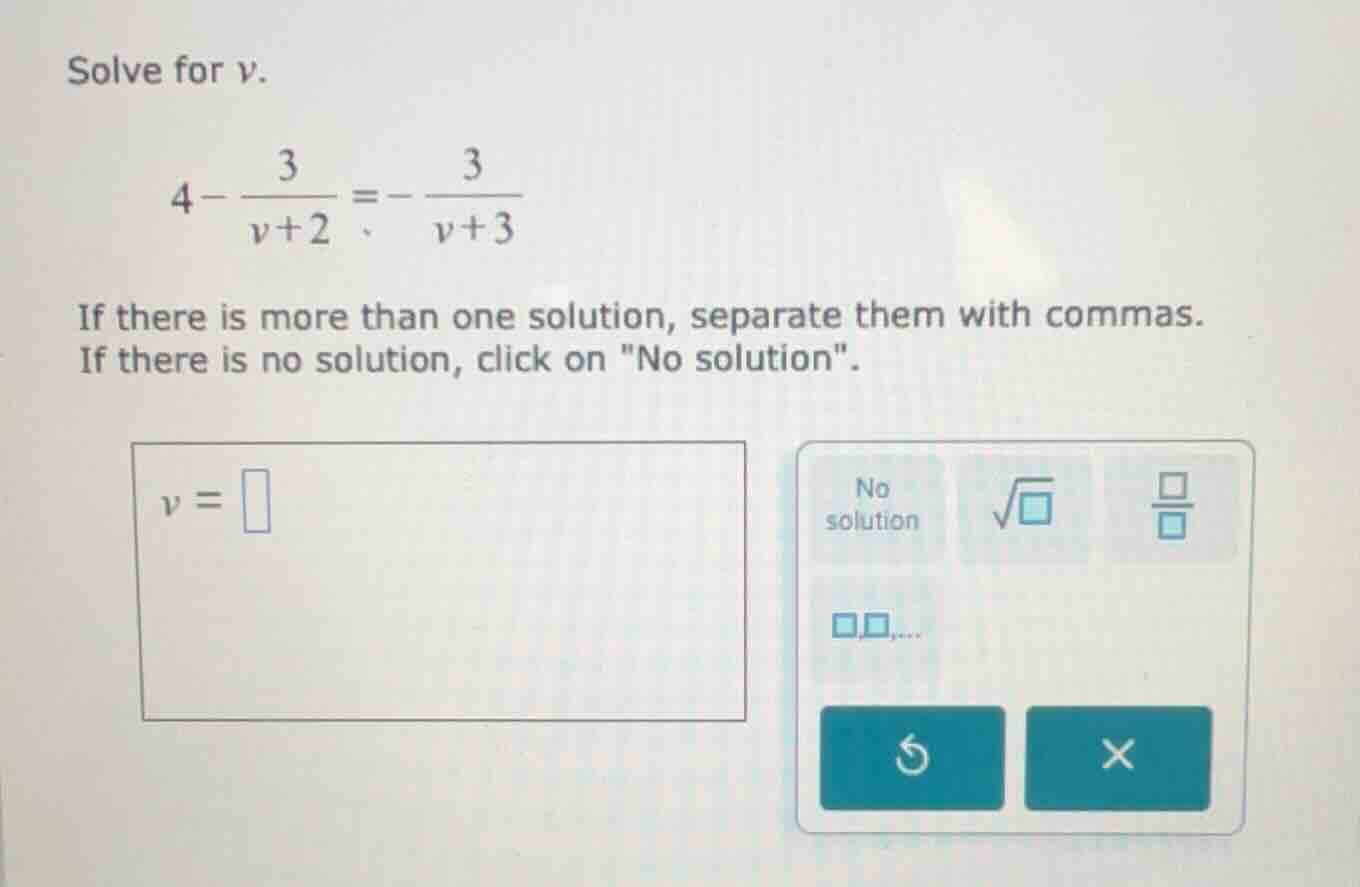
solve for ( v ).
( 4 - \frac{3}{v + 2} = -\frac{3}{v + 3} )
if there is more than one solution, separate them with commas.
if there is no solution, click on
o solution\.
( v = square )
Step1: Eliminate denominators
Multiply all terms by $(v+2)(v+3)$:
$$4(v+2)(v+3) - 3(v+3) = -3(v+2)$$
Step2: Expand all expressions
Expand each product using distribution:
$$4(v^2+5v+6) - 3v -9 = -3v -6$$
$$4v^2+20v+24 -3v -9 = -3v -6$$
Step3: Simplify both sides
Combine like terms on left side:
$$4v^2+17v+15 = -3v -6$$
Step4: Move all terms to left
Set equation to 0 by adding $3v+6$:
$$4v^2+20v+21 = 0$$
Step5: Solve quadratic equation
Use quadratic formula $v=\frac{-b\pm\sqrt{b^2-4ac}}{2a}$ where $a=4, b=20, c=21$:
$$v=\frac{-20\pm\sqrt{20^2-4(4)(21)}}{2(4)}$$
$$v=\frac{-20\pm\sqrt{400-336}}{8}$$
$$v=\frac{-20\pm\sqrt{64}}{8}$$
$$v=\frac{-20\pm8}{8}$$
Step6: Calculate two solutions
Compute each root separately:
$$v_1=\frac{-20+8}{8}=\frac{-12}{8}=-\frac{3}{2}$$
$$v_2=\frac{-20-8}{8}=\frac{-28}{8}=-\frac{7}{2}$$
Step7: Verify no extraneous roots
Check that $v
eq-2,-3$ (both solutions satisfy this).

Snap & solve any problem in the app
Get step-by-step solutions on Sovi AI
Photo-based solutions with guided steps
Explore more problems and detailed explanations
$v = -\frac{7}{2}, -\frac{3}{2}$