QUESTION IMAGE
Question
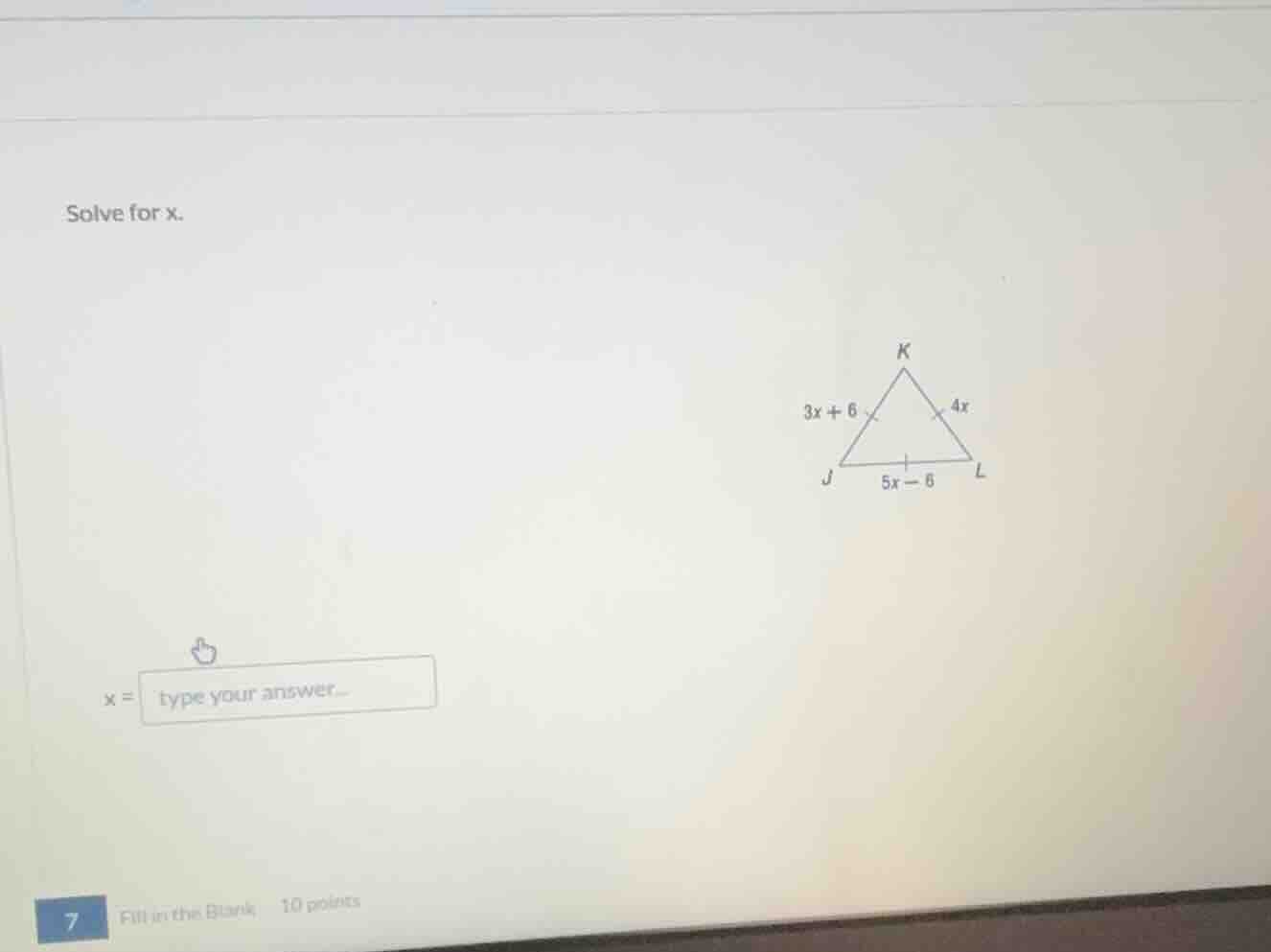
solve for x.
x = type your answer...
7 fill in the blank 10 points
Step1: Identify triangle type
The triangle \( \triangle KJL \) has all sides marked equal (isosceles? Wait, no—wait, the marks show all three sides are equal? Wait, the marks: \( KJ = 3x + 6 \), \( KL = 4x \), \( JL = 5x - 6 \). Wait, actually, the marks (the tick marks) indicate that all three sides are equal? Wait, no, maybe it's an equilateral triangle? Wait, the tick marks: each side has one tick? Wait, no, looking at the diagram: \( KJ \) and \( KL \) have one tick, \( JL \) has one tick? Wait, no, maybe it's an isosceles, but actually, the tick marks: \( KJ \) ( \( 3x + 6 \)) and \( KL \) ( \( 4x \)) have one tick, \( JL \) ( \( 5x - 6 \)) has one tick? Wait, no, maybe all three sides are equal? Wait, no, maybe it's an equilateral triangle, so all sides are equal. So \( KJ = KL = JL \). Wait, but let's check: if \( KJ = KL \), then \( 3x + 6 = 4x \). Let's solve that.
Step2: Solve \( 3x + 6 = 4x \)
Subtract \( 3x \) from both sides: \( 6 = x \). Wait, but let's check with \( JL \). If \( x = 6 \), then \( KJ = 3(6) + 6 = 24 \), \( KL = 4(6) = 24 \), \( JL = 5(6) - 6 = 24 \). So all sides are 24, so it's equilateral. So that works.

Snap & solve any problem in the app
Get step-by-step solutions on Sovi AI
Photo-based solutions with guided steps
Explore more problems and detailed explanations
\( x = 6 \)