QUESTION IMAGE
Question
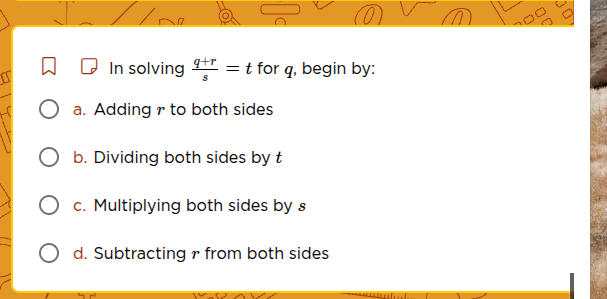
in solving \\(\frac{q + r}{s} = t\\) for \\(q\\), begin by:
a. adding \\(r\\) to both sides
b. dividing both sides by \\(t\\)
c. multiplying both sides by \\(s\\)
d. subtracting \\(r\\) from both sides
To solve \(\frac{q + r}{s}=t\) for \(q\), we need to isolate the term containing \(q\). The first step is to eliminate the denominator \(s\). By the multiplication property of equality, we multiply both sides by \(s\) to get \(q + r=ts\). Option a is incorrect as we don't need to add \(r\) first. Option b is incorrect as dividing by \(t\) doesn't help isolate \(q\) initially. Option d is incorrect as we can't subtract \(r\) until we eliminate the denominator. So the correct first step is multiplying both sides by \(s\).

Snap & solve any problem in the app
Get step-by-step solutions on Sovi AI
Photo-based solutions with guided steps
Explore more problems and detailed explanations
c. Multiplying both sides by \(s\)