QUESTION IMAGE
Question
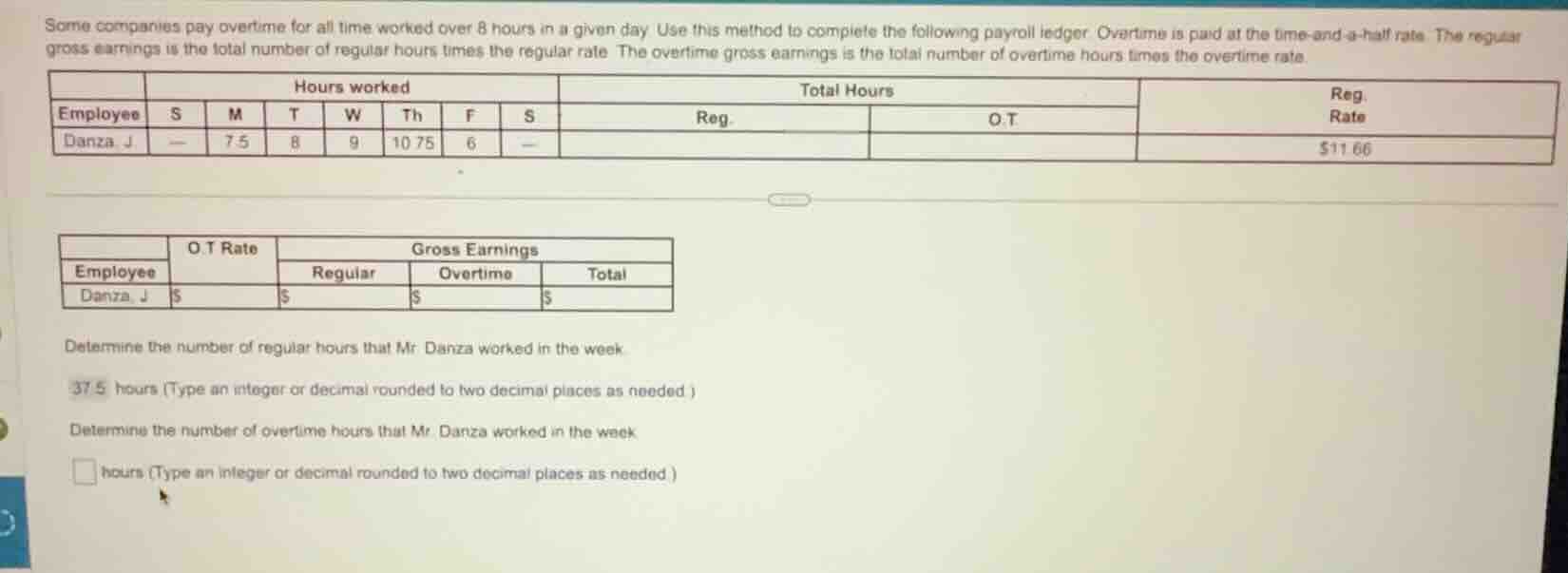
some companies pay overtime for all time worked over 8 hours in a given day. use this method to complete the following payroll ledger. overtime is paid at the time - and - a - half rate. the regular gross earnings is the total number of regular hours times the regular rate. the overtime gross earnings is the total number of overtime hours times the overtime rate.
employee | hours worked | total hours | reg. rate
| s | m | t | w | th | f | s | reg. | o.t |
danza j | — | 7.5 | 8 | 9 | 10.75 | 6 | — | | | $11.66
employee | o.t rate | gross earnings |
| regular | overtime | total |
danza, j | $ | $ | $ | $
determine the number of regular hours that mr. danza worked in the week.
37.5 hours (type an integer or decimal rounded to two decimal places as needed.)
determine the number of overtime hours that mr. danza worked in the week.
□ hours (type an integer or decimal rounded to two decimal places as needed.)
Step1: Calculate total hours worked
First, sum up all the hours worked each day: \(7.5 + 8 + 9 + 10.75 + 6\) (we ignore the days with no work). Let's compute that: \(7.5 + 8 = 15.5\), \(15.5 + 9 = 24.5\), \(24.5 + 10.75 = 35.25\), \(35.25 + 6 = 41.25\) total hours.
Step2: Calculate regular hours
Regular hours are the sum of hours up to 8 per day. Let's check each day:
- Monday: 7.5 (regular, since \(7.5 \leq 8\))
- Tuesday: 8 (regular)
- Wednesday: 9 (so regular is 8, overtime is \(9 - 8 = 1\))
- Thursday: 10.75 (regular is 8, overtime is \(10.75 - 8 = 2.75\))
- Friday: 6 (regular)
Now sum the regular hours: \(7.5 + 8 + 8 + 8 + 6\). Let's compute: \(7.5 + 8 = 15.5\), \(15.5 + 8 = 23.5\), \(23.5 + 8 = 31.5\), \(31.5 + 6 = 37.5\) (which matches the given regular hours).
Step3: Calculate overtime hours
Total hours - regular hours = \(41.25 - 37.5 = 3.75\). Alternatively, sum the overtime from each day: Wednesday overtime \(1\) and Thursday overtime \(2.75\), so \(1 + 2.75 = 3.75\).

Snap & solve any problem in the app
Get step-by-step solutions on Sovi AI
Photo-based solutions with guided steps
Explore more problems and detailed explanations
3.75