QUESTION IMAGE
Question
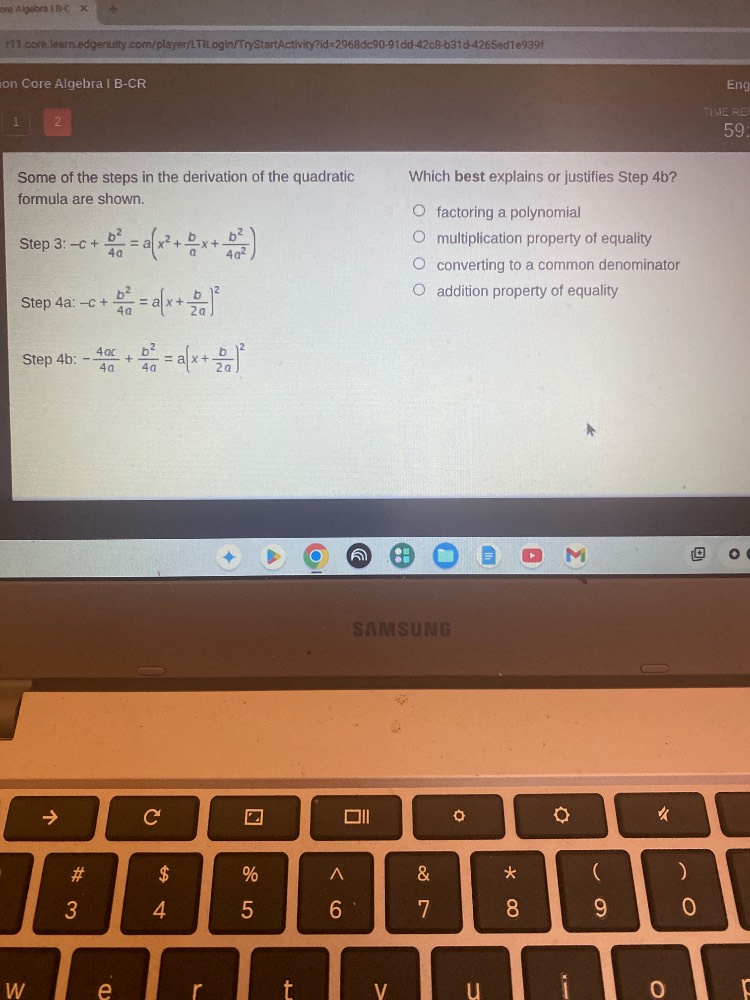
some of the steps in the derivation of the quadratic formula are shown. step 3: $-c + \frac{b^2}{4a} = a\left(x^2 + \frac{b}{a}x + \frac{b^2}{4a^2}\
ight)$ step 4ai: $-c + \frac{b^2}{4a} = a\left(x + \frac{b}{2a}\
ight)^2$ step 4b: $\frac{-4ac}{4a} + \frac{b^2}{4a} = a\left(x + \frac{b}{2a}\
ight)^2$ which best explains or justifies step 4b? \\(\circ\\) factoring a polynomial \\(\circ\\) multiplication property of equality \\(\circ\\) converting to a common denominator \\(\circ\\) addition property of equality
To justify Step 4b, we analyze the transformation from Step 3/4a to Step 4b. In Step 4b, \(-c\) is rewritten as \(\frac{-4ac}{4a}\). This is done by multiplying the numerator and denominator of \(-c\) (which can be thought of as \(\frac{-c}{1}\)) by \(4a\) to get a common denominator with \(\frac{b^{2}}{4a}\). Factoring a polynomial involves expressing as a product, the multiplication property of equality multiplies both sides, and the addition property adds to both sides—none of these match. Converting to a common denominator matches the operation here.

Snap & solve any problem in the app
Get step-by-step solutions on Sovi AI
Photo-based solutions with guided steps
Explore more problems and detailed explanations
converting to a common denominator