QUESTION IMAGE
Question
some of these traits in the best - adapted males also help them avoid predators. more - colorful plumage can make males more visible to predators. but males with longer tails might be more agile and better able to escape.
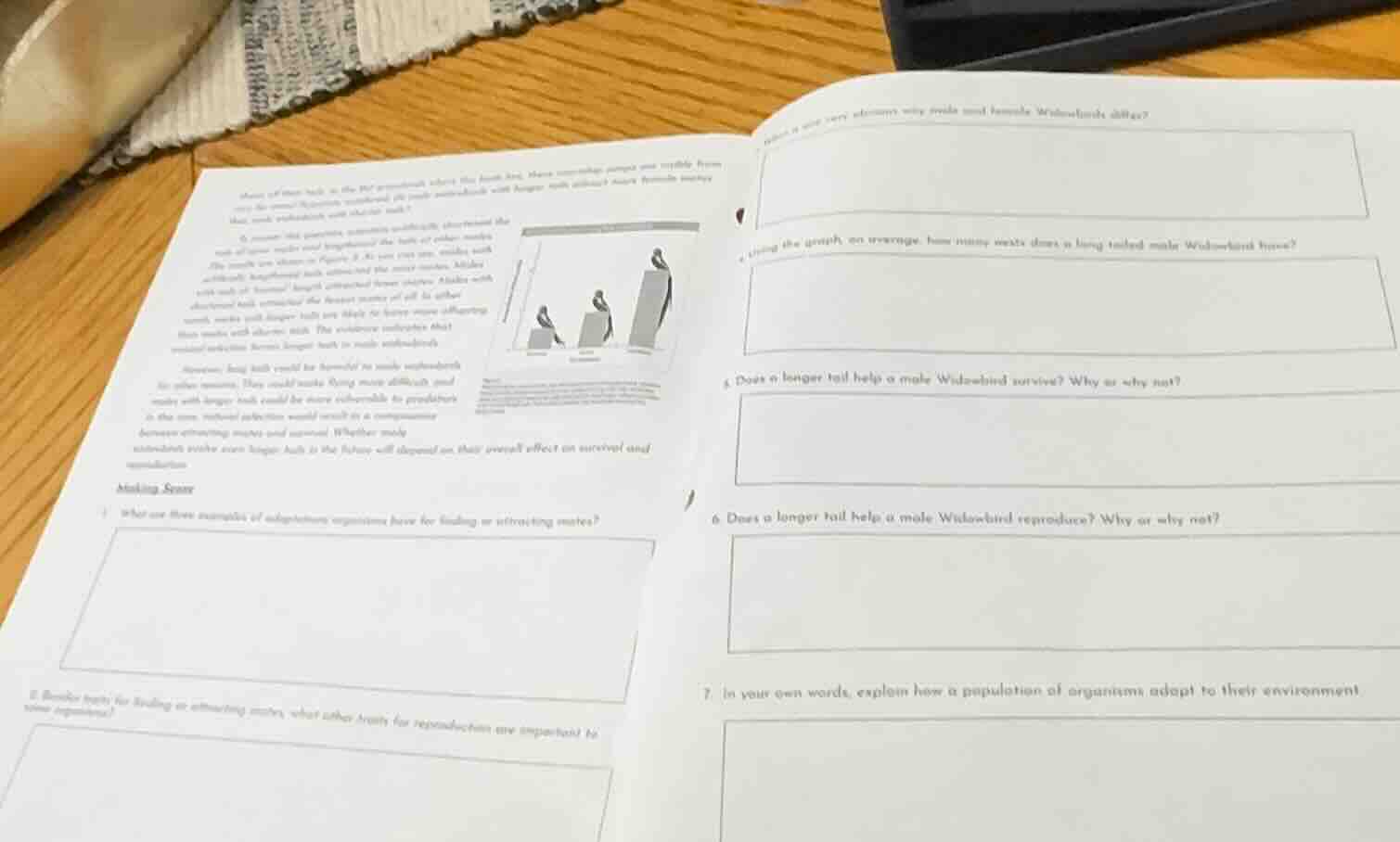
to answer this question, scientists studied the tail lengths of male widowbirds. as you can see in figure 1, 6, short - tailed males attracted the fewest females. males with artificially lengthened tails attracted more females. males with shortened tails attracted the fewest females of all. in other words, males with longer tails are likely to have more offspring than males with shorter tails. the scientists concluded that sexual selection favors longer tails in male widowbirds.
however, long tails could be harmful to males in other ways. they could make flying more difficult, and males with longer tails could be more vulnerable to predators. in this case, natural selection would result in a compromise between attracting mates and survival. whether male widowbirds evolve even longer tails in the future will depend on their overall effect on survival and reproduction.
making sense
- what are three examples of adaptations organisms have for finding or attracting mates?
- besides traits for finding or attracting mates, what other traits for reproduction are important to some organisms?
- in what very obvious way do male and female widowbirds differ?
- using the graph, on average, how many nests does a long - tailed male widowbird have?
- does a longer tail help a male widowbird survive? why or why not?
- does a longer tail help a male widowbird reproduce? why or why not?
- in your own words, explain how a population of organisms adapt to their environment
Question 1: What are three examples of adaptations organisms have for finding or attracting mates?
- Visual Displays: Like the long tails of male Widowbirds (or peacocks' colorful tails) that attract females. These visual traits are used to signal fitness.
- Auditory Signals: For example, birdsong (like nightingales) or frog calls. These sounds can attract mates and also signal territory or fitness.
- Chemical Signals (Pheromones): Insects like moths use pheromones to attract mates from a distance. Mammals also use scent marking (e.g., deer) to signal reproductive readiness.
- Parental Care Traits: Some organisms (e.g., mammals, birds) have traits like mammary glands (in mammals) or brooding behavior (in birds) to care for offspring, increasing their survival.
- Reproductive Anatomy Adaptations: For internal fertilization, organisms like reptiles, birds, and mammals have specialized reproductive organs. External fertilizers (e.g., fish) have adaptations for releasing gametes in sync.
- Seed Dispersal/Offspring Dispersal Traits: Plants have adaptations like winged seeds (e.g., maple) or fleshy fruits (eaten by animals) to disperse seeds. Animals like turtles lay eggs in safe locations, or some young (e.g., salmon) migrate to suitable habitats.
Male Widowbirds have much longer tails than females. This is a sexual dimorphism trait, where males’ long tails are used in mate attraction (as per the context of the reading, likely about sexual selection). Females have shorter, more practical tails for survival and basic functions.

Snap & solve any problem in the app
Get step-by-step solutions on Sovi AI
Photo-based solutions with guided steps
Explore more problems and detailed explanations
- Visual displays (e.g., long tails in male Widowbirds, peacock feathers).
- Auditory signals (e.g., birdsong, frog calls).
- Chemical signals (pheromones, e.g., in moths, deer scent marking).