QUESTION IMAGE
Question
sonnet 73
assigned by: morris smith
due: feb 6, 2026 11:59 pm
reading quiz
question 4
instructions
read the question carefully and select the best answer.
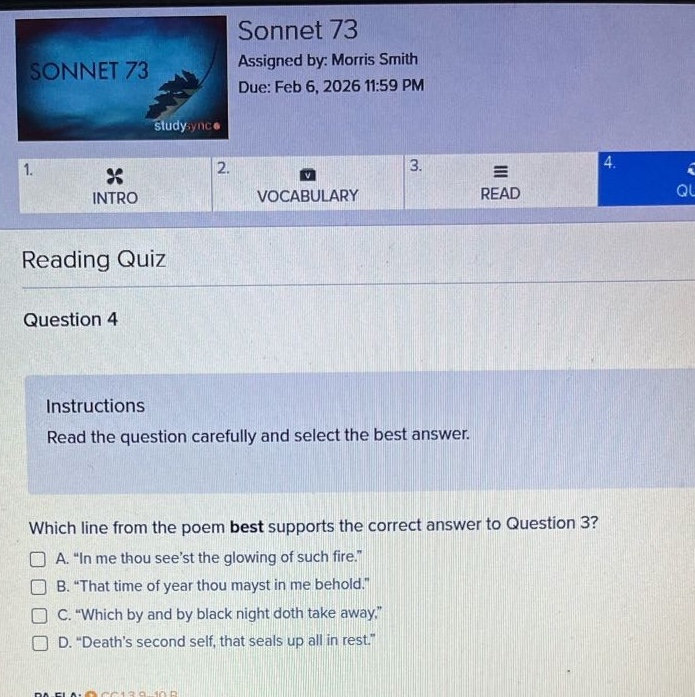
which line from the poem best supports the correct answer to question 3?
□ a. \in me thou seest the glowing of such fire.\
□ b. \that time of year thou mayst in me behold.\
□ c. \which by and by black night doth take away.\
□ d. \deaths second self, that seals up all in rest.\
To solve this, we analyze each option in the context of Sonnet 73 (by Shakespeare, which uses seasonal, day - end, and death - like imagery to reflect aging).
Option A
The line “In me thou seest the glowing of such fire” is about the embers of a fire, related to the later stage of a fire (and aging), but it's more about the final glow. It doesn't directly set up the main imagery of the sonnet's themes as well as option B.
Option B
“That time of year thou mayst in me behold” is the opening line. It introduces the central metaphor of the sonnet - using the seasons (like autumn) to represent aging. If Question 3 was about the overall theme of aging or the use of seasonal imagery, this line is the starting point that sets up the rest of the sonnet's imagery (like the “yellow leaves” etc. that follow).
Option C
“Which by and by black night doth take away” is part of the day - end imagery (the sun setting, day turning to night), but it's a secondary metaphor compared to the seasonal one introduced in option B. It's more of a supporting detail after the main seasonal metaphor is established.
Option D
“Death's second self, that seals up all in rest” is about sleep as a precursor to death, which is a later, more final image in the sonnet. It's not the line that best supports the overall theme or the main imagery setup.

Snap & solve any problem in the app
Get step-by-step solutions on Sovi AI
Photo-based solutions with guided steps
Explore more problems and detailed explanations
B. "That time of year thou mayst in me behold."