QUESTION IMAGE
Question
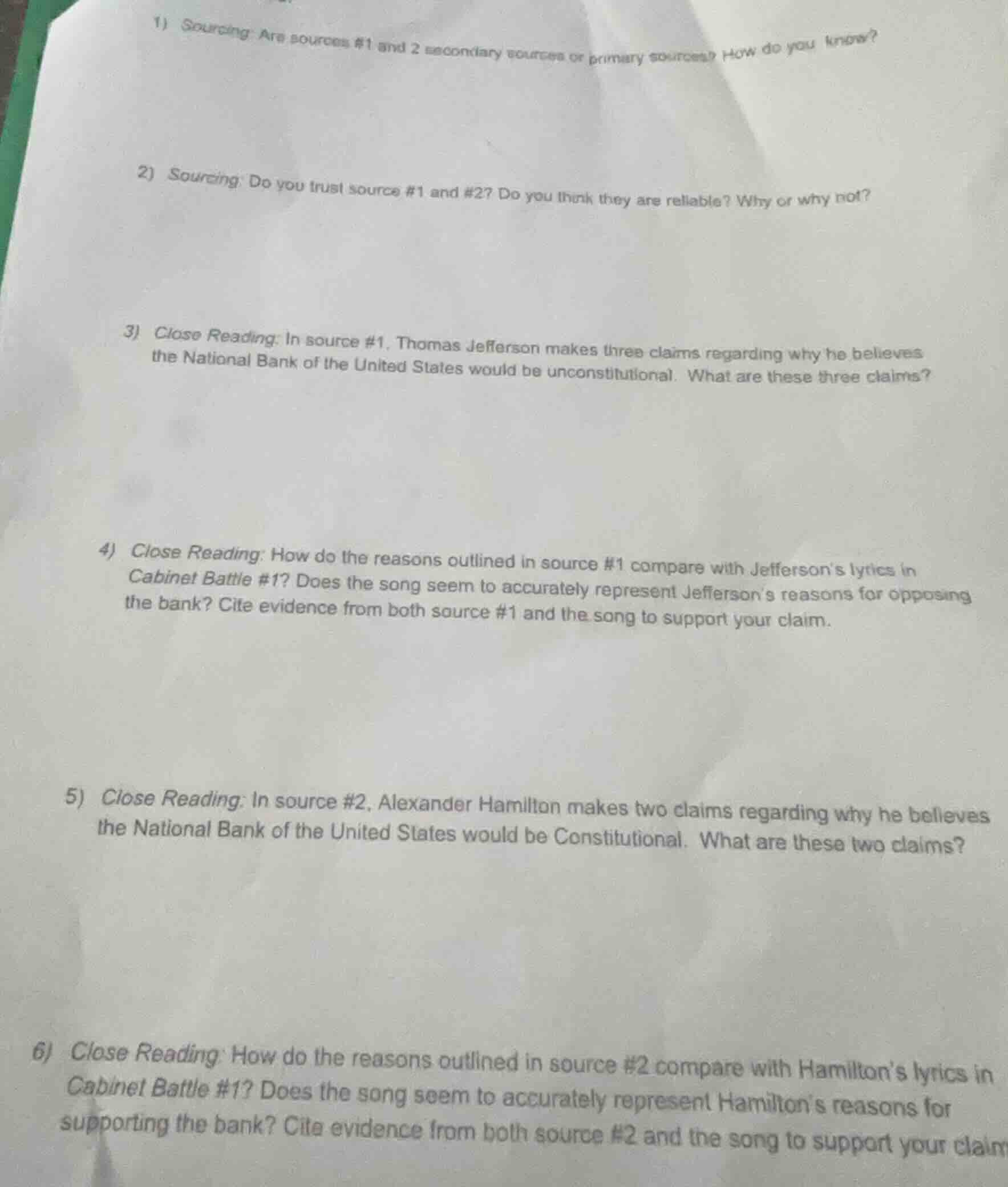
- sourcing: are sources #1 and 2 secondary sources or primary sources? how do you know?
- sourcing: do you trust source #1 and #2? do you think they are reliable? why or why not?
- close reading: in source #1, thomas jefferson makes three claims regarding why he believes the national bank of the united states would be unconstitutional. what are these three claims?
- close reading: how do the reasons outlined in source #1 compare with jefferson’s lyrics in cabinet battle #1? does the song seem to accurately represent jefferson’s reasons for opposing the bank? cite evidence from both source #1 and the song to support your claim.
- close reading: in source #2, alexander hamilton makes two claims regarding why he believes the national bank of the united states would be constitutional. what are these two claims?
- close reading: how do the reasons outlined in source #2 compare with hamilton’s lyrics in cabinet battle #1? does the song seem to accurately represent hamilton’s reasons for supporting the bank? cite evidence from both source #2 and the song to support your claim
To answer these questions, we would need access to the actual sources (source #1 and source #2) as well as the lyrics of "Cabinet Battle #1" from the musical Hamilton. Since the sources and lyrics are not provided here, we can't give specific answers yet. However, here's a general guide on how to approach each question:
1) Sourcing: Are sources #1 and 2 secondary sources or primary sources? How do you know?
- Primary sources are original materials from the time period in question (e.g., letters, speeches, official documents, diaries).
- Secondary sources analyze, interpret, or summarize primary sources (e.g., textbooks, biographies, journal articles).
- To determine this, examine the origin of each source. For example, if source #1 is a letter written by Thomas Jefferson and source #2 is a letter written by Alexander Hamilton about the National Bank, they would be primary sources because they are original documents from the people involved in the debate.
2) Sourcing: Do you trust source #1 and #2? Do you think they are reliable? Why or why not?
- Reliability depends on factors like the author's credibility, bias, and the purpose of the source.
- For example, if source #1 is a letter from Jefferson expressing his personal views on the National Bank, it is a reliable primary source for understanding his perspective, even if he has a political bias against the bank. Similarly, a letter from Hamilton would be reliable for his perspective. However, if the sources were edited or taken out of context, their reliability might be questionable.
3) Close Reading: In source #1, Thomas Jefferson makes three claims regarding why he believes the National Bank of the United States would be unconstitutional. What are these three claims?
- To answer this, you would need to carefully read source #1 (likely a document by Jefferson) and identify three distinct arguments against the constitutionality of the National Bank. Common arguments from Jefferson included:
- The Constitution does not explicitly grant Congress the power to create a national bank (strict construction of the Constitution).
- The bank would give too much power to the federal government at the expense of the states.
- The bank would benefit wealthy interests (like merchants and investors) over ordinary citizens and farmers.
4) Close Reading: How do the reasons outlined in source #1 compare with Jefferson’s lyrics in “Cabinet Battle #1”? Does the song seem to accurately represent Jefferson’s reasons for opposing the bank? Cite evidence from both source #1 and the song to support your claim.
- First, identify Jefferson’s arguments in source #1. Then, analyze the lyrics of “Cabinet Battle #1” (from Hamilton).
- For example, in the song, Jefferson might argue about states’ rights, the bank favoring the wealthy, or the lack of constitutional authority. Compare these lyrics to the claims in source #1. If the song’s lyrics reflect the same themes (e.g., “The bank’s against the constitution” or “It’s for bankers and speculators”), then it is accurate. Cite specific quotes from both the source and the song.
5) Close Reading: In source #2, Alexander Hamilton makes two claims regarding why he believes the National Bank of the United States would be Constitutional. What are these two claims?
- Read source #2 (likely a document by Hamilton) and identify two distinct arguments for the constitutionality of the National Bank. Common arguments from Hamilton included:
- The Constitution’s “Necessary and Proper” Clause (Article I, Section 8) gives Congr…

Snap & solve any problem in the app
Get step-by-step solutions on Sovi AI
Photo-based solutions with guided steps
Explore more problems and detailed explanations
To answer these questions, we would need access to the actual sources (source #1 and source #2) as well as the lyrics of "Cabinet Battle #1" from the musical Hamilton. Since the sources and lyrics are not provided here, we can't give specific answers yet. However, here's a general guide on how to approach each question:
1) Sourcing: Are sources #1 and 2 secondary sources or primary sources? How do you know?
- Primary sources are original materials from the time period in question (e.g., letters, speeches, official documents, diaries).
- Secondary sources analyze, interpret, or summarize primary sources (e.g., textbooks, biographies, journal articles).
- To determine this, examine the origin of each source. For example, if source #1 is a letter written by Thomas Jefferson and source #2 is a letter written by Alexander Hamilton about the National Bank, they would be primary sources because they are original documents from the people involved in the debate.
2) Sourcing: Do you trust source #1 and #2? Do you think they are reliable? Why or why not?
- Reliability depends on factors like the author's credibility, bias, and the purpose of the source.
- For example, if source #1 is a letter from Jefferson expressing his personal views on the National Bank, it is a reliable primary source for understanding his perspective, even if he has a political bias against the bank. Similarly, a letter from Hamilton would be reliable for his perspective. However, if the sources were edited or taken out of context, their reliability might be questionable.
3) Close Reading: In source #1, Thomas Jefferson makes three claims regarding why he believes the National Bank of the United States would be unconstitutional. What are these three claims?
- To answer this, you would need to carefully read source #1 (likely a document by Jefferson) and identify three distinct arguments against the constitutionality of the National Bank. Common arguments from Jefferson included:
- The Constitution does not explicitly grant Congress the power to create a national bank (strict construction of the Constitution).
- The bank would give too much power to the federal government at the expense of the states.
- The bank would benefit wealthy interests (like merchants and investors) over ordinary citizens and farmers.
4) Close Reading: How do the reasons outlined in source #1 compare with Jefferson’s lyrics in “Cabinet Battle #1”? Does the song seem to accurately represent Jefferson’s reasons for opposing the bank? Cite evidence from both source #1 and the song to support your claim.
- First, identify Jefferson’s arguments in source #1. Then, analyze the lyrics of “Cabinet Battle #1” (from Hamilton).
- For example, in the song, Jefferson might argue about states’ rights, the bank favoring the wealthy, or the lack of constitutional authority. Compare these lyrics to the claims in source #1. If the song’s lyrics reflect the same themes (e.g., “The bank’s against the constitution” or “It’s for bankers and speculators”), then it is accurate. Cite specific quotes from both the source and the song.
5) Close Reading: In source #2, Alexander Hamilton makes two claims regarding why he believes the National Bank of the United States would be Constitutional. What are these two claims?
- Read source #2 (likely a document by Hamilton) and identify two distinct arguments for the constitutionality of the National Bank. Common arguments from Hamilton included:
- The Constitution’s “Necessary and Proper” Clause (Article I, Section 8) gives Congress the power to create the bank as a means to carry out its enumerated powers (like regulating currency, collecting taxes, borrowing money).
- A national bank is essential for the economic stability and growth of the United States (e.g., facilitating trade, managing debt, providing a uniform currency).
6) Close Reading: How do the reasons outlined in source #2 compare with Hamilton’s lyrics in “Cabinet Battle #1”? Does the song seem to accurately represent Hamilton’s reasons for supporting the bank? Cite evidence from both source #2 and the song to support your claim.
- First, identify Hamilton’s arguments in source #2. Then, analyze the lyrics of “Cabinet Battle #1.”
- For example, in the song, Hamilton might argue about the bank’s necessity for the economy, the “Necessary and Proper” Clause, or the benefits of a strong central government. Compare these lyrics to the claims in source #2. If the song’s lyrics reflect the same themes (e.g., “It’s necessary for the economy” or “The Constitution gives us the power”), then it is accurate. Cite specific quotes from both the source and the song.
If you can provide the text of source #1, source #2, and the lyrics of “Cabinet Battle #1,” we can help you answer these questions in detail!