QUESTION IMAGE
Question
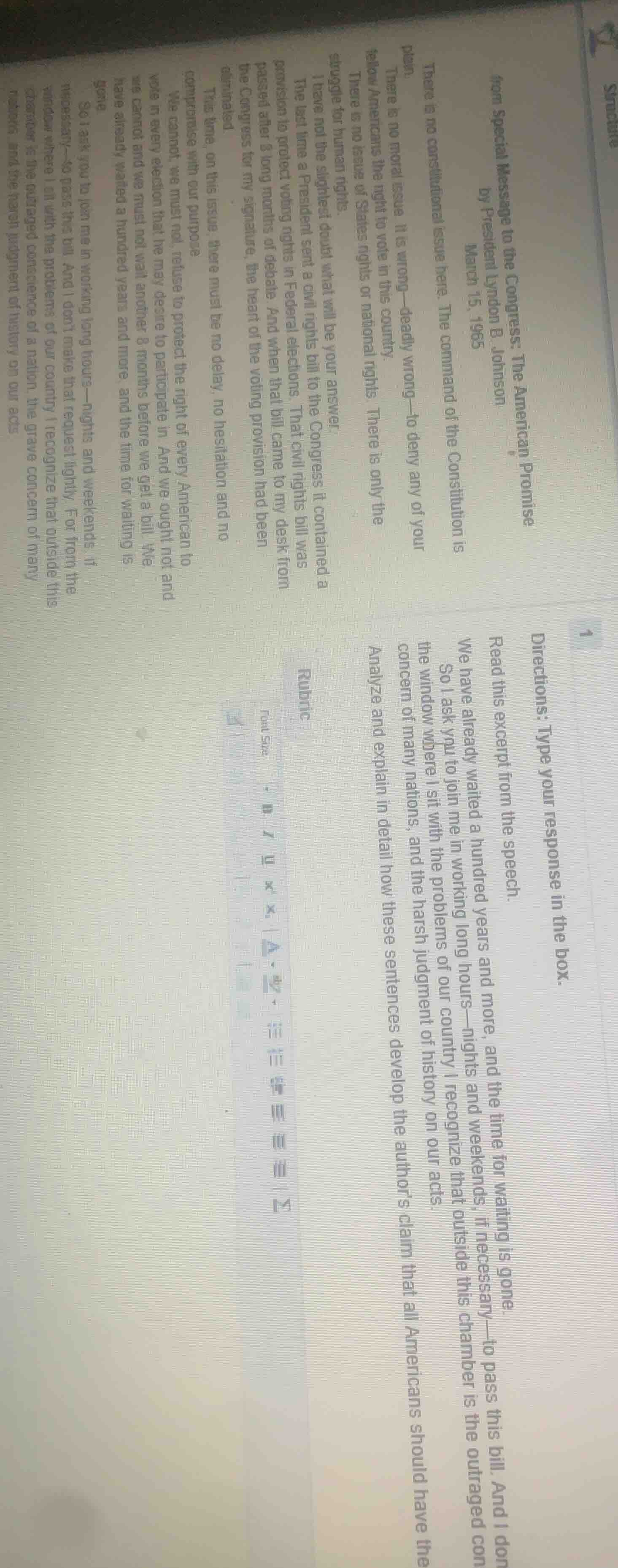
from special message to the congress: the american promise by president lyndon b. johnson march 15, 1965 there is no constitutional issue here. the command of the constitution is plain. there is no moral issue. it is wrong—deadly wrong—to deny any of your fellow americans the right to vote in this country. there is no issue of states rights or national rights. there is only the struggle for human rights. i have not the slightest doubt what will be your answer. the last time a president sent a civil rights bill to the congress it contained a provision to protect voting rights in federal elections. that civil rights bill was passed after 8 long months of debate. and when that bill came to my desk from the congress for my signature, the heart of the voting provision had been eliminated. this time, on this issue, there must be no delay, no hesitation and no compromise with our purpose. we cannot, we must not, refuse to protect the right of every american to vote in every election that he may desire to participate in. and we ought not and we cannot and we must not wait another 8 months before we get a bill. we have already waited a hundred years and more, and the time for waiting is gone. so i ask you to join me in working long hours—nights and weekends, if necessary—to pass this bill. and i dont make that request lightly. for from the window where i sit with the problems of our country i recognize that outside this chamber is the outraged conscience of a nation, the grave concern of many nations, and the harsh judgment of history on our acts. directions: type your response in the box. read this excerpt from the speech. we have already waited a hundred years and more, and the time for waiting is gone. so i ask you to join me in working long hours—nights and weekends, if necessary—to pass this bill. and i dont make that request lightly. for from the window where i sit with the problems of our country i recognize that outside this chamber is the outraged conscience of a nation, the grave concern of many nations, and the harsh judgment of history on our acts. analyze and explain in detail how these sentences develop the author’s claim that all americans should have the

Snap & solve any problem in the app
Get step-by-step solutions on Sovi AI
Photo-based solutions with guided steps
Explore more problems and detailed explanations
First, the line "We have already waited a hundred years and more, and the time for waiting is gone" establishes urgency by highlighting the century-long delay in securing voting rights, framing inaction as unjustly prolonged. Next, "So I ask you to join me in working long hours—nights and weekends, if necessary—to pass this bill" translates that urgency into a direct call to action, emphasizing the gravity of the task. Then, "And I don't make that request lightly. For from the window where I sit with the problems of our country I recognize that outside this chamber is the outraged conscience of a nation, the grave concern of many nations, and the harsh judgment of history on our acts" reinforces the moral and global stakes: it links the bill to national integrity, international reputation, and historical accountability, tying the need for immediate voting rights protection to preserving the nation's character and standing, thus strengthening the claim that all Americans must have access to the vote.