QUESTION IMAGE
Question
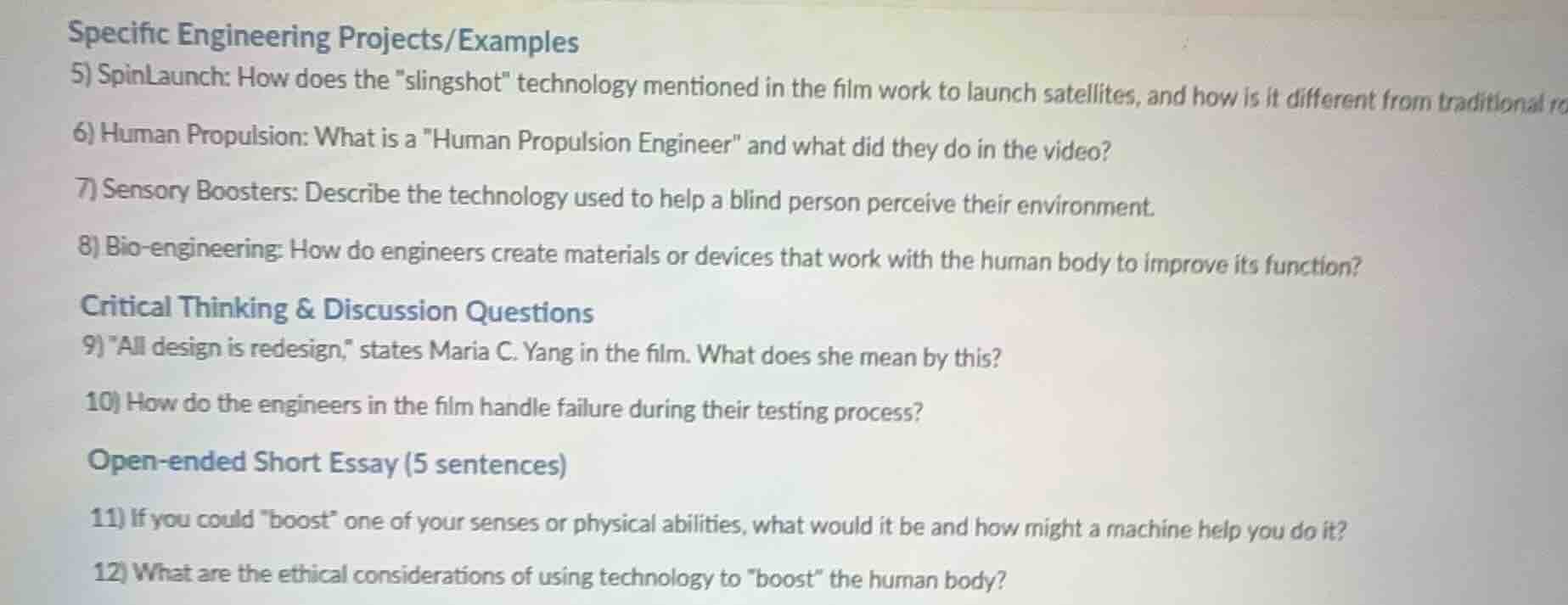
specific engineering projects/examples
- spinlaunch: how does the \slingshot\ technology mentioned in the film work to launch satellites, and how is it different from traditional ro
- human propulsion: what is a \human propulsion engineer\ and what did they do in the video?
- sensory boosters: describe the technology used to help a blind person perceive their environment.
- bio - engineering: how do engineers create materials or devices that work with the human body to improve its function?
critical thinking & discussion questions
- \all design is redesign,\ states maria c. yang in the film. what does she mean by this?
- how do the engineers in the film handle failure during their testing process?
open - ended short essay (5 sentences)
- if you could \boost\ one of your senses or physical abilities, what would it be and how might a machine help you do it?
- what are the ethical considerations of using technology to \boost\ the human body?
For question 5:
SpinLaunch's slingshot technology uses a large, vacuum-sealed centrifuge to accelerate a satellite-carrying payload to hypersonic speeds using rotational force, then releases it upward; a small rocket finalizes orbit insertion. Traditional rocket launches use chemical propulsion to generate thrust from liftoff, carrying all fuel onboard, while SpinLaunch reduces fuel needs by using mechanical energy for initial acceleration.
For question 6:
A Human Propulsion Engineer focuses on designing systems that enhance or enable human movement, often for accessibility or performance. In relevant media, they typically develop devices like exoskeletons, prosthetics, or specialized gear to help people with mobility impairments walk, or assist athletes/industrial workers with strength and endurance.
For question 7:
Common technologies include tactile feedback devices (like smart canes with ultrasonic sensors that vibrate to detect obstacles), visual-to-audio sensory substitution systems (which convert camera-captured visual data into sound frequencies a blind user learns to interpret), and brain-computer interfaces that stimulate the visual cortex to create basic light or shape perceptions.
For question 8:
Engineers first study biological systems to understand compatibility, then use biocompatible materials (like titanium for implants or hydrogels for soft tissue) to build devices. They test prototypes in controlled biological environments (lab-grown tissues, animal models) to ensure safety and functionality, then iterate designs to integrate with the body's natural processes, such as prosthetics that attach to bone or nerve endings for intuitive control.
For question 9:
Maria C. Yang means that nearly all new designs build on existing solutions. Engineers rarely create something entirely from scratch; instead, they adapt, refine, or repurpose existing technologies, materials, or design principles to solve new or improved problems, leveraging prior knowledge and proven systems.
For question 10:
Engineers in the film view failure as a data-gathering step. They document every failure, analyze its root cause (e.g., material stress, design flaw), adjust their prototypes or testing parameters accordingly, and retest. They prioritize iterative improvement, using failures to refine designs rather than abandoning projects.
For question 11:
If I could boost my sense of hearing, a wearable, AI-powered audio processing device would help. The device would use directional microphones to isolate and amplify faint, important sounds (like distant speech in a noisy room) while filtering out background noise. It could also convert high or low-frequency sounds outside human hearing range into audible frequencies, letting me detect things like approaching machinery or subtle animal movements. The device would sync with a small earpiece, delivering clear, customized audio without overwhelming my natural hearing. This would enhance situational awareness and make it easier to engage in environments where sound clarity is critical.
For question 12:
Key ethical considerations include equity: access to boosting technologies may be limited to wealthy individuals, widening social and economic gaps. There are also concerns about coercion, where people might feel pressured to use enhancements for work or social acceptance. Long-term health risks are unknown, as many boosting technologies have not been tested for decades of use. Additionally, there are questions about human identity: if we alter our natural senses or abilities, do…

Snap & solve any problem in the app
Get step-by-step solutions on Sovi AI
Photo-based solutions with guided steps
Explore more problems and detailed explanations
- SpinLaunch uses a vacuum centrifuge to mechanically accelerate payloads to hypersonic speeds before a small rocket finalizes orbit; it differs from traditional rockets by reducing onboard fuel use, relying on mechanical energy instead of full chemical propulsion from liftoff.
- A Human Propulsion Engineer designs systems to enhance human movement. In the video, they likely developed devices like exoskeletons/prosthetics to aid mobility for people with impairments or boost performance for workers/athletes.
- Technologies include ultrasonic smart canes (vibrate to detect obstacles), visual-to-audio sensory substitution (converts camera input to sound), and brain-computer interfaces that stimulate the visual cortex to create basic visual perceptions.
- Engineers study biological compatibility, use biocompatible materials (titanium, hydrogels), test prototypes in controlled biological settings, and iterate designs to integrate with natural bodily processes (e.g., nerve-attached prosthetics).
- She means all new designs adapt existing solutions; engineers build on prior technologies/principles instead of creating from scratch.
- They treat failure as a data source: document failures, analyze root causes, adjust prototypes/test parameters, and iterate to improve designs.
- I would boost my hearing. An AI-powered wearable device with directional microphones would amplify critical sounds, filter background noise, and convert inaudible frequencies to audible ones, delivered via a customized earpiece to enhance situational awareness.
- Ethical considerations include equity gaps (limited access for low-income groups), coercion to use enhancements, unknown long-term health risks, impacts on human identity, and unfair advantages in competitive spaces.