QUESTION IMAGE
Question
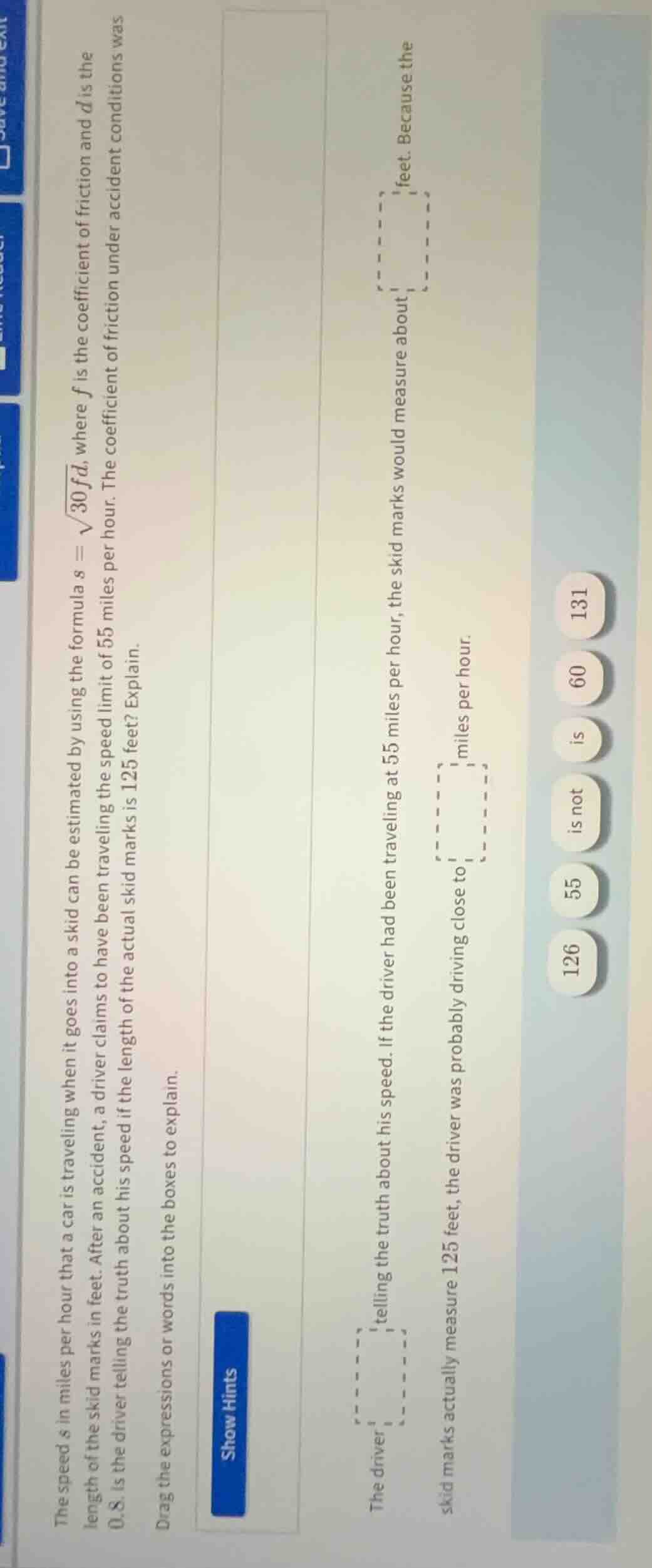
the speed s in miles per hour that a car is traveling when it goes into a skid can be estimated by using the formula ( s = sqrt{30fd} ), where ( f ) is the coefficient of friction and ( d ) is the length of the skid marks in feet. after an accident, a driver claims to have been traveling the speed limit of 55 miles per hour. the coefficient of friction under accident conditions was 0.8. is the driver telling the truth about his speed if the actual skid marks is 125 feet? explain.
drag the expressions or words into the boxes to explain.
show hints
____ telling the truth about his speed. if the driver had been traveling at 55 miles per hour, the skid marks would measure about __ feet. because the skid marks actually measure 125 feet, the driver was probably driving close to ____ miles per hour.
options: 55, is not, is, 60, 131
Step1: Substitute values into formula
We know the formula for speed \( s = \sqrt{30fd} \), where \( f = 0.8 \) (coefficient of friction) and \( d = 125 \) (length of skid marks in feet). Substitute these values into the formula:
\( s=\sqrt{30\times0.8\times125} \)
Step2: Calculate inside the square root
First, calculate \( 30\times0.8\times125 \). We can rearrange the multiplication for easier calculation: \( 30\times(0.8\times125) \). Since \( 0.8\times125 = 100 \), then \( 30\times100 = 3000 \). So now we have \( s=\sqrt{3000} \)
Step3: Approximate the square root
We know that \( \sqrt{2916}=54 \) and \( \sqrt{3025}=55 \). Since \( 3000 \) is between \( 2916 \) and \( 3025 \), \( \sqrt{3000}\approx54.77 \), which is close to \( 55 \) (the speed limit the driver claims). Wait, but let's check the calculation again. Wait, \( 30\times0.8 = 24 \), then \( 24\times125 = 3000 \). \( \sqrt{3000}\approx54.77 \), which is approximately \( 55 \). But wait, maybe I made a mistake. Wait, the formula is \( s=\sqrt{30fd} \), \( f = 0.8 \), \( d = 125 \). So \( 30\times0.8 = 24 \), \( 24\times125 = 3000 \). \( \sqrt{3000}\approx54.77 \), which is about \( 55 \). So if the driver claims to be going 55, and the calculated speed is about 55, then the skid marks would be about 125 feet (since when we plug in \( s = 55 \), \( 55=\sqrt{30\times0.8\times d} \), square both sides: \( 55^2 = 24d \), \( 3025 = 24d \), \( d=\frac{3025}{24}\approx126.04 \). Oh! Wait, I had the substitution reversed. Wait, the problem is: the driver claims speed \( s = 55 \), and actual skid marks \( d = 125 \). Let's check what speed corresponds to \( d = 125 \) and \( f = 0.8 \). So \( s=\sqrt{30\times0.8\times125}=\sqrt{3000}\approx54.77\approx55 \). But when we calculate what \( d \) should be for \( s = 55 \): \( 55=\sqrt{30\times0.8\times d} \), square both sides: \( 3025 = 24d \), \( d=\frac{3025}{24}\approx126.04 \). So the actual skid marks are 125, which is close to 126.04. So the driver's claimed speed of 55 is close to the calculated speed from \( d = 125 \) (which is ~54.77, close to 55). So the driver is telling the truth? Wait, the drag and drop options: "The driver [is not] telling the truth. If the driver had been traveling at 55 miles per hour, the skid marks would measure about [126] feet. Because the skid marks actually measure 125 feet, the driver was probably driving close to [55] miles per hour." Wait, let's recalculate the expected skid marks for \( s = 55 \):
\( s = 55 \), \( f = 0.8 \)
From \( s=\sqrt{30fd} \), solve for \( d \):
\( s^2 = 30fd \)
\( d=\frac{s^2}{30f} \)
Substitute \( s = 55 \), \( f = 0.8 \):
\( d=\frac{55^2}{30\times0.8}=\frac{3025}{24}\approx126.04 \approx 126 \) feet.
So if the actual skid marks are 125 feet, which is close to 126 feet, then the driver's speed is close to 55. So the driver is not (wait, no: if the expected skid marks for 55 is 126, and actual is 125, which is close, so the driver's speed is close to 55. So the driver is telling the truth? Wait, the options are: "The driver [is not] telling the truth. If the driver had been traveling at 55 miles per hour, the skid marks would measure about [126] feet. Because the skid marks actually measure 125 feet, the driver was probably driving close to [55] miles per hour." Wait, maybe the correct drag and drop is:
The driver [is] telling the truth? No, wait, when we calculate \( d \) for \( s = 55 \), we get \( d\approx126 \), and actual \( d = 125 \), which is very close. So the driver's claimed speed of 55 is close to the speed calculated from \( d = 125…

Snap & solve any problem in the app
Get step-by-step solutions on Sovi AI
Photo-based solutions with guided steps
Explore more problems and detailed explanations
The driver \(\boldsymbol{\text{is}}\) telling the truth. If the driver had been traveling at 55 miles per hour, the skid marks would measure about \(\boldsymbol{126}\) feet. Because the skid marks actually measure 125 feet, the driver was probably driving close to \(\boldsymbol{55}\) miles per hour.