QUESTION IMAGE
Question
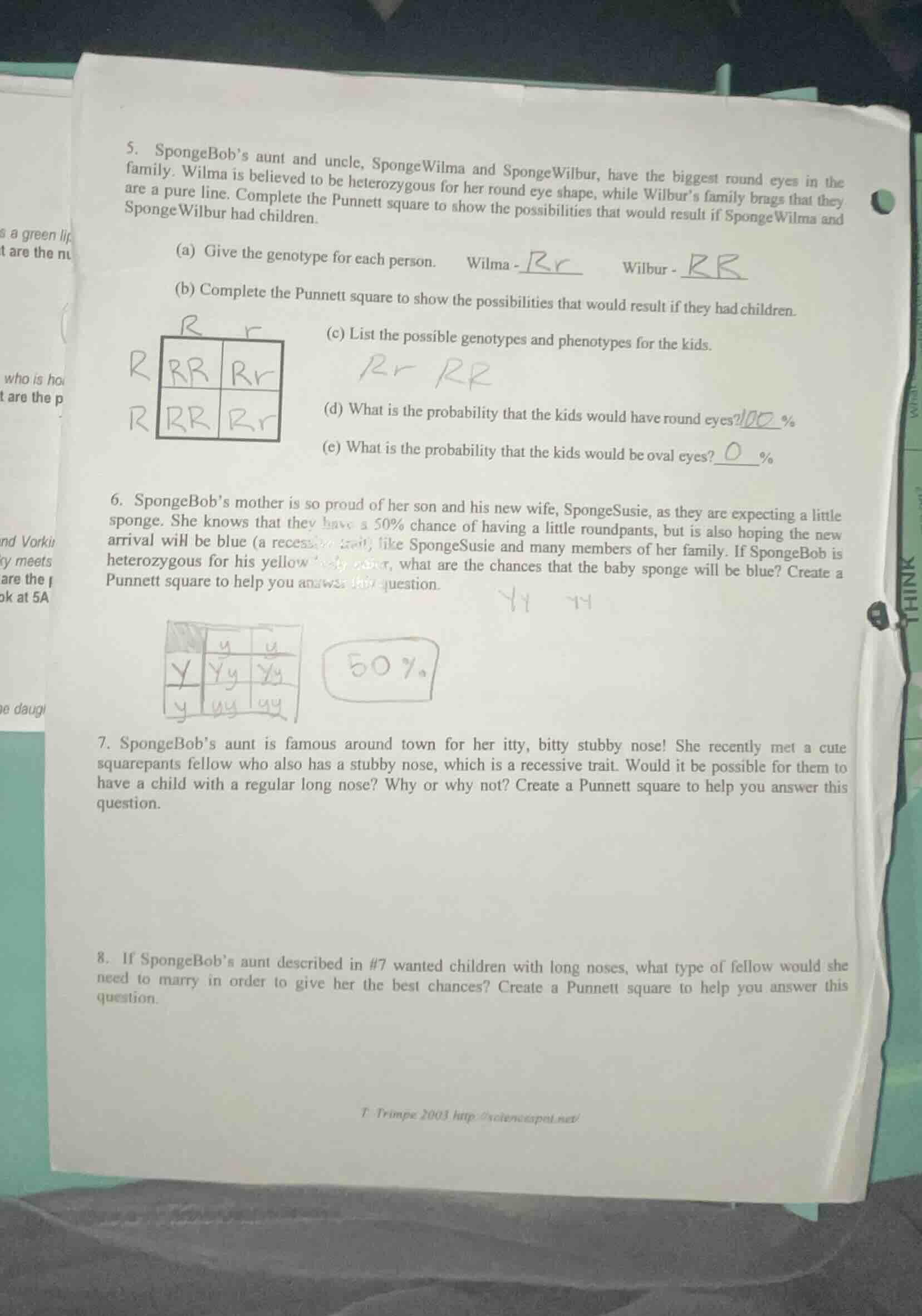
- spongebobs aunt and uncle, spongewilma and spongewilbur, have the biggest round eyes in the family. wilma is believed to be heterozygous for her round eye shape, while wilburs family brags that they are a pure line. complete the punnett square to show the possibilities that would result if spongewilma and spongewilbur had children.
(a) give the genotype for each person. wilma - rr wilbur - rr
(b) complete the punnett square to show the possibilities that would result if they had children.
(c) list the possible genotypes and phenotypes for the kids.
rr rr
(d) what is the probability that the kids would have round eyes? 100 %
(e) what is the probability that the kids would be oval eyes? 0 %
- spongebobs mother is so proud of her son and his new wife, spongesusie, as they are expecting a little sponge. she knows that they have a 50% chance of having a little roundpants, but is also hoping the new arrival will be blue, like spongesusie and many members of her family. if spongebob is heterozygous for his yellow, what are the chances that the baby sponge will be blue? create a punnett square to help you answer this question.
yy yy
50%
- spongebobs aunt is famous around town for her itty, bitty stubby nose! she recently met a cute squarepants fellow who also has a stubby nose, which is a recessive trait. would it be possible for them to have a child with a regular long nose? why or why not? create a punnett square to help you answer this question.
- if spongebobs aunt described in #7 wanted children with long noses, what type of fellow would she need to marry in order to give her the best chances? create a punnett square to help you answer this question.
t trimpe 2003 http://sciencespot.net/
---
Problem 5
Step1: Identify given genotypes
Wilma: $Rr$, Wilbur: $RR$
Step2: Complete Punnett square
| $R$ | $r$ | |
|---|---|---|
| $R$ | $RR$ | $Rr$ |
Step3: List genotypes/phenotypes
Genotypes: $RR$, $Rr$; Phenotype: Round eyes (all)
Step4: Calculate round eye probability
$\frac{4}{4} \times 100 = 100\%$
Step5: Calculate oval eye probability
$\frac{0}{4} \times 100 = 0\%$
---
Problem 6
Step1: Identify given genotypes
SpongeBob: $Yy$, SpongeSusie: $yy$
Step2: Complete Punnett square
| $y$ | $y$ | |
|---|---|---|
| $y$ | $yy$ | $yy$ |
Step3: Calculate blue body probability
$\frac{2}{4} \times 100 = 50\%$
---
Problem 7
Step1: Identify recessive trait genotype
Stubby nose (recessive) = $nn$ (both parents)
Step2: Complete Punnett square
| $n$ | $n$ | |
|---|---|---|
| $n$ | $nn$ | $nn$ |
Step3: Analyze long nose possibility
Long nose is dominant ($NN$ or $Nn$); no dominant alleles present.
---
Problem 8
Step1: Identify optimal partner genotype
To get long nose ($N\_$), partner needs dominant allele. Best: $NN$ (homozygous dominant)
Step2: Complete Punnett square (aunt $nn$ × $NN$)
| $N$ | $N$ | |
|---|---|---|
| $n$ | $Nn$ | $Nn$ |
Step3: Confirm highest probability
All offspring have $Nn$ (long nose), 100% chance.

Snap & solve any problem in the app
Get step-by-step solutions on Sovi AI
Photo-based solutions with guided steps
Explore more problems and detailed explanations
- Problem 5:
(a) Wilma: $Rr$, Wilbur: $RR$
(b) Punnett square as shown in Step2
(c) Genotypes: $RR$, $Rr$; Phenotype: Round eyes
(d) $100\%$
(e) $0\%$
- Problem 6:
Punnett square as shown in Step2; Probability of blue baby: $50\%$
- Problem 7:
No, they cannot have a child with a long nose. Both parents are homozygous recessive ($nn$) for stubby nose, so all offspring will inherit two recessive alleles ($nn$) and have stubby noses.
- Problem 8:
She should marry a sponge that is homozygous dominant ($NN$) for long nose. This gives a 100% chance of children with long noses (all $Nn$ genotype).