QUESTION IMAGE
Question
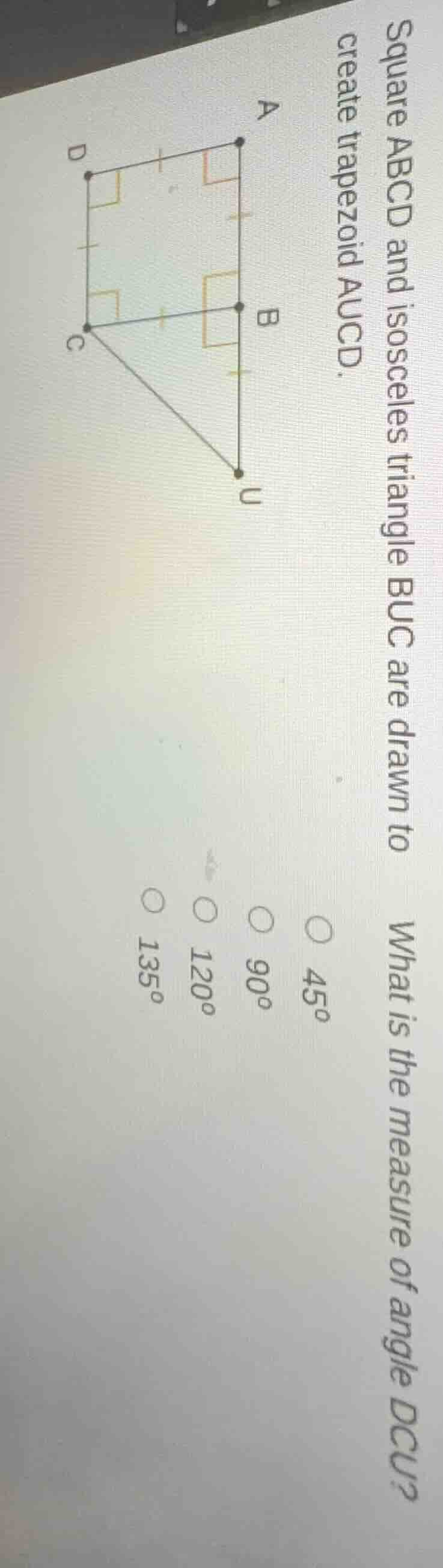
square abcd and isosceles triangle buc are drawn to create trapezoid aucd. what is the measure of angle dcu? 45° 90° 120° 135°
Step1: Analyze the square
In square \(ABCD\), \(\angle BCD = 90^\circ\) (all angles in a square are right angles), and \(BC = CD\) (all sides of a square are equal).
Step2: Analyze the isosceles triangle \(BUC\)
Since \(ABCD\) is a square and \(BUC\) is isosceles with \(BC = BU\) (implied by the markings, as \(AB = BC\) and \(AB = BU\) from the trapezoid and square construction), triangle \(BUC\) is an isosceles right triangle? Wait, no, actually, since \(ABCD\) is a square, \(BC\) is equal to \(CD\), and \(BUC\) is isosceles, so \(\angle BCU = 45^\circ\)? Wait, no, let's correct.
Wait, in square \(ABCD\), \(\angle BCD = 90^\circ\). Now, \(ABCD\) is a square, so \(AB = BC = CD = DA\). The trapezoid \(AUCD\) is created, so \(AU\) is parallel to \(CD\)? Wait, maybe \(ABCD\) is a square, so \(AB \perp BC\), \(CD \perp BC\), so \(AB \parallel CD\). Then \(AUCD\) is a trapezoid, so \(AU \parallel CD\). Now, triangle \(BUC\) is isosceles, so \(BC = BU\). Since \(BC = AB\) (square), and \(AB = BU\) (from the markings, as \(AB\) and \(BU\) are marked equal), so triangle \(BUC\) is isosceles with \(BC = BU\), so \(\angle BCU = \angle BUC\). But since \(ABCD\) is a square, \(\angle ABC = 90^\circ\), so \(\angle UBC = 90^\circ\) (since \(AUCD\) is a trapezoid, \(AU \parallel CD\), so \(AB \perp BC\), \(BU\) is an extension? Wait, maybe better: \(\angle BCD = 90^\circ\), and \(\angle BCU = 45^\circ\) (if \(BUC\) is isosceles right triangle, but no, wait, the angle we need is \(\angle DCU\), which is \(\angle BCD + \angle BCU\)? Wait, no, maybe \(\angle DCU = \angle BCD + \angle BCU\). Wait, in square, \(\angle BCD = 90^\circ\), and in isosceles triangle \(BUC\), since \(BC = BU\) and \(\angle UBC = 90^\circ\) (because \(ABCD\) is square, \(AB \perp BC\), and \(AUCD\) is trapezoid, so \(BU\) is along \(AB\) extension? Wait, maybe \(BUC\) is isosceles right triangle, so \(\angle BCU = 45^\circ\). Then \(\angle DCU = \angle BCD + \angle BCU = 90^\circ + 45^\circ = 135^\circ\)? Wait, no, that can't be. Wait, maybe \(\angle BCD = 90^\circ\), and \(\angle BCU = 45^\circ\), but in the other direction. Wait, no, let's think again.
Wait, the square has \(\angle BCD = 90^\circ\). The triangle \(BUC\) is isosceles, so \(BC = CU\)? No, the markings: in the square, \(AB = BC = CD = DA\), and \(AB = BU\) (marked equal), so \(BC = BU\). So triangle \(BUC\) is isosceles with \(BC = BU\), so \(\angle BCU = \angle BUC\). Since \(\angle UBC = 90^\circ\) (because \(ABCD\) is square, \(AB \perp BC\), and \(BU\) is along \(AB\) extended, so \(\angle UBC = 90^\circ\)), then in triangle \(BUC\), \(\angle BCU + \angle BUC + \angle UBC = 180^\circ\), so \(2\angle BCU + 90^\circ = 180^\circ\), so \(2\angle BCU = 90^\circ\), so \(\angle BCU = 45^\circ\). Now, \(\angle DCU = \angle BCD + \angle BCU = 90^\circ + 45^\circ = 135^\circ\)? Wait, no, \(\angle BCD\) is \(90^\circ\), and \(\angle BCU\) is \(45^\circ\), but if \(C\) is the vertex, then \(\angle DCU\) is \(\angle D CB + \angle B CU\)? Wait, \(D\), \(C\), \(B\) are in a square, so \(D\) to \(C\) to \(B\) is a right angle, then \(C\) to \(U\) is such that triangle \(BUC\) is isosceles, so \(\angle DCU = 90^\circ + 45^\circ = 135^\circ\).

Snap & solve any problem in the app
Get step-by-step solutions on Sovi AI
Photo-based solutions with guided steps
Explore more problems and detailed explanations
\(135^\circ\)