QUESTION IMAGE
Question
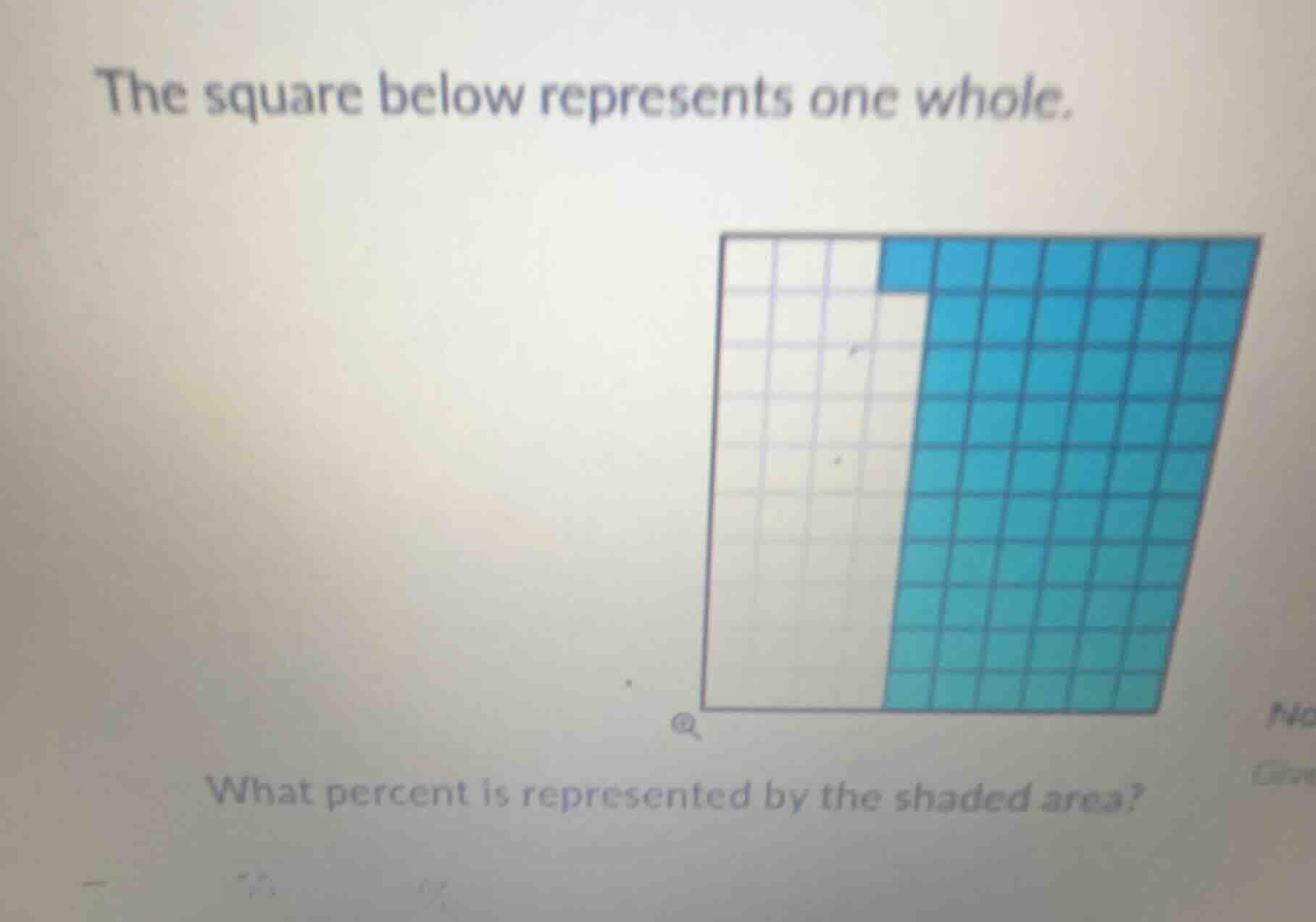
the square below represents one whole.
what percent is represented by the shaded area?
Step1: Determine total number of squares
Assume the square is a 10x10 grid (since it's a common whole representation for percentages). So total number of squares is $10\times10 = 100$.
Step2: Count shaded squares
Looking at the grid, the shaded part: Let's see the columns. The unshaded part is 4 columns (wait, no, let's count rows and columns. Wait, the grid: let's see, the white part is 4 columns? Wait, no, looking at the grid, the shaded area: let's count the number of shaded squares. Let's see, the grid has 10 rows. The shaded columns: from column 4 (assuming first column is 1) to column 10? Wait, no, let's count the number of shaded squares. Wait, maybe better: the white area is 4 columns (each with 10 rows) minus 1 square? Wait, no, the first row: white has 3 squares, shaded has 7? Wait, no, let's do it properly. Wait, the total grid is 10x10=100. Let's count the shaded squares. Let's see, the shaded region: let's count the number of squares. Let's see, the white part: in the first row, 3 white, 7 shaded? No, wait, the grid: let's see, the columns: the white area is 4 columns (each column has 10 rows) but the first row of the 4th column is shaded? Wait, no, maybe the white area is 4 columns (4x10=40) minus 1? No, wait, let's look again. Wait, the square is divided into 10 columns and 10 rows. Let's count the shaded squares:
Looking at the grid, the shaded part: columns 4 to 10? Wait, no, let's count the number of shaded squares. Let's see, the white area: in the first row, 3 white, 7 shaded? No, wait, the first row: white has 3 squares, shaded has 7? Then rows 2 to 10: white has 4 squares per row, shaded has 6? Wait, no, that can't be. Wait, maybe the correct way: the grid is 10x10=100. Let's count the shaded squares. Let's see, the shaded area: let's count the number of squares. Let's see, the white part is 4 columns (4 columns) with 10 rows, but the first row of the 4th column is shaded. Wait, no, maybe the white area is 4 columns (410=40) minus 1 (since the first row of the 4th column is shaded), so white is 39, shaded is 100 - 39 = 61? Wait, no, that's not right. Wait, maybe I made a mistake. Wait, let's look at the grid again. Wait, the user's image: the square is a 10x10 grid. The shaded area: let's count the number of shaded squares. Let's see, the white area: in the first row, 3 white squares, then the rest of the rows (rows 2 - 10) have 4 white squares each. So white squares: 3 + 94 = 3 + 36 = 39. Therefore, shaded squares: 100 - 39 = 61? Wait, no, that doesn't seem right. Wait, maybe the white area is 4 columns (4 columns) with 10 rows, but the first row of the 4th column is shaded. So white squares: 4*10 - 1 = 39. So shaded is 100 - 39 = 61. Wait, but maybe I miscounted. Wait, alternatively, maybe the shaded area is 6 columns? No, wait, let's do it again. Wait, the grid is 10 rows and 10 columns. Let's count the shaded squares:
Row 1: shaded squares: 7 (since 3 white)
Rows 2 - 10: shaded squares: 6 per row (since 4 white)
So total shaded: 7 + 9*6 = 7 + 54 = 61. Yes, that makes sense. So shaded squares are 61.
Step3: Calculate percentage
Percentage is (number of shaded squares / total number of squares) 100. So (61 / 100) 100 = 61%.

Snap & solve any problem in the app
Get step-by-step solutions on Sovi AI
Photo-based solutions with guided steps
Explore more problems and detailed explanations
61%