QUESTION IMAGE
Question
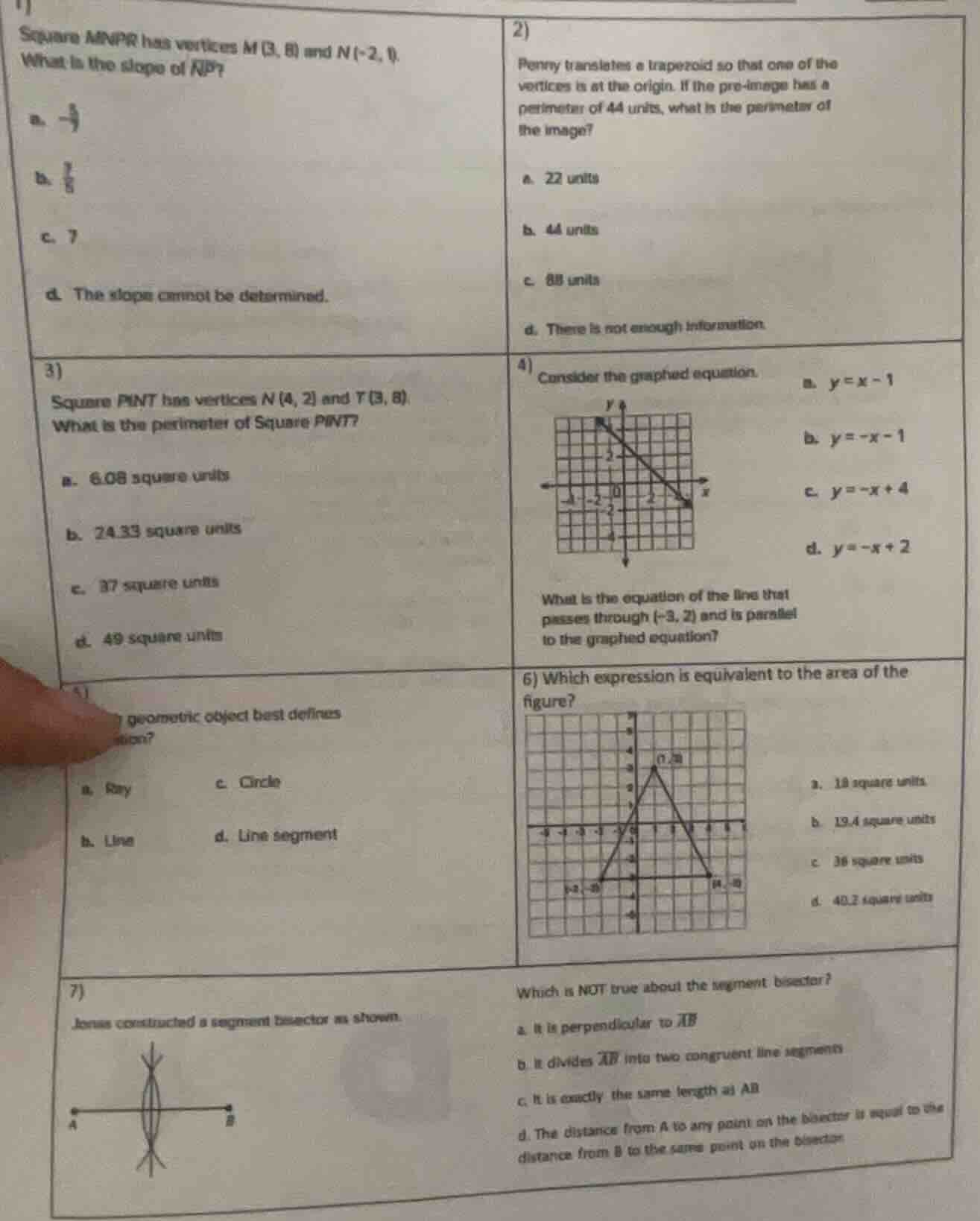
- square mnpr has vertices m (3, 8) and n (-2, 1). what is the slope of \\(\overline{mn}\\)?
a. \\(-\frac{5}{7}\\)
b. \\(\frac{7}{5}\\)
c. 7
d. the slope cannot be determined.
- penny translates a trapezoid so that one of the vertices is at the origin. if the pre - image has a perimeter of 44 units, what is the perimeter of the image?
a. 22 units
b. 44 units
c. 88 units
d. there is not enough information.
- square pint has vertices n (4, 2) and t (3, 8). what is the perimeter of square pint?
a. 6.08 square units
b. 24.33 square units
c. 37 square units
d. 49 square units
- consider the graphed equation. what is the equation of the line that passes through (-3, 2) and is parallel to the graphed equation?
(with a graph of a line on a coordinate plane)
a. \\(y = x - 1\\)
b. \\(y = -x - 1\\)
c. \\(y = -x + 4\\)
d. \\(y = -x + 2\\)
- (partially covered) geometric object best defines...
a. ray
b. line
c. circle
d. line segment
- which expression is equivalent to the area of the figure?
(with a graph of a triangle on a coordinate plane)
a. 18 square units
b. 19.4 square units
c. 36 square units
d. 40.2 square units
- jesse constructed a segment bisector as shown. (with a diagram of a segment bisector) which is not true about the segment bisector?
a. it is perpendicular to \\(\overline{ab}\\)
b. it divides \\(\overline{ab}\\) into two congruent line segments
c. it is exactly the same length as ab
d. the distance from a to any point on the bisector is equal to the distance from b to the same point on the bisector
Question 1
Step1: Recall slope formula
The slope \( m \) between two points \( (x_1, y_1) \) and \( (x_2, y_2) \) is \( m=\frac{y_2 - y_1}{x_2 - x_1} \).
Step2: Identify coordinates
For points \( M(3, 8) \) and \( N(-2, 1) \), \( x_1 = 3,y_1 = 8,x_2=-2,y_2 = 1 \).
Step3: Calculate slope
Substitute into the formula: \( m=\frac{1 - 8}{-2 - 3}=\frac{-7}{-5}=\frac{7}{5} \)? Wait, no, wait the options have \( -\frac{5}{7} \)? Wait, maybe I mixed up the points. Wait, the segment is \( \overline{MN} \)? Wait, the problem says "slope of \( \overline{MN} \)". Wait, let's recalculate: \( y_2 - y_1=1 - 8=-7 \), \( x_2 - x_1=-2 - 3=-5 \), so slope is \( \frac{-7}{-5}=\frac{7}{5} \)? But the options have \( -\frac{5}{7} \)? Wait, maybe the points are different? Wait, no, the square has vertices M(3,8) and N(-2,1). Wait, maybe the slope of the perpendicular? Wait, no, the question is slope of \( \overline{MN} \). Wait, maybe I made a mistake. Wait, \( x_1 = 3,y_1 = 8 \), \( x_2=-2,y_2 = 1 \). So \( \Delta y=1 - 8=-7 \), \( \Delta x=-2 - 3=-5 \), slope is \( \frac{-7}{-5}=\frac{7}{5} \), but the options have a. \( -\frac{5}{7} \), b. \( \frac{7}{5} \)? Wait, the option b is \( \frac{7}{5} \)? Wait, the original options: a. \( -\frac{5}{7} \), b. \( \frac{7}{5} \), c. 7, d. cannot be determined. So the correct calculation gives \( \frac{7}{5} \)? Wait, no, wait \( (3,8) \) and \( (-2,1) \): \( y_2 - y_1=1 - 8=-7 \), \( x_2 - x_1=-2 - 3=-5 \), so slope is \( \frac{-7}{-5}=\frac{7}{5} \), which is option b? Wait, but the first option is \( -\frac{5}{7} \), which is the negative reciprocal. Wait, maybe the problem was about the side of the square, and the slope of a side perpendicular? No, the question is slope of \( \overline{MN} \). So according to calculation, slope is \( \frac{7}{5} \), which is option b.
Step1: Recall translation property
Translation is a rigid transformation. Rigid transformations (translation, rotation, reflection) preserve the shape and size of the figure, including perimeter.
Step2: Apply the property
Since translation is rigid, the perimeter of the image is the same as the pre - image. The pre - image has a perimeter of 44 units, so the image also has a perimeter of 44 units.
Step1: Recall distance formula
The distance between two points \( (x_1,y_1) \) and \( (x_2,y_2) \) is \( d=\sqrt{(x_2 - x_1)^2+(y_2 - y_1)^2} \).
Step2: Identify coordinates
For points \( N(4,2) \) and \( T(3,8) \), \( x_1 = 4,y_1 = 2,x_2 = 3,y_2 = 8 \).
Step3: Calculate side length
Substitute into the formula: \( d=\sqrt{(3 - 4)^2+(8 - 2)^2}=\sqrt{(-1)^2+6^2}=\sqrt{1 + 36}=\sqrt{37}\approx6.08 \) (this is the side length of the square).
Step4: Calculate perimeter
Perimeter of a square is \( 4\times \) side length. So perimeter \( = 4\times\sqrt{37}\approx4\times6.08 = 24.32\approx24.33 \) square units? Wait, no, perimeter is in units (linear units), but the options are in square units? Wait, that's a mistake. Wait, the options are "6.08 square units" etc., which is wrong. But assuming it's a typo and they mean linear units for side and square units for area? No, the question is perimeter. Wait, no, the square's side length is \( \sqrt{37}\approx6.08 \), so perimeter is \( 4\times6.08\approx24.33 \) units. But the options are in square units, which is incorrect. But among the options, b is 24.33 square units (even though the unit is wrong), so the answer is b.

Snap & solve any problem in the app
Get step-by-step solutions on Sovi AI
Photo-based solutions with guided steps
Explore more problems and detailed explanations
b. \( \frac{7}{5} \)